
GED Reasoning Through Language Arts RLA Practice Test 2026 | Real Exam Questions and Answers
$69.00
- Buy to unlock unlimited access to all Quiz questions and Answers in this Quiz.
- After purchase you can print a PDF of the whole quiz at any point. The PDF will contain the questions and the correct answers.
About this Exam
The GED Reasoning Through Language Arts (RLA) exam serves as the definitive assessment for demonstrating high school-level literacy skills in reading and writing.
This comprehensive test is specifically designed for adults and youth who did not complete a traditional high school program but wish to earn their high school equivalency diploma.
Successfully passing the RLA exam proves to employers and colleges that an individual possesses the critical thinking and communication abilities necessary to thrive in both modern academic settings and contemporary dynamic workplaces.
It is often the first and most crucial step for candidates pursuing higher education or advanced career training.
Ready to test your knowledge?
Buy Now to Access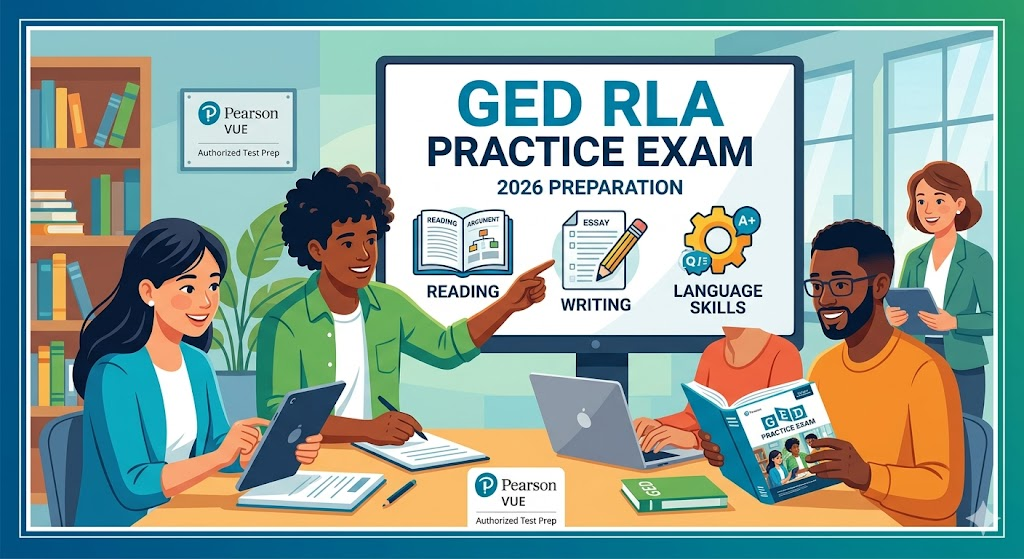
Additional Information
What the Course Entails and Exam Details
Preparing for the GED RLA exam involves mastering a diverse set of complex skills related to literacy and analysis.
The curriculum focuses on three foundational pillars: Reading Comprehension, Language Conventions, and Analytical Writing.
Candidates must develop the ability to interpret informational texts from social studies and science, as well as analyze various works of literature, including complex fiction.
Within the Language section, students review essential English conventions, focusing on grammar, correct sentence structure, standard usage, and effective mechanics.
Finally, the critical Extended Response portion requires test-takers to construct a comprehensive, evidence-based written analysis after reading and comparing two source arguments.
What to Expect in the Final Exam
The actual GED Reasoning Through Language Arts exam is a computerized test designed to assess reasoning abilities rather than rote memory.
Test-takers should expect a total time limit of approximately 150 minutes, which includes distinct sections and a brief, scheduled 10-minute break.
The exam utilizes varied question formats, including standard multiple-choice, drag-and-drop interactions, fill-in-the-blank responses, and hot-spot selections.
A significant and vital portion of the test is the Extended Response (the essay), where candidates have 45 minutes to draft a detailed analysis of two contrasting texts.
To pass, students must achieve a scaled score of 145 out of 200, which indicates a performance level equivalent to the traditional high school graduate standard.
How to Study and Exam Centers
Effective preparation for the 2026 RLA exam demands a consistent, structured study strategy that prioritizes active practice over passive reading.
Candidates should utilize official GED practice tests early in their preparation to identify specific skill gaps and become familiar with the online testing interface.
Regular, dedicated practice reading complex, high-level informational and literary texts is essential to increase reading speed and deepen overall comprehension.
Additionally, students must practice analyzing sample essays and drafting full-length, timed extended responses, focusing heavily on supporting arguments with text-based evidence and analyzing the credibility of source texts.
Grammar review should focus on common errors found in professional writing rather than obscure stylistic rules.
When ready, candidates can schedule their official exam at an authorized GED testing center.
These physical locations are often situated within local adult education centers, technical schools, or community colleges.
In many regions, an Online Proctored (OP) exam option is also available, allowing eligible students to take the official test on a personal computer at home if they meet specific technology and environment requirements.
Job Opportunities from the Course
Earning a GED diploma by passing the RLA exam opens doors to a wide range of job opportunities and acts as a required credential for many career paths.
It is recognized by nearly all employers and academic institutions across the United States.
Below are some specific career roles that the GED certification unlocks:
Office Support Specialist: Includes positions like receptionist, administrative assistant, or data entry clerk, requiring strong communication skills.
Customer Service Representative: Requires high-level reading comprehension and clear written communication to interact effectively with clients.
Skilled Trades Apprentice: Paves the way for entrance into certified training programs for careers such as electrician, HVAC technician, or plumber.
Early Childhood Educator/Assistant: Often requires a high school equivalency to work in licensed childcare or preschool settings.
Healthcare Support Staff: Opens pathways to positions like Pharmacy Technician, Medical Assistant, or Certified Nursing Assistant (which usually require further specialized training).
Logistics and Sales Associate: Prepares individuals for entry-level retail management, warehousing roles, or transportation coordination.
Frequently Asked Questions
Reviews
5.0
Based on 0 reviews
Leave a Review
No reviews yet. Be the first to review!