
GED Science Practice Test 2026 | Real Exam Questions and Answers
$69.00
- Buy to unlock unlimited access to all Quiz questions and Answers in this Quiz.
- After purchase you can print a PDF of the whole quiz at any point. The PDF will contain the questions and the correct answers.
About this Exam
The 2026 GED Science Practice Exam is an essential tool designed for individuals preparing for the GED Science test. This study guide is specifically created for adults who are seeking to earn their High School Equivalency credential and are focusing on demonstrating their scientific literacy. The primary goal of this practice exam is to build confidence and proficiency in understanding fundamental scientific concepts and reasoning skills required to pass the official GED Science test and progress toward higher education or better career opportunities.
Ready to test your knowledge?
Buy Now to Access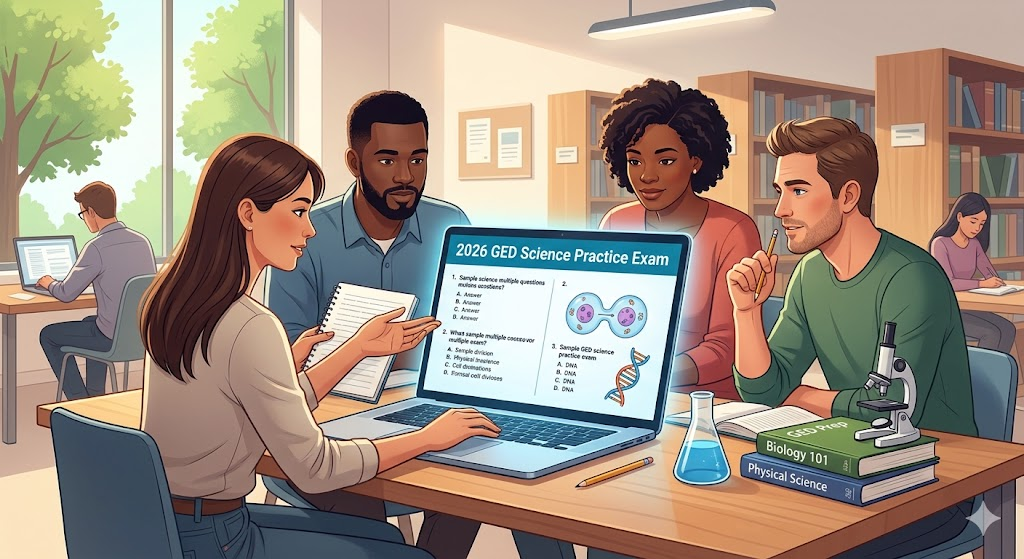
Additional Information
What the Course Entails and Exam Details
This comprehensive course covers the major subject areas tested on the official GED Science exam. Students will encounter questions that evaluate their understanding of life science, physical science, and Earth and space science. The topics include cells and human biology, chemical reactions, forces and motion, geology, and weather patterns. The exam emphasizes scientific practices, assessing your ability to interpret and apply scientific information, evaluate conclusions based on data, design and investigate scientific research, and understand scientific principles. The questions often present real-world scenarios, experiments, or diagrams, requiring you to think critically and apply scientific knowledge rather than simply memorizing facts.
What to Expect in the Final Exam
The official GED Science test is an approximately 90-minute examination. It consists of multiple question types to test a range of skills, including multiple-choice, select-an-area, drop-down, and fill-in-the-blank questions. You will need a scale score of 145 or higher on a scale of 100-200 to pass this section of the GED. The exam includes questions related to identifying scientific evidence, understanding cause-and-effect relationships, and interpreting data. There are no essay or free-response questions in the Science section of the GED test. You will be provided with an on-screen scientific calculator (TI-30XS) or can bring your own handheld calculator if the testing center permits.
How to Study and Exam Centers
Effective study strategies are crucial for success in the GED Science test. Begin by taking practice tests to identify your strengths and weaknesses in the various scientific domains. Focus your study on areas where you encounter difficulties. Utilize official GED study materials, online practice questions, and review core concepts in biology, physics, chemistry, and Earth science. Dedicate regular study time and create a study schedule. Join study groups or seek assistance from a tutor if needed. The exam can be taken at official GED testing centers located throughout the United States and internationally. To take the test, you must create a MyGED account at GED.com and schedule your exam through their online portal. Some states and locations may also offer the Online Proctored GED Test option, which allows you to take the exam from the comfort of your home with a live proctor monitoring the session via a webcam.
Job Opportunities from the Course
Passing the GED Science test, as part of achieving your full GED credential, is a major step toward a successful career. Your score demonstrates competency in scientific literacy, which is highly valued by employers in many industries. Earning this credential opens doors to entry-level jobs and the opportunity for further education and career advancement in numerous fields. Here are some examples of job titles and career paths this achievement unlocks:
Nursing Assistant
Laboratory Technician Assistant
Pharmacy Technician Trainee
Environmental Services Worker
Emergency Medical Technician (EMT)
Medical Assistant
Automotive Service Technician
Electrician Apprentice
HVAC Technician Apprentice
Manufacturing Production Worker
Quality Control Inspector
Forestry Technician Assistant
Dental Assistant
Physical Therapist Aide
Solar Panel Installer
Home Health Aide
Frequently Asked Questions
Reviews
5.0
Based on 0 reviews
Leave a Review
No reviews yet. Be the first to review!