
GED Test Prep 2026 | Practice Questions and Answers
$69.00
- Buy to unlock unlimited access to all Quiz questions and Answers in this Quiz.
- After purchase you can print a PDF of the whole quiz at any point. The PDF will contain the questions and the correct answers.
About this Exam
The GED (General Educational Development) test is a vital stepping stone for individuals who did not complete their traditional high school education.
Earning your GED credential proves that you possess high school-level academic skills and knowledge equivalent to a graduating senior.
It is expertly designed for adult learners, career changers, and anyone looking to unlock new educational and professional pathways in 2026 and beyond.
By passing this exam, candidates can finally move forward with confidence, knowing they hold a state-recognized high school equivalency diploma.
Ready to test your knowledge?
Buy Now to Access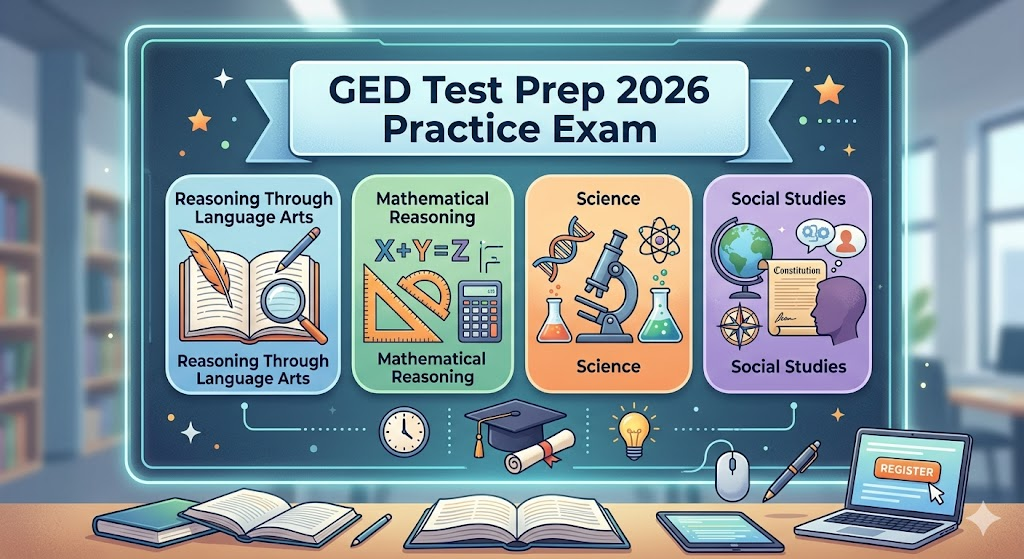
Additional Information
What the Course Entails and Exam Details
Preparing for the GED entails mastering four primary academic subjects that form the core of a high school curriculum.
The Mathematical Reasoning section covers quantitative problem solving, basic math, geometry, algebra, and interpreting graphs.
The Reasoning Through Language Arts (RLA) section tests your ability to read closely, write clearly, edit written text, and understand complex arguments.
The Science section focuses on life science, physical science, and Earth and space science, requiring candidates to read and interpret scientific data.
Finally, the Social Studies section evaluates your understanding of history, government, economics, and geography, often using historical documents and political cartoons.
What to Expect in the Final Exam
The final exam is entirely computer-based and utilizes a variety of interactive question formats to test your knowledge.
You can expect a mix of standard multiple-choice, drag-and-drop, fill-in-the-blank, and extended response (essay) questions.
To pass the GED, you must score a minimum of 145 on each of the four individual subject tests.
The total testing time is approximately seven and a half hours, but you are not required to take all four tests at once.
Each subject has its own specific time limit, ranging from 70 minutes for Social Studies to 150 minutes for the RLA section, which includes a 10-minute break.
How to Study and Exam Centers
To study effectively, start by taking a diagnostic practice test to identify your baseline strengths and weaknesses.
Create a consistent, realistic study schedule that dedicates specific days to each of the four subjects so you do not feel overwhelmed.
Utilize official practice questions and timed mock exams to build your test-taking stamina and get comfortable with the digital format.
When you are ready to test, you can seamlessly schedule your exam through the official GED testing service portal.
Exams are administered at authorized physical testing centers, such as local community colleges or designated Pearson VUE locations.
Additionally, many states now offer secure, online proctored testing, allowing you to take the exam from the comfort of your own home if your equipment meets the necessary requirements.
Job Opportunities from the Course
Earning your GED credential immediately unlocks a wealth of job opportunities and career advancement possibilities.
It is the fundamental requirement for the vast majority of entry-level positions across almost every industry in the current job market.
With a GED, you can confidently pursue roles such as an Administrative Assistant, coordinating daily office operations.
You will also be qualified for positions as a Retail Manager, overseeing store sales and employee relations.
Customer Service Representative roles, which are high in demand, frequently require a GED for employment.
It is also the crucial first step for becoming an Entry-Level Healthcare Worker, such as a medical receptionist or home health aide.
Furthermore, a GED allows you to enroll in vocational schools, community colleges, or universities, paving the way for advanced, higher-paying careers in nursing, information technology, specialized trades, and beyond.
Frequently Asked Questions
Reviews
5.0
Based on 0 reviews
Leave a Review
No reviews yet. Be the first to review!