
General Certificate of Secondary Education (GCSE) Business Practice Exam
$69.00
- Buy to unlock unlimited access to all Quiz questions and Answers in this Quiz.
- After purchase you can print a PDF of the whole quiz at any point. The PDF will contain the questions and the correct answers.
About this Exam
The General Certificate of Secondary Education (GCSE) in Business is a key qualification designed to introduce students (typically aged 14–16) to the fundamental concepts of commerce, management, and the economic environment.
It provides foundational knowledge required to understand how businesses operate, succeed, and grow.
A dedicated GCSE Business Practice Exam serves as a crucial component of this course of study. It is designed to simulate the actual exam conditions, helping candidates assess their knowledge gaps, build confidence, and refine their time management skills before the final test day.
Taking practice exams is one of the most effective ways for students to move from understanding concepts to applying them effectively under pressure.
Ready to test your knowledge?
Buy Now to Access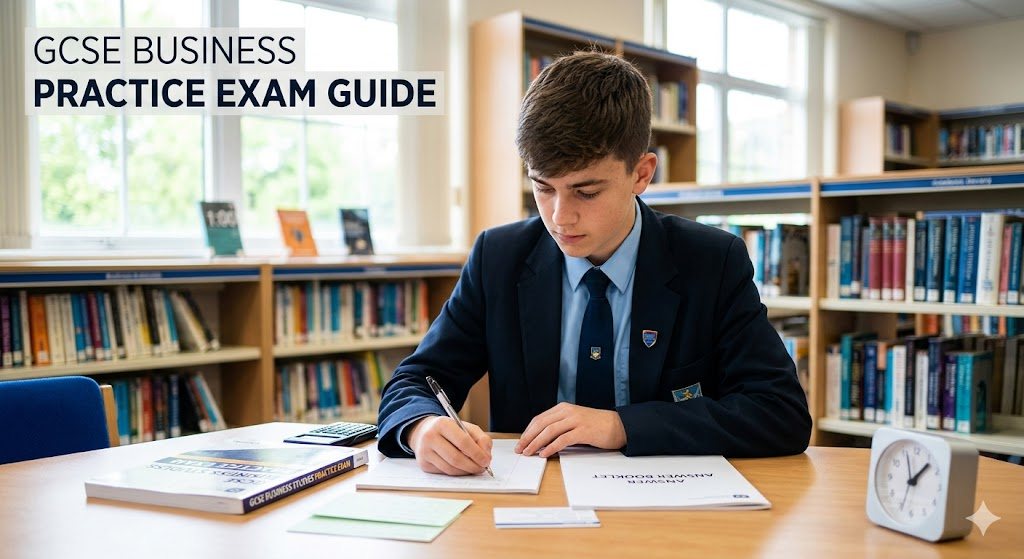
Additional Information
What the Course Entails and Exam Details
The full GCSE Business qualification covers a diverse syllabus that prepares students for higher education or entry-level positions in the commercial sector.
The core topics typically encompass:
Business Operations: How goods and services are produced, and how operations must adapt to global markets.
Finance: Managing money, including sources of finance, budgeting, forecasting, and calculating profit and loss.
Human Resources: Understanding organizational structures, recruitment, training, and motivating employees.
Marketing: Identifying target markets, developing the marketing mix (product, price, place, promotion), and analyzing competitor behavior.
External Influences: How legal systems, technology, economic conditions, and ethical considerations impact business decisions.
The comprehensive syllabus requires students to develop analytical and evaluative skills rather than just memorizing facts.
What to Expect in the Final Exam
While the specific GCSE Business Practice Exam is a preparatory resource, the final formal exam dictates the structure candidates must master.
Candidates taking the GCSE Business qualification (e.g., through major boards like Pearson Edexcel, AQA, or OCR) typically complete two final written papers.
Each paper is usually 1 hour and 30 minutes long.
The exam format includes a varied mix of question styles, such as multiple-choice questions, short-answer questions requiring concise definitions, and structured response questions based on detailed case studies. These case studies require candidates to apply their business knowledge to real-world scenarios.
The grading system uses a numerical scale from 9 (highest) to 1 (lowest). To succeed in the final exam and achieve a high grade, practicing with simulated exams that mirror this exact structure is essential.
How to Study and Exam Centers
Effective preparation for the GCSE Business Practice Exam and the final qualification requires structured effort.
Actionable study strategies include creating concise revision flashcards for key business terms and acronyms.
You should use past papers and official examiner reports to understand common mistakes and optimal answering techniques.
Candidates must actively practice written case study analysis, focusing on developing balanced arguments with clear business justification.
Access to practice exams is often provided through authorized schools or online educational portals. The final formal GCSE Business exams must be taken at an authorized examination center.
For the majority of students, this center will be their school or college. Private candidates must register with an approved exam center (often a local school or a recognized Pearson VUE testing location) well in advance of the examination dates.
Job Opportunities from the Course
A strong performance in the GCSE Business Practice Exam and the subsequent final qualification unlocks multiple future opportunities.
This course serves as a critical stepping stone, providing foundational knowledge required for higher qualifications like A-Levels in Business or Economics, or a Level 3 T Level in Business and Administration.
It also develops highly transferable skills valued across all job markets, specifically improving career paths in:
Business Analyst (Entry-Level)
Marketing Assistant
Digital Marketing Executive
Human Resources Assistant
Finance/Accounting Administrator
Project Management Office (PMO) Coordinator
Entrepreneur and Small Business Owner
The knowledge gained provides the commercial awareness necessary for long-term success in any corporate or self-employed environment.
Frequently Asked Questions
Reviews
5.0
Based on 0 reviews
Leave a Review
No reviews yet. Be the first to review!