
General Certificate of Secondary Education (GCSE) Design Technology Practice Exam
$69.00
- Buy to unlock unlimited access to all Quiz questions and Answers in this Quiz.
- After purchase you can print a PDF of the whole quiz at any point. The PDF will contain the questions and the correct answers.
About this Exam
The GCSE Design Technology qualification is an innovative and engaging course designed for students who are passionate about creating, inventing, and solving real-world problems. This examination is intended for Key Stage 4 students (typically aged 14–16) in the UK, although many private candidates and international students also sit for it.
The course encourages students to think creatively and critically, assessing how design shapes our society and the environment. It is the perfect foundation for anyone interested in engineering, product design, architecture, or any creative, solution-focused industry.
Ready to test your knowledge?
Buy Now to Access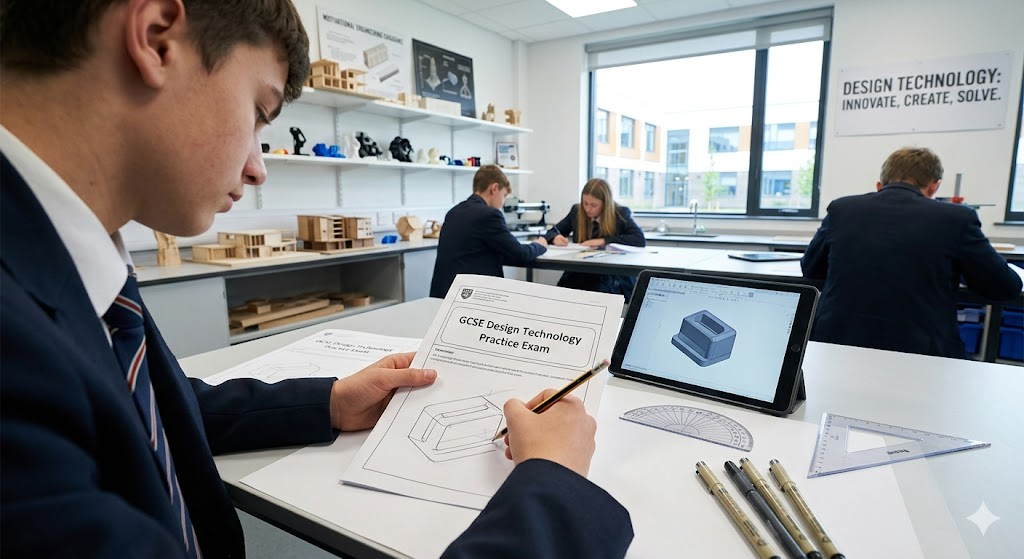
Additional Information
What the Course Entails and Exam Details
The course syllabus is broad, ensuring students gain knowledge in both theoretical concepts and practical application. While specifics can vary slightly between exam boards (such as AQA, Pearson Edexcel, or OCR), all require a deep understanding of core principles. Students study:
Core Technical Principles: Including new and emerging technologies, energy generation and storage, and modern materials (like composites and smart materials).
Specialist Technical Principles: Deep-dive knowledge into a chosen material category (such as papers and boards, timber-based materials, metal-based materials, or polymers/plastics).
Designing and Making Principles: The iterative design process, from understanding user needs and creating prototypes to evaluation and testing.
A central component of this course is the requirement to understand the ecological and social footprint of products, ethical sourcing of materials, and manufacturing processes like CAD/CAM (Computer-Aided Design and Manufacturing).
What to Expect in the Final Exam
It is important to understand that the final GCSE grade is usually determined by a 50/50 split between a written examination and a Non-Exam Assessment (NEA), often referred to as the design-and-make project.
The Written Examination (50% of the final grade): This exam is typically two hours long. It consists of multiple-choice questions, short-answer questions, and more extended writing or design-based questions that test both the core content and the student's specialist material knowledge. Students must analyze, evaluate, and solve design scenarios within the paper.
The Non-Exam Assessment (NEA) (50% of the final grade): This is a substantial project (roughly 30–35 hours) where students respond to a design brief. They must research, design, prototype, and manufacture a working product or model. Crucially, they must document this entire iterative process in an accompanying portfolio.
A practice exam, like this one, specifically mimics the written component, preparing students for the pressure and question formats they will face in the exam hall.
How to Study and Exam Centers
Preparation for the GCSE Design Technology exam requires a dual approach that addresses both the practical skills and the wide-ranging theoretical knowledge base.
Use Past Papers and Practice Exams: There is no substitute for doing timed practice sessions. Analyzing the mark schemes for past papers is the best way to understand exactly what examiners are looking for in high-level answers.
Focus on Specialist Areas: While the core theory is vital, students must ensure they are experts in their chosen specialist material area (e.g., timbers or polymers). They need to understand its properties, manufacturing techniques, and applications.
Analyze Case Studies: Look at real-world products. Why did the designer choose that specific material? How does it interact with the user? What was the environmental impact? This application of theory is critical for extended-writing questions.
Exam Centers: This is not an exam taken on an online portal at home. As it is a standardized qualification, it must be sat in an authorized center under strict examination conditions. The vast majority of students will sit the exam at their school. Private candidates can arrange to sit the exam as an external candidate at registered schools, further education colleges, or authorized testing centers.
Job Opportunities from the Course
A GCSE in Design Technology is an exceptional foundation that opens doors to many diverse and exciting career paths, many of which can be furthered through A-Levels, apprenticeships, or degrees. The skills learned—problem-solving, creative thinking, project management, and iterative design—are universally valued.
Job opportunities and career paths unlocked by this qualification include:
Product Designer
Industrial Designer
Civil Engineer
Mechanical Engineer
Architect
Architectural Technologist
CAD Technician
Graphic Designer
Furniture Designer
Automotive Engineer
Materials Scientist
Stage/Set Designer
Interior Designer
Fashion Designer (if specialized in textiles)
Frequently Asked Questions
Reviews
5.0
Based on 0 reviews
Leave a Review
No reviews yet. Be the first to review!