
General Certificate of Secondary Education (GCSE) Geography Paper 2 Practice Exam
$69.00
- Buy to unlock unlimited access to all Quiz questions and Answers in this Quiz.
- After purchase you can print a PDF of the whole quiz at any point. The PDF will contain the questions and the correct answers.
About this Exam
Welcome to your essential roadmap for achieving excellence in your GCSE Geography Paper 2.
This comprehensive guide is meticulously designed for secondary school students throughout the UK who are preparing for this foundational assessment.
The General Certificate of Secondary Education (GCSE) in Geography is a key academic milestone, validating your understanding of complex global issues.
Paper 2, specifically, focuses on the "Challenges in the Human Environment."
It bridges the gap between theoretical knowledge and real-world scenarios, testing your ability to analyze critical human issues.
Ready to test your knowledge?
Buy Now to Access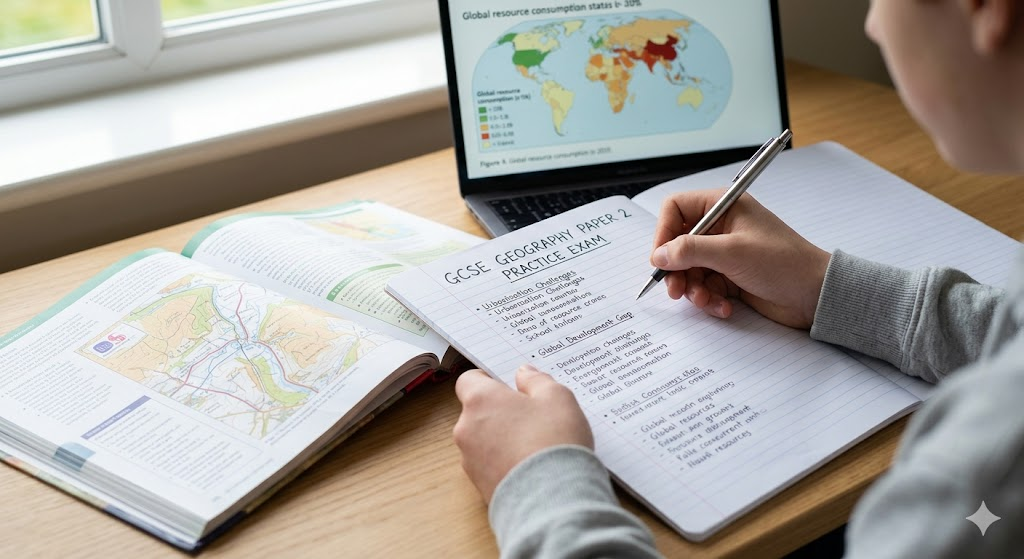
Additional Information
What the Course Entails and Exam Details
The foundation of GCSE Geography Paper 2 rests on understanding how human activity interacts with and reshapes the planet.
This course is extensive, and Paper 2 rigorously examines three specific components.
Core Topics Covered:
Urban Issues and Challenges: This crucial topic explores the growth of cities and the opportunities and challenges this rapid urbanization creates.
You will compare issues in contrasting cities, such as a major UK city (like London or Bristol) and a city in a Licensing Newly Industrializing Country (LIC/NEE), such as Rio de Janeiro or Mumbai.
Key concepts include managing urban growth, provide housing, water, sanitation, and sustainable urban living.
The Changing Economic World: This section analyzes global development patterns and economic shifts.
You will study the factors defining the development gap, contrasting life and economic opportunity between High Income Countries (HICs) and Lower Income Countries (LICs).
Case studies of a dynamic industrializing economy (like Nigeria) and the changing economy of the UK provide necessary depth.
Topics include strategies to reduce the development gap, such as aid, trade, and debt relief.
The Challenge of Resource Management: This topic investigates how the human population interacts with the earth's natural resources.
You will study the significance of food, water, and energy, with a detailed focus on one of these resources.
This covers consumption patterns, resource insecurity, and sustainable strategies to manage these essential resources globally.
Geographical Skills: Across all these topics, Paper 2 tests your practical geographical skills, including analyzing cartographic evidence (OS maps), interpreting complex statistical data, and using qualitative data to form balanced arguments.
What to Expect in the Final Exam
Knowing what to expect on exam day is the best way to conquer anxiety.
Paper 2 is a single written examination that accounts for a substantial percentage (often 35%, depending on the specific exam board) of your total GCSE Geography qualification.
Exam Format:
Assessment Type: External written examination.
Time Limit: Students typically have 1 hour and 30 minutes to complete the paper.
Structure: The exam paper is divided into clear sections corresponding to the core topics (Urban Issues, Changing Economic World, and Resource Management).
Question Types: You will encounter a strategic mix of question formats designed to test different levels of understanding. These range from:
Multiple-choice questions (testing quick recall).
Short-answer questions (testing specific definitions or processes).
Longer, extended-response, essay-style questions (testing your depth of knowledge, use of detailed case studies, and critical analytical skills).
Grading and Passing: Like all GCSE subjects, the Geography qualification is graded from 9 (the highest achievement) to 1. A grade of 4 is generally considered a standard pass, and a grade 5 is recognized as a strong pass.
How to Study and Exam Centers
Preparation is paramount for success in GCSE Geography.
Here are the most effective, actionable strategies to optimize your study time and approach your exam with confidence.
Actionable Study Strategies:
Use Past Papers Frequently: This is non-negotiable. Familiarize yourself with the types of questions that appear, the specific wording used by examiners, and the precise timing you need to adhere to.
Case Study Mastery is Key: The highest marks on extended questions require detailed, contrasting case study evidence. Don't just list facts; you must apply these facts to argue a point, e.g., contrasting London's housing challenge with that in a favela.
Practice Skill Application: Do not ignore map skills. Revise your OS map reading (symbols, 4 and 6-figure grid references), and practice interpreting diverse graphs, climate data, and charts, as these skills are often integrated into exam questions.
Create Structured Revision Notes: Use spider diagrams or flashcards to categorize each topic (Urban Issues, Economic World, Resources) by key definitions, named examples, specific challenges, and sustainable management solutions.
Exam Centers and How to Take the Exam:
Unlike some professional certifications taken at commercial test centers, GCSE examinations are administered nationally, simultaneously.
For School Students: If you are currently enrolled in a school or college, your school is an authorized examination center. You will sit your GCSE exams within your own school environment.
For Private Candidates: If you are a private candidate (e.g., home-schooled or resitting an exam outside of a standard institution), you must contact authorized schools or dedicated private examination centers in advance to register as an external candidate. These centers facilitate the exam process on your behalf.
Specific details regarding exam dates and logistics will be communicated directly to you by your school or designated examination center in the months preceding the exam period.
Job Opportunities from the Course
GCSE Geography develops transferrable skills—such as critical analysis, data interpretation, and an understanding of global interconnectivity—that are highly valued by employers. While this is a foundation and further qualification is usually required, it unlocks diverse career paths.
Career Paths and Job Titles Linked to Geography Skills:
Urban Planning and Development: Cartographer, Planning Officer, Urban Designer, Surveyor, Planning and Development Manager.
Environmental Management: Environmental Consultant, Sustainability Officer, Climatologist, Conservationist, Ecological Consultant.
Global Economy and Commerce: Travel and Tourism Manager, Logistics Manager, Foreign Service Officer, Global Risk Analyst, International Development Worker.
Geographical Information Systems (GIS): GIS Specialist, Geospatial Data Analyst, Remote Sensing Specialist, Surveyor, Crime Analyst (using mapping data).
Education and Communication: Geography Teacher (requires higher qualification), Higher Education Lecturer, Environmental Educator, Geographical Journalist.
Achieving a strong grade in your GCSE Geography Paper 2 is a significant achievement that showcases your understanding of complex world issues and prepares you for success in advanced studies and diverse professional industries. Start your preparation early and approach your practice with confidence.
Frequently Asked Questions
Reviews
5.0
Based on 0 reviews
Leave a Review
No reviews yet. Be the first to review!