
General Certificate of Secondary Education (GCSE) Maths Practice Exam
$69.00
- Buy to unlock unlimited access to all Quiz questions and Answers in this Quiz.
- After purchase you can print a PDF of the whole quiz at any point. The PDF will contain the questions and the correct answers.
About this Exam
The General Certificate of Secondary Education (GCSE) in Mathematics is a core qualification taken by students in England, Wales, and Northern Ireland, typically at the end of their Key Stage 4 education (around age 16).
This qualification is more than just a certificate; it is a fundamental measure of numerical fluency, problem-solving ability, and logical thinking.
It is designed for all secondary school students to ensure they possess the essential mathematical skills required for everyday life, further study, and employment.
Achieving a good grade in GCSE Maths (typically a Grade 4 or 5 and above) is a standard entry requirement for most sixth forms, colleges, universities, and varied career paths.
Ready to test your knowledge?
Buy Now to Access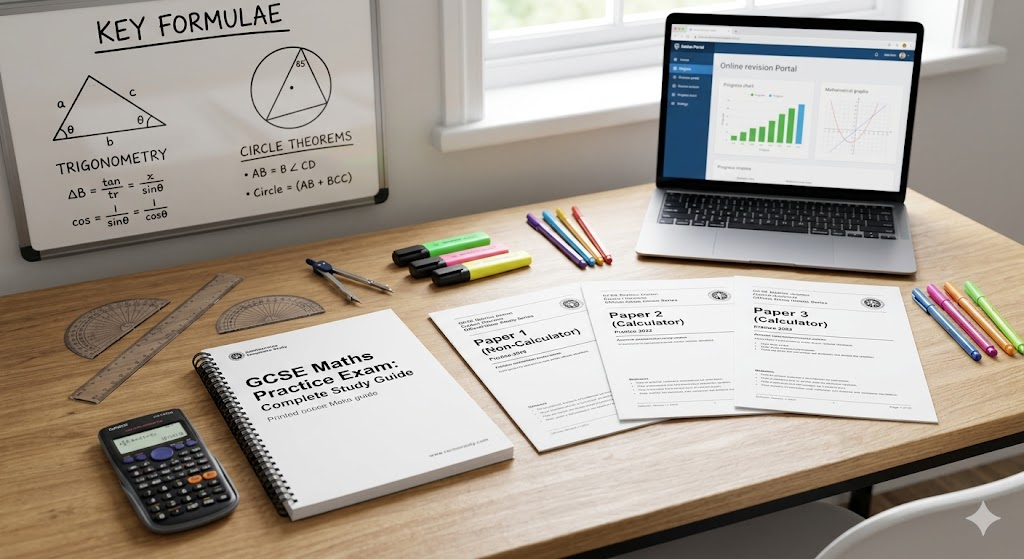
Additional Information
What the Course Entails and Exam Details
The GCSE Maths syllabus is comprehensive, designed to build from foundational concepts to complex problem-solving.
While exact specifics can vary slightly between different exam boards (such as AQA, Edexcel, OCR, and WJEC), the core curriculum is mandated by the Department for Education (DfE).
The course is divided into six main content areas.
The first area is Number, which covers operations, fractions, decimals, percentages, ratio, and proportion.
The second area is Algebra, focusing on expressions, equations, formulae, sequences, and graphs.
The third area is Ratio, proportion, and rates of change, dealing with scale factors, compound measures, and direct/inverse proportion.
The fourth area is Geometry and measures, including properties of shapes, angles, trigonometry, circle theorems, and vectors.
The fifth area is Probability, assessing the likelihood of events and using Venn diagrams.
The sixth area is Statistics, which involves collecting, representing, and analyzing data.
The exam is offered at two different tiers of entry: Foundation and Higher.
The Foundation tier allows students to achieve grades from 1 to 5.
The Higher tier allows students to achieve grades from 4 to 9.
Students and teachers carefully choose the tier that best matches the student's mathematical capability.
What to Expect in the Final Exam
For most UK exam boards, the final GCSE Maths assessment consists of three equally weighted written papers.
Each of the three papers is 1 hour and 30 minutes long.
Each paper contains 80 marks, making a total of 240 marks for the entire qualification.
There is a distinct format for the papers.
Paper 1 is a non-calculator assessment, testing mental arithmetic, written methods, and conceptual understanding without technological aid.
Papers 2 and 3 are calculator assessments, where students are expected to use a scientific calculator effectively to solve complex problems and perform intricate calculations.
The questions range from short, factual recall questions to multi-step, structured problem-solving tasks that require students to interpret a real-world context and apply their mathematical knowledge.
The grading system is linear, based on the total marks accumulated across all three papers.
Passing requirements differ by institution and employer, but a "standard pass" is universally considered a Grade 4, and a "strong pass" is a Grade 5.
How to Study and Exam Centers
Preparation for the GCSE Maths exam requires a consistent and active approach to revision.
The most effective strategy is practice.
You must engage with mathematics by solving problems, rather than simply reading notes.
A highly successful method is to use past exam papers.
By practicing under timed conditions, you familiarize yourself with the structure of the exam and the style of questions.
After completing a past paper, carefully review your answers using the official mark scheme to understand exactly what examiners are looking for.
This process highlights your strengths and exposes your weak areas.
Create a spaced repetition schedule to revisit topics regularly.
Utilize high-quality online resources, including dedicated revision websites, instructional video channels, and interactive practice platforms.
Regarding exam centers, GCSE Maths exams must be taken at an authorized exam center.
For the vast majority of students, this is their own school or college.
Private candidates (such as mature students or home-educated learners) must register with an approved external center, which can be a local school, a college of further education, or a dedicated private testing center.
You cannot take the formal GCSE Maths final exam online from home; it must be sat in person under strict, invigilated conditions.
Job Opportunities from the Course
A strong performance in GCSE Mathematics is a prerequisite for a vast array of educational and career opportunities.
It unlocks routes into specialized fields such as accounting, engineering, technology, and health.
The mathematical, analytical, and logical skills gained are valued in almost every sector.
Specific job titles and career paths that often list a strong GCSE Maths grade as a essential requirement include:
Accountant
Actuary
Aerospace Engineer
Architect
Data Analyst
Doctor
Civil Engineer
Computer Programmer
Economist
Electrician
Finance Manager
Investment Banker
Nurse
Pharmacist
Pilot
Quantity Surveyor
Research Scientist
Software Engineer
Statistician
Teacher (all subjects)
Frequently Asked Questions
Reviews
5.0
Based on 0 reviews
Leave a Review
No reviews yet. Be the first to review!