
General Certificate of Secondary Education (GCSE) Physical Education (PE) Practice Exam
$69.00
- Buy to unlock unlimited access to all Quiz questions and Answers in this Quiz.
- After purchase you can print a PDF of the whole quiz at any point. The PDF will contain the questions and the correct answers.
About this Exam
The General Certificate of Secondary Education (GCSE) in Physical Education (PE) is a vital qualification for students in the United Kingdom, typically aged 14 to 16, who have a keen interest in sports, health, and the science of the human body.
This course serves as a critical stepping stone, providing foundational knowledge for those considering careers in sports science, coaching, physiotherapy, and personal training.
While a significant portion of the course involves practical performance, the written exams assess critical theoretical understanding of anatomy, physiology, socio-cultural influences, and sports psychology.
This practice exam is designed specifically to mirror the challenge and format of the real assessment, giving you the confidence to perform your best on the day.
Ready to test your knowledge?
Buy Now to Access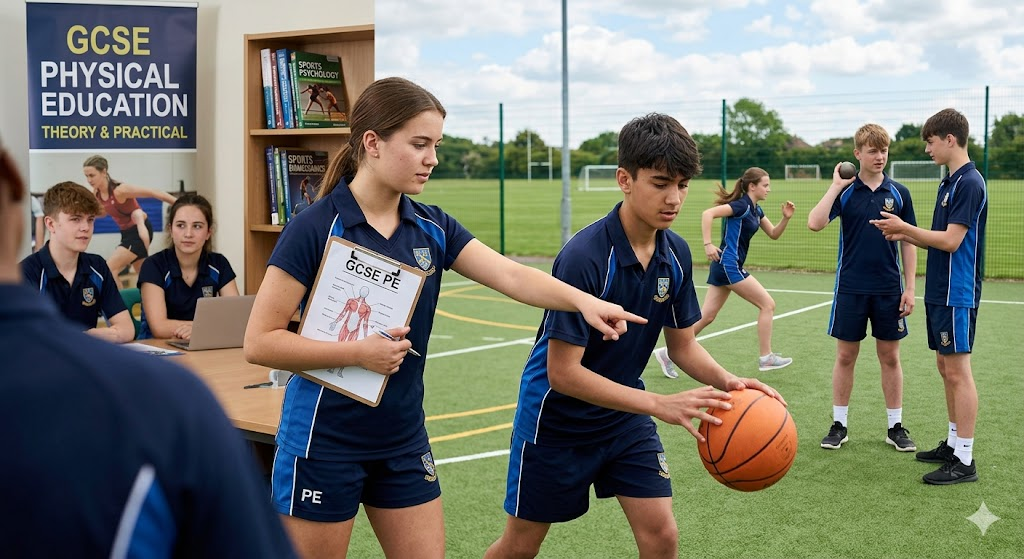
Additional Information
What the Course Entails and Exam Details
The GCSE PE curriculum is split broadly between theoretical understanding and practical performance. The theory component generally accounts for 60% of the total qualification and is split across two core papers:
Paper 1: The Human Body and Movement in Physical Activity and Sport: You will study applied anatomy and physiology (skeletal, muscular, cardio-respiratory systems), biomechanics, and the impact of exercise and training on the body.
Paper 2: Socio-Cultural Influences and Well-Being in Physical Activity and Sport: Topics include sports psychology, socio-cultural factors (like engagement patterns and commercialism), and the relationship between physical activity, health, and well-being.
The remaining 40% is assessed through a Non-Exam Assessment (NEA), commonly referred to as the practical component.
In this NEA, students must demonstrate performance and assessment in three different physical activities: one from the 'team' category, one from the 'individual' category, and a third from either category.
Students are also required to complete an analysis and evaluation of performance to bring the NEA total up to 40%.
What to Expect in the Final Exam
The theoretical exams (the main GCSE PE papers) are formal, written assessments. While the exact structure can vary slightly by the exam board (AQA, OCR, Pearson Edexcel, or WJEC/Eduqas), students should generally prepare for the following format:
Format: Each theory paper (Paper 1 and Paper 2) typically lasts between 1 hour 15 minutes and 1 hour 45 minutes.
Question Types: The exams feature a mixture of multiple-choice, short-answer questions (testing recall), and extended, 6- or 9-mark essay questions (testing application and analysis).
Calculations: Students should be prepared to handle basic numerical data and calculations, especially in the applied anatomy and data analysis sections.
Practical Assessment: Your performance in your three selected physical activities will be internally assessed by your teachers and then externally moderated by a representative from the exam board to ensure standardisation.
Passing scores are determined on a scale from 9 (highest) to 1 (lowest). A grade 4 is generally considered a standard pass, while a grade 5 is a 'strong pass'.
How to Study and Exam Centers
Effective preparation is the key to unlocking your potential in the GCSE PE exam. We recommend focusing on the following strategies:
Focus on the Specification: Download the exact specification (syllabus) from your specific exam board’s website (e.g., AQA or OCR). Use this as your roadmap, checking off topics as you master them to ensure you cover every potential question.
Interleave Your Revision: Do not study one topic for hours. Instead, rotate between anatomy, sports psychology, and socio-cultural issues. This technique improves long-term retention.
Master the Command Words: Pay close attention to what a question asks. There is a profound difference between a question asking you to "State" (1 mark) versus "Explain" (2-3 marks) or "Analyze/Evaluate" (6-9 marks). Practice breaking down essay questions.
Use Past Papers: This is the single most effective study method. Completing actual past exam papers under timed conditions is crucial for identifying your weak points and familiarizing yourself with the language used by the examiners.
GCSEs are taken through authorised exam centers, which are almost exclusively recognized schools and colleges across the UK. Students are typically registered for their exams by their school, which manages the entire administration and practical assessment process.
Job Opportunities from the Course
Achieving a strong result in your GCSE PE opens clear pathways to a wide array of inspiring and dynamic careers. Here are some of the career paths this qualification can lead to:
Secondary School PE Teacher
Sports Coach / Head Coach
Physiotherapist
Personal Trainer / Fitness Instructor
Sports Therapist
Nutritionist
Leisure Center Manager
Sports Psychologist
Performance Analyst
Sports Journalist / Commentator
Sport Development Officer
Armed Forces Physical Training Instructor
This qualification also provides an excellent foundation for proceeding to further study, including A-Levels in Physical Education and Biology, or vocational qualifications like BTEC Nationals in Sport.
Frequently Asked Questions
Reviews
5.0
Based on 0 reviews
Leave a Review
No reviews yet. Be the first to review!