
General Certificate of Secondary Education (GCSE) Religious Studies Practice Exam
$69.00
- Buy to unlock unlimited access to all Quiz questions and Answers in this Quiz.
- After purchase you can print a PDF of the whole quiz at any point. The PDF will contain the questions and the correct answers.
About this Exam
Embark on a journey into the heart of human belief and values with the General Certificate of Secondary Education (GCSE) Religious Studies. This vital qualification isn't just about memorizing facts; it's designed for students to explore their own perspectives and engage critically with the world’s major religions and contemporary ethical themes. Who is it for? It’s for curious minds in secondary school, generally aged 14 to 16, and anyone seeking a solid understanding of how diverse faiths and philosophical viewpoints shape modern culture and morality.
The official GCSE Religious Studies qualification is a robust, academic course typically taken over two years. It provides a foundational appreciation of religious beliefs, teachings, and practices, and importantly, teaches students how to analyze, evaluate, and formulate well-structured arguments. A GCSE Religious Studies Practice Exam is a crucial stepping stone to success. This simulated assessment allows you to become familiar with the actual exam’s structure, question types, and time pressures. By engaging with these practice papers, you are not only testing your knowledge but also honing the very skills that will empower you to perform your best when it matters most. It’s an indispensable revision tool, helping you identify areas for improvement and gain the confidence to approach the final official exams with ease. This guide is designed to help you prepare effectively for that essential practice session, bringing you closer to achieving your desired GCSE grade.
Ready to test your knowledge?
Buy Now to Access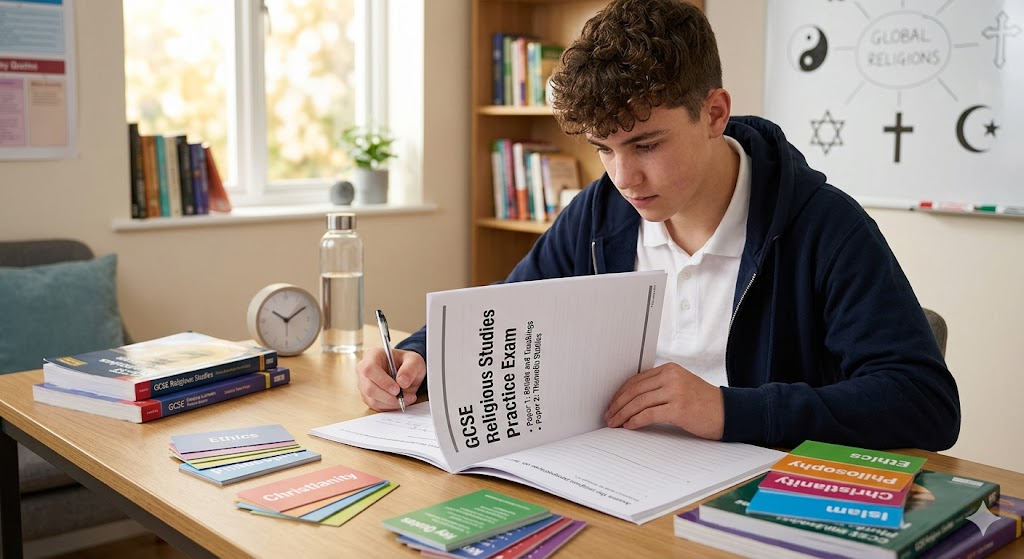
Additional Information
What the Course Ent entails and Exam Details
A comprehensive GCSE Religious Studies course delves deeply into both religious traditions and human experience. While specific syllabuses can vary slightly between major exam boards like AQA, Edexcel, and OCR, the core components generally include:
The Study of Religions: You will typical study the distinct beliefs, teachings, and practices of at least two prominent world religions. Standard choices often include Christianity and Islam, but schools may also select from Judaism, Hinduism, Buddhism, or Sikhism. This section builds thorough subject knowledge of each faith's core tenets, significant texts, and historical context.
Thematic Studies: This section applies religious and non-religious teachings to key issues in the modern world. Topics can range from the philosophy of religion (e.g., arguments for the existence of God, religious experience) to compelling ethical dilemmas. Typical themes explore:
Relationships and families
The existence of God and revelation
Religion, peace, and conflict
Religion, crime, and punishment
Religion and life (including creation, life after death, and environmental issues)
Human rights and social justice
The actual GCSE Religious Studies exam is entirely written; there are no practical assessments. It is designed to evaluate both your knowledge and your higher-order thinking skills. Your ability to apply diverse perspectives, quote relevant sources, and present balanced, reasoned arguments is essential for achieving a high grade. The specific division of marks, paper durations, and total number of papers will be determined by your chosen exam board's unique specification. A typical structure involves at least two separate written papers, each with a defined focus (e.g., one paper on religions, one on themes). The knowledge you apply must come from both within religious frameworks and from contemporary, secular points of view.
What to Expect in the Final Exam
As you prepare for a comprehensive practice session, it’s vital to understand the structure and demands of the final official GCSE Religious Studies exam. These detailed and demanding assessments are designed to test the full breadth and depth of your knowledge.
Exam Format: The actual GCSE usually consists of multiple written papers, taken under strict examination conditions. There are no multiple-choice questions or practical components. Each paper will present a mix of short, structured questions and longer, extended-response or essay-style questions. The questions will be clearly marked with their values, typically ranging from 1 or 2 marks for simple recall to 12 marks for an extended evaluation question. You must be prepared to write coherent paragraphs and essays, integrating key terms, religious terminology, relevant quotations from religious texts or other authoritative sources, and supporting evidence. A crucial skill is structuring your answers using methods like PEEL (Point, Evidence, Explanation, Link) for multi-mark questions.
Time Limits: Official GCSE papers are strictly timed. While durations can vary slightly, each major paper typically lasts approximately 1 hour and 45 minutes. This time limit is designed to be challenging, requiring you to be highly efficient in planning, writing, and reviewing your answers. Managing your time across different questions and sections is a fundamental exam skill.
Passing Score/Grades: The final GCSE outcome is not a simple pass or fail with a percentage score. Instead, your performance across all papers determines your overall grade on a numerical scale of 9 (highest) to 1. A grade 4 or 5 is generally considered a 'standard' or 'strong pass', but individual institutions and employers will have their own grade requirements. The precise grade boundaries are adjusted each year based on the difficulty of the paper and the overall student performance.
Simulated Practice Exam Expectations: Your GCSE Religious Studies Practice Exam will be designed to mirror these official conditions as closely as possible. It will feature question types, a similar structure, relevant topics, and a realistic time limit to give you a genuine taste of the real challenge. You should approach it with the same level of focus and preparation as the actual exam. The goal isn't just about the 'grade' you achieve on the day, but about learning how to manage the test's unique demands. Your final official exams will be held in accredited, standardized centers like your own secondary school or college, under the supervision of qualified invigilators. There will be strict rules regarding behavior, prohibited items (such as phones), and the use of authorized materials, all to ensure a fair testing environment for every student.
How to Study and Exam Centers
Preparation for both your practice and final exams must be proactive, varied, and structured. Here are actionable strategies and information on test environments:
Active Revision:
Know Your Specification: First and foremost, identify your specific exam board and syllabus (AQA, Edexcel, OCR, etc.). Download the actual specification from the board’s official website; this document is your blueprint for everything you need to know.
Past Papers & Practice Exams: The single most effective strategy is practicing with past papers and official specimen questions. This is your core practice. For a practice exam, your school or revision provider may provide specific papers designed for this purpose, but using genuine past papers is also excellent practice. Time yourself, use the official mark schemes to understand what examiners are looking for, and pay attention to common pitfalls in examiners' reports.
Flashcards & Mind Maps: Create detailed flashcards for key terms, definitions, significant quotes, and important examples within each religion and theme. Use mind maps to visualize complex relationships between different concepts, themes, and perspectives.
Memorize Key Quotes: Compile a concise list of impactful quotations from religious texts and other authoritative sources for each topic. Learn where these quotes are from and, crucially, understand how to interpret and apply them in your essays.
PEEL Essay Structure: For all extended questions, master the PEEL structure (Point, Evidence, Explanation, Link) to ensure your answers are structured, focused, and persuasive. Dedicate time to outlining and planning your responses for larger mark questions.
Discussion & Debate: Discussing ethical and philosophical themes with peers, teachers, or family can deepen your understanding, expose you to diverse viewpoints, and help you refine your arguments.
Regular, Spaced Practice: Revise consistently in manageable blocks, using techniques like the Pomodoro technique (25 minutes of focus, 5 minutes break). Space your practice over time rather than cramming.
Use Up-to-Date Guides: Ensure any study guides or online resources you use are current and align with your specific syllabus.
Exam Centers:
Real GCSE Exams: Official GCSE Religious Studies exams are conducted in authorized examination centers. For the vast majority of students, this center is the secondary school or college where they are enrolled. The school handles all aspects of registration and administers the exams on the specified dates set by the exam boards. Private candidates (those not enrolled in a participating school) must find an approved center, often another local school or dedicated test center, by contacting exam boards like AQA or Edexcel directly to discover authorized venues in their region. They may need to pay an additional fee to use these centers. The exam is typically a physical, written assessment taken at the center; it is not standard to take final GCSE exams via online portals.
Practice Exams: A GCSE Religious Studies Practice Exam is most often administered directly by your school or college as a internal assessment (frequently called a 'mock' exam) to help you prepare. Your school will arrange the timing, location, and invigilation. Alternatively, you might take a private mock exam through a tutoring service or independent revision company, in which case they would provide the logistics. If you are doing self-led practice, you would simply set up a timed, quiet environment for yourself at home or in a library.
Job Opportunities from the Course
A qualification in GCSE Religious Studies does not directly certify you for specific job roles, but it provides a wealth of transferrable skills highly valued across a diverse range of careers. These skills – including critical thinking, empathy, strong communication, analysis of complex ideas, and a deep understanding of diverse cultures and ethics – are foundational for success in numerous professional paths. Consider it a superb springboard towards future study and career opportunities. Here are specific career fields and job titles where this qualification and the skills it develops are particularly relevant:
Secondary School Teacher (Religious Studies / RE)
Primary School Teacher
Social Worker
Civil Servant (Policy, Administration, Community Relations)
Police Officer
Journalist
Editor or Writer
Community Development Worker
Youth Worker
Charity Officer / Fundraiser
Legal Professional (Lawyer, Solicitor - with further qualifications)
Archivist or Museum Curator (with further study)
Equality and Diversity Officer
Health Service Manager
Diplomatic Service Officer
Community Mediator
HR Manager (Focus on diversity, ethics, and employee relations)
Politician’s Assistant
Interfaith Relations Specialist
Researcher (in sociology, theology, or related fields)
Remember, most of these careers will require further specialist training, degrees, or experience, but a GCSE in Religious Studies serves as an excellent starting point and a signal of your commitment to understanding people, ethics, and global cultures.
Frequently Asked Questions
Reviews
5.0
Based on 0 reviews
Leave a Review
No reviews yet. Be the first to review!