
General Contractor License (KB2) Practice Exam
$69.00
- Buy to unlock unlimited access to all Quiz questions and Answers in this Quiz.
- After purchase you can print a PDF of the whole quiz at any point. The PDF will contain the questions and the correct answers.
About this Exam
A General Contractor License, specifically the Dual Residential and Small Commercial (KB2) classification, is a significant professional milestone for individuals aspiring to manage and supervise a wide range of construction projects. This specific license combines the scope of residential and small-scale commercial contracting, allowing a single licensee to oversee both types of work, typically with project value limits (e.g., in Arizona, up to $2 million for the commercial portion). It is designed for experienced construction professionals, including project managers, superintendents, and aspiring business owners, who seek to validate their knowledge of building codes, safety regulations, and project management practices. The KB2 classification is often a "dual" license, streamlining the regulatory process and expanding the holder's market reach in states that utilize this specific designation.
Ready to test your knowledge?
Buy Now to Access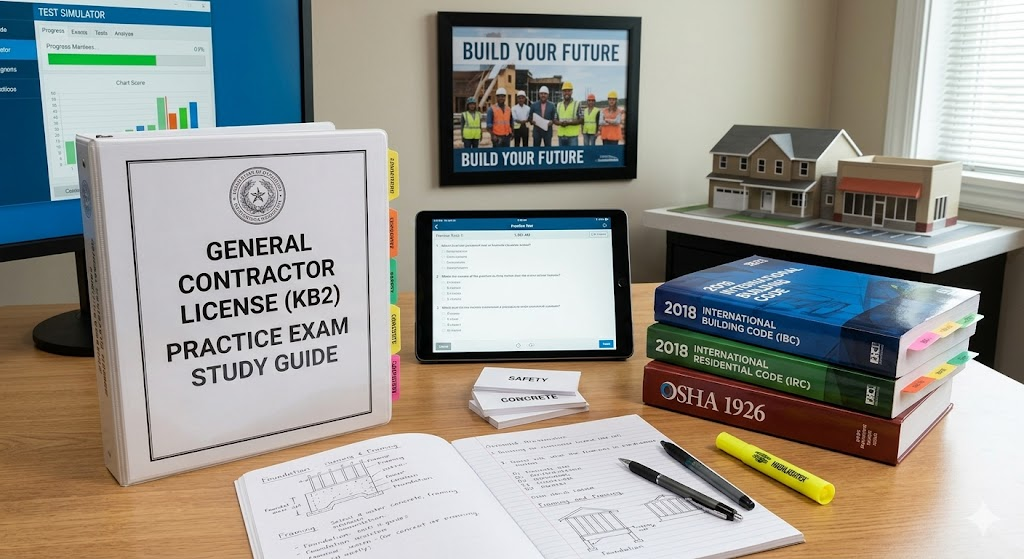
Additional Information
What the Course Entails and Exam Details
To prepare for the final licensure, candidates typically undertake a comprehensive study course or engage in structured self-study covering a diverse array of construction topics. This "course" isn't usually a single class but rather a program of study based on a state's designated reference materials. The material encompasses key elements of both residential and commercial building construction. While exact requirements can vary slightly by jurisdiction, a KB2 exam syllabus usually includes in-depth coverage of: Sitework (including excavation and grading), Concrete construction (foundations, slabs, and mix design), Masonry (brick, block, and stone), Metals (structural and non-structural metalwork), Carpentry (framing and finish work), Thermal and Moisture Protection (insulation, roofing, and waterproofing), Doors and Windows installation, Finishes (drywall, painting, flooring), comprehensive Safety standards (primarily OSHA 1926 Construction Industry Regulations), and general Building Codes, including both the International Residential Code (IRC) and the International Building Code (IBC).
What to Expect in the Final Exam
The final qualifying examination for a General Contractor License (KB2) is a critical step that assesses a candidate's mastery of the subject matter. It is primarily administered as a multiple-choice, computer-based test. In jurisdictions that use the KB2 designation, such as Arizona, the exam is a combined trade test that includes both general residential and small commercial construction principles. The format is typically open-book, which means candidates can bring specific, pre-approved reference manuals into the testing center. A common configuration is a 100-question exam, for which you are given a total of 240 minutes (4 hours) to complete. To receive a passing grade and qualify for licensure, a score of at least 70% is generally required. The "open-book" nature of the exam does not make it easy; instead, it tests your ability to navigate complex code books and reference materials efficiently to find accurate information under a strict time limit. In addition to the trade-specific exam, most states also require candidates to pass a separate "Business, Law, and Project Management" exam to ensure competence in the operational aspects of running a contracting business.
How to Study and Exam Centers
Preparation for the open-book KB2 exam requires a focus on familiarization and efficiency, not just memorization. The most critical step is to obtain the exact editions of the reference books approved by your state's contractor licensing board. These usually include the IRC, IBC, and OSHA 1926. For effective studying, it is highly recommended to use pre-tabbed and highlighted books, as state-approved, permanent tabs can significantly speed up your ability to find key passages. Taking numerous, realistic practice exams from a reputable "General Contractor License (KB2) Practice Exam" provider is essential. These practice tests help you get comfortable with the exam format, manage your time, and learn how to use your books to answer questions. Online exam prep courses can also provide structured guidance, narrated highlighting, and calculated answer walkthroughs. When you are ready to take the actual test, you will typically need to register through an authorized testing vendor, such as PSI, which operates computer-based testing centers in various physical locations across the state. In some cases, specific training or statue-based exams may be available through online portals directly from the contractor licensing authority, like the Arizona Registrar of Contractors.
Job Opportunities from the Course
Earning a General Contractor License with the Dual Residential and Small Commercial (KB2) classification unlocks powerful career opportunities and permits individuals to legally operate at a higher level of responsibility within the construction industry. This qualification allows for diverse job roles and business leadership paths.
Here are specific job titles and career paths this license makes possible:
Licensed General Contractor (for both Residential and Commercial projects)
Construction Project Manager (CPM)
Construction Superintendent
Owner/Operator of a Construction Company
Construction Estimator
Licensed Subcontractor (often, general contracting knowledge allows for specialization)
Building Inspector
Frequently Asked Questions
Reviews
5.0
Based on 0 reviews
Leave a Review
No reviews yet. Be the first to review!