
General Crane Safety Practice Test
$69.00
- Buy to unlock unlimited access to all Quiz questions and Answers in this Quiz.
- After purchase you can print a PDF of the whole quiz at any point. The PDF will contain the questions and the correct answers.
About this Exam
The General Crane Safety certification is a vital credential designed to establish a foundational knowledge of safe crane operations. This comprehensive training program is engineered for aspiring crane operators, riggers, signal persons, and safety supervisors across various industries. It serves as a necessary prerequisite for advanced specialty certifications. The primary goal is to equip professionals with the skills and knowledge to prevent workplace accidents and ensure a culture of safety. This course acquaints students with essential regulatory requirements, such as those from OSHA, ensuring all personnel can identify and mitigate potential hazards before they occur. It is the perfect starting point for anyone looking to build a career in heavy lifting and material handling.
Ready to test your knowledge?
Buy Now to Access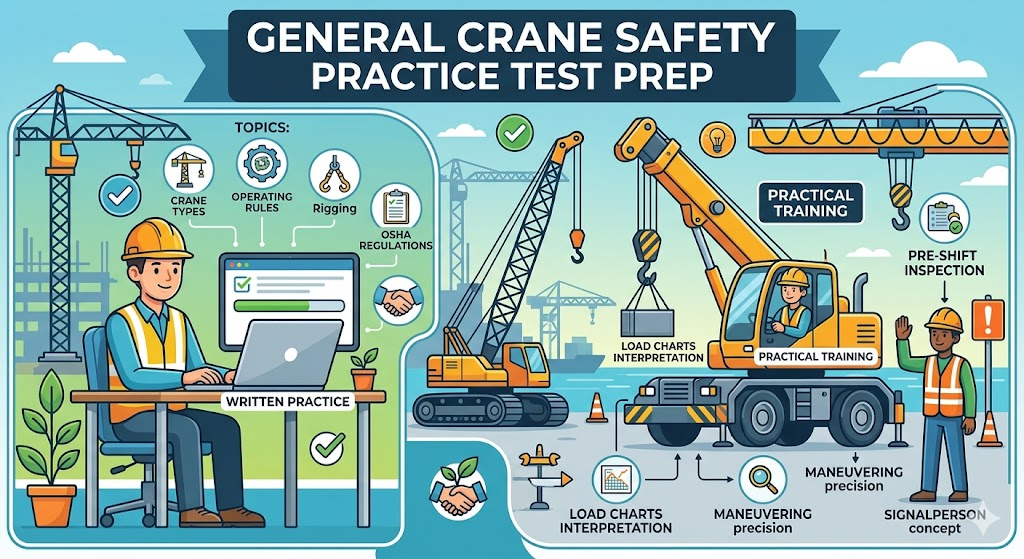
Additional Information
What the Course Entails and Exam Details
The course syllabus provides a robust overview of every critical aspect of crane safety. It is designed to take a student from zero knowledge to a competent understanding of safe field operations. The core topics covered typically include:
Crane Types and Components: Identification and classification of various crane categories, including mobile, tower, overhead (EOT), and derrick cranes. It covers all major structural and mechanical parts, from the boom and hoist to the bridge and trolley.
Safe Operating Procedures: Setting up equipment for a lift, including using outriggers and ensuring ground stability. This section places a strong emphasis on conducting thorough pre-operational inspections, known as the Operator's Daily Checklist (ODCL).
Load Dynamics and Management: Mastering simple mathematics and unit weights to determine exact load weights. Students will learn how to read and interpret complex load charts to understand a crane's lifting capacity under varying conditions.
Rigging and Signaling: A deep dive into the selection, inspection, and proper use of rigging gear, such as slings and hitches. It also teaches the standardized system of hand and voice signals crucial for effective crane team communication.
Hazard Awareness and Control: Critical safety guidelines for working near power lines, understanding the effects of wind and weather, and implementing lockout/tagout procedures to protect personnel.
What to Expect in the Final Exam
The final exam is a two-part assessment that tests both theoretical knowledge and practical skill. This dual-format ensures a candidate is not only proficient in a classroom setting but can also safely manage a real-world lifting scenario.
Written Examination: The written component is typically a comprehensive multiple-choice test, although some exams may include multi-answer or fill-in-the-blank questions. Candidates can expect around 50-100 questions covering all syllabus topics. While individual testing bodies vary, a common passing score is 80% for the core written exam.
Practical Examination: The practical test requires a student to demonstrate their skill in a controlled environment under the supervision of a certified examiner. This part often involves completing specific maneuvering tasks, such as raising and lowering a test weight through a predefined obstacle course. Examiners look for precision, smooth control, and a strict adherence to safety protocol.
Procedural Rules and Time Limits: Applicants must be at least 18 years old and typically must possess a valid driver's license and meet certain physical/medical requirements, often requiring a medical examiner's certificate. While entire courses may span weeks, individual components of the practical exam have strict time limits to ensure competence. Candidates must always comply with a strict code of ethics and substance abuse policy during the entire process.
How to Study and Exam Centers
Successfully passing the General Crane Safety exam requires a structured study plan that balances learning theory with practical exercise. Your preparation should include:
Mastering the Study Material: Start by diving deep into all provided study materials and reference manuals. Focus on understanding the theory behind crane operations, including mechanical principles and best practices for safe handling. Take detailed notes to reinforce key concepts.
Practicing with Load Charts: This is often the most challenging part of the written exam. Dedicate significant time to practicing with dozens of load chart scenarios, making sure you can interpret them quickly and accurately.
Taking Mock Exams: Use online practice tests, such as a dedicated General Crane Safety Practice Test, to become familiar with the types of questions and the time management required during the actual exam. Identify weak areas and review them until confident.
Hands-on Training for the Practical Test: If possible, gain experience under the guidance of a mentor or through a formal apprenticeship. Familiarity with the equipment's controls is invaluable. Study the literature provided by the manufacturer for the specific crane you will use for your test.
Exam Centers: Training and examinations are offered through a variety of recognized institutions. You can access training online through various e-learning portals for the written portion or a refresher. The official certification exams, however, are typically administered at authorized physical testing centers, such as Pearson VUE, or specialized crane training schools, such as CCO School or a regional maritime academy. Always verify that your chosen training provider or center is fully authorized by the relevant accreditation body.
Job Opportunities from the Course
A General Crane Safety certification is an extremely versatile credential that unlocks a wide range of rewarding career paths. Once you have successfully passed, you will be qualified for a variety of roles within the construction, manufacturing, logistics, and specialized lifting industries. Specific job opportunities and career titles this certification unlocks include:
Crane Operator: Operating a variety of crane types, from mobile hydraulic cranes on construction sites to large overhead cranes in workshops.
Rigger / Rigging Specialist: Responsibly selecting and attaching rigging gear to safely secure loads for lifting.
Signal Person: Providing critical communication and direction to crane operators, ensuring safe movement through a worksite.
Crane Safety Supervisor / Inspector: Overseeing operations to ensure all work adheres to safety regulations and performing necessary equipment inspections.
Port Operation Equipment Operator: Utilizing heavy machinery like cranes and reach stackers for cargo handling in a maritime or logistics terminal.
Positions in Manufacturing and Fabrication: Moving heavy materials and components within a production facility.
Roles in Oil & Gas and Alternative Energy: Participating in specialized lifts for large infrastructure projects.
This certification is your foundational step toward a career in an essential and high-demand sector, where your skill and commitment to safety will make a real impact every day.
Frequently Asked Questions
Reviews
5.0
Based on 0 reviews
Leave a Review
No reviews yet. Be the first to review!