
General Educational Development (GED) Social Studies Practice Test
$69.00
- Buy to unlock unlimited access to all Quiz questions and Answers in this Quiz.
- After purchase you can print a PDF of the whole quiz at any point. The PDF will contain the questions and the correct answers.
About this Exam
The General Educational Development (GED) test is a globally recognized high school equivalency credential. It is specifically designed for adults who did not complete high school but want to demonstrate they have acquired the same level of academic knowledge and skills. The GED Social Studies test is one of four subject-area tests that make up the complete GED. It evaluates your ability to understand, interpret, and apply information related to history, geography, civics, and economics. For many, passing the GED is the key to unlocking higher education opportunities, securing better-paying jobs, and achieving personal fulfillment.
Ready to test your knowledge?
Buy Now to Access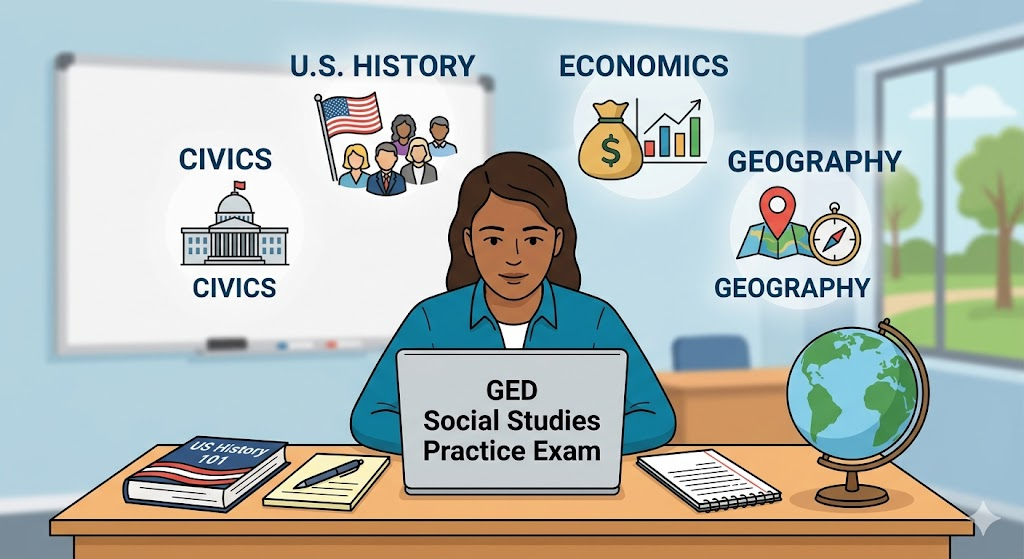
Additional Information
What the Course Entails and Exam Details
The GED Social Studies test focuses on key skills rather than rote memorization of facts. You will be tested on your ability to read and analyze various types of texts and data. The core content areas are:
Civics and Government (50%) This is the largest section. It covers the foundation of the American constitutional democracy, the structure and function of the U.S. government, individual rights and responsibilities, and civic participation.
United States History (20%) This section covers major events and eras from the nation’s founding to the present day, emphasizing historical cause and effect, and interpreting diverse perspectives.
Economics (15%) You will need to understand fundamental economic concepts, including supply and demand, the role of government in the economy, and consumer economics.
Geography and the World (15%) This area tests your knowledge of spatial views of the world, human systems, and how the environment and society interact.
The exam focuses on testing your reasoning skills, including "Reading for Meaning in Social Studies," "Analyzing Historical Events and Arguments," and "Using Numbers and Graphs in Social Studies."
What to Expect in the Final Exam
Here is a breakdown of what to expect on test day:
Total Time: You will have 70 minutes to complete the GED Social Studies test. There are no breaks during this section.
Format: The exam consists of approximately 35 questions. The question types are diverse and include multiple-choice, drag-and-drop, select-an-area, and hot spot.
No Extended Response: Unlike the Reasoning Through Language Arts (RLA) test, the Social Studies section does not include a long essay question.
Calculator: You are not permitted to use a handheld calculator. However, a basic on-screen calculator and a calculator reference sheet will be provided for questions that require numerical calculations.
Passing Score: To pass, you must score at least 145 out of 200 points.
How to Study and Exam Centers
Your preparation should focus on practical application and familiarizing yourself with the test format. Here are actionable study strategies:
Take Practice Tests: This is the most effective method. Start with a free practice test to gauge your current knowledge. We highly recommend the official GED Ready® practice test, which is half the length of the real test and provides a "Likely to Pass" score.
Focus on Skills, Not Memorization: Practice interpreting maps, graphs, political cartoons, and historical documents (e.g., the U.S. Constitution and Declaration of Independence).
Study Key Concepts: Brush up on fundamental terms and concepts within each of the four content areas.
Improve Reading Comprehension: Work on identifying main ideas, analyzing an author's purpose, distinguishing fact from opinion, and evaluating arguments.
Where to Take the Exam: You can take the GED test at authorized physical testing centers (often operated by Pearson VUE) or via the Online Proctored GED Test in eligible states. All registration, scheduling, and payment must be completed through your official account at ged.com.
Job Opportunities from the Course
Earning your GED is a powerful credential that immediately qualifies you for a vast array of jobs and career paths. It demonstrates to employers that you have the determination and foundational knowledge required for the modern workforce. Here is a list of job titles and career paths this certification unlocks:
Customer Service Representative
Office Assistant / Administrative Assistant
Sales Associate (Retail and wholesale)
Medical Receptionist
Home Health Aide / Personal Care Aide
Security Guard / Gaming Surveillance Officer
Correctional Officer
Postal Worker / Mail Carrier
Dental Assistant (Entry-level)
Trades/Manufacturing roles (e.g., Carpenter, Electrician, Machinist, after completing apprenticeships)
Banking Teller
Food Service Manager (Step up from service roles)
The GED is also the primary requirement for enrollment in community colleges, trade schools, and four-year universities.
We wish you the best of luck on your journey to passing the GED Social Studies exam!
Frequently Asked Questions
Reviews
5.0
Based on 0 reviews
Leave a Review
No reviews yet. Be the first to review!