
General Genetics Exam 1 Practice
$69.00
- Buy to unlock unlimited access to all Quiz questions and Answers in this Quiz.
- After purchase you can print a PDF of the whole quiz at any point. The PDF will contain the questions and the correct answers.
About this Exam
The General Genetics Exam 1 is a crucial introductory assessment in many university biology, biochemistry, and pre-med programs. This practice exam is designed to help students master the fundamental principles of heredity and molecular genetics covered in the initial portion of their course. It is an essential tool for undergraduates seeking to solidify their understanding of topics like Mendelian laws, probability, and cell division before the actual high-stakes university exam. By simulating the test-taking experience, this guide enables students to identify knowledge gaps, build confidence, and refine their problem-solving skills in one of biology's most foundational fields.
Ready to test your knowledge?
Buy Now to Access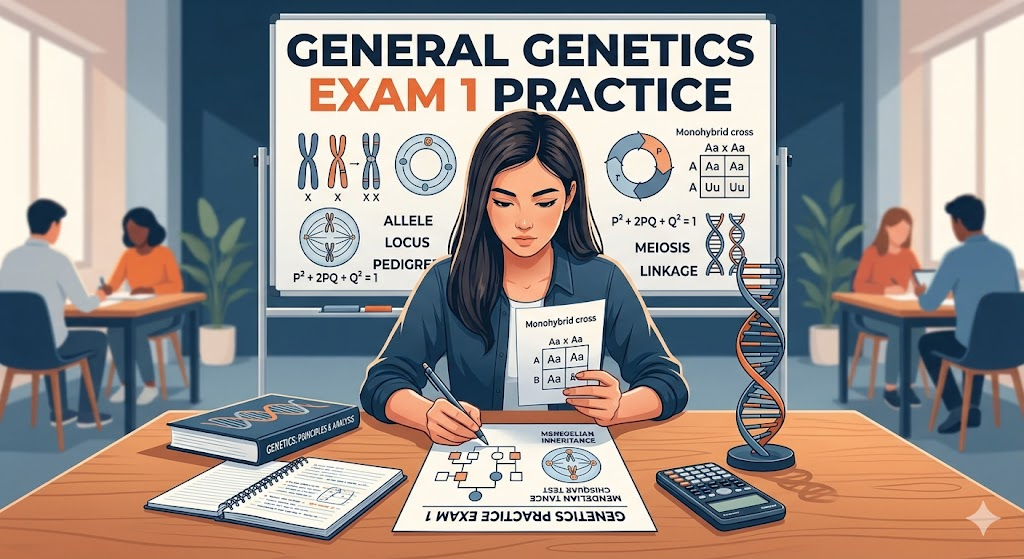
Additional Information
What the Course Entails and Exam Details
A full introductory General Genetics course provides a deep dive into how traits are inherited and how genetic information is stored, replicated, and expressed. While exact course syllabus content varies by institution, a typical "Exam 1" usually covers the first third of the course. Key topics and skills evaluated often include:
Introduction to Genetics: History, terminology, and the distinction between genotype and phenotype.
Mendelian Inheritance: Mastering monohybrid, dihybrid, and polyhybrid crosses using Punnett squares. Understanding and applying Mendel's Laws of Segregation and Independent Assortment.
Extensions of Mendelian Genetics: Analyzing incomplete dominance, codominance, multiple alleles, and lethal alleles.
Sex Determination and Sex Linkage: Understanding different sex-determination systems and solving genetic problems involving X-linked and Y-linked traits.
Pedigree Analysis: Interpreting family trees to determine modes of inheritance for genetic disorders.
Probability and Chi-Square Analysis: Applying statistical rules to genetic predictions and testing if observed data fit a genetic hypothesis.
Cell Division: Mastering the stages of mitosis and, more critically, meiosis, and their relationship to Mendelian principles.
What to Expect in the Final Exam
The formal university General Genetics Exam 1 is a timed, proctored assessment. The specific format depends entirely on your professor, but it commonly includes:
Multiple-Choice and True/False: A section testing your rapid recall of facts, definitions, and simple conceptual relationships.
Short Answer/Problem Solving: This is often the largest and most critical section. You must set up and solve genetic crosses, draw pedigrees, perform probability calculations, and interpret provided data. Partial credit is often given for showing your work.
Essay or Conceptual Questions: Some exams include questions requiring a paragraph or two to explain a process like meiosis or a concept like epistasis in detail.
Passing Score and Time Limit: These are set by your university department. Typically, a "C" (around 70%) is required to advance. The time limit is usually a standard class period, from 50 to 90 minutes.
How to Study and Exam Centers
Preparation for a genetics exam must be active, with a primary focus on problem-solving rather than passive reading.
Solve Practice Problems Daily: Do not just read your textbook; work through every end-of-chapter problem. Redo problems you got wrong until you can solve them flawlessly. This practice exam is a key resource in this strategy.
Master the Terminology: Genetics has a precise language. Create flashcards for terms like heterozygous, allele, locus, epistasis, and aneuploidy.
Draw Everything: Practice drawing Punnett squares, pedigrees, and the phases of meiosis, explicitly labeling where alleles segregate and assort independently.
Attend Review Sessions: Participate in Professor or Teaching Assistant (TA) review sessions to ask specific questions about complex problems.
Form a Study Group: Teaching a concept to someone else is the best way to ensure you have mastered it yourself.
Exam Centers: Unlike standard standardized certification exams, your General Genetics Exam 1 will be held in a physical classroom or lecture hall on your specific college or university campus. Check your course syllabus and official university portal for the exact location, date, and time. Ensure you arrive early and bring authorized materials, such as non-programmable calculators, if permitted.
Job Opportunities from the Course
A General Genetics course is a prerequisite for advanced studies and a wide range of career paths in life sciences and healthcare. While a single course doesn't grant a certification, mastering this content unlocks opportunities that a degree in the field provides:
Genetic Counselor: Helping families understand genetic conditions and risks.
Medical Scientist: Conducting research to understand human diseases and develop treatments.
Biotechnologist: Using genetic engineering to create new products and technologies in agriculture, medicine, and industry.
Bioinformatician: Using computational tools to analyze large genetic and genomic data sets.
Clinical Laboratory Geneticist: Performing diagnostic genetic tests in medical laboratories.
Research Associate: Working in academic or corporate labs to advance genetic knowledge.
Pharmaceutical Scientist: Designing and developing drugs based on genetic targets.
Forensic Scientist: Analyzing DNA evidence to assist in legal investigations.
Frequently Asked Questions
Reviews
5.0
Based on 0 reviews
Leave a Review
No reviews yet. Be the first to review!