
General Lines Property and Casualty Insurance Practice Exam
$69.00
- Buy to unlock unlimited access to all Quiz questions and Answers in this Quiz.
- After purchase you can print a PDF of the whole quiz at any point. The PDF will contain the questions and the correct answers.
About this Exam
The General Lines Property and Casualty (P&C) Insurance License is a foundational credential for professionals aspiring to launch a successful career in the insurance industry. This comprehensive licensing exam evaluates a candidate's knowledge and understanding of essential concepts related to property and liability insurance for both individuals and businesses. This guide is designed to provide you with a structured overview of the material, a clear understanding of the exam format, effective study strategies, and information on the promising career paths that await successful candidates. This is a critical step for anyone aspiring to sell commercial and personal insurance. A detailed, SEO-optimized study guide and practice exam are the cornerstones of effective preparation.
Ready to test your knowledge?
Buy Now to Access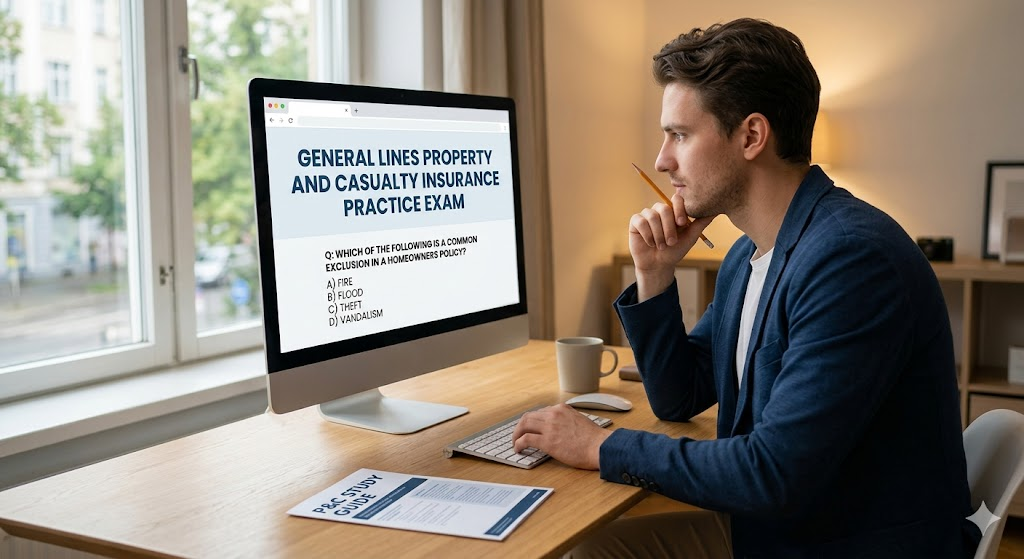
Additional Information
What the Course Entails and Exam Details
The material covered in the state pre-licensing courses and consequently, the licensing exam, covers a broad spectrum of P&C insurance principles and practices. The core syllabus generally encompasses the following areas:
Insurance Principles and Concepts: Standard definitions of risk, insurance contract components (offer, acceptance, consideration, etc.), policy types (commercial and personal), and legal concepts such as negligence.
Property Insurance Basics: An in-depth look at different types of properties (homeowners, commercial property), covered perils, standard forms, and unique coverages like flood or earthquake insurance.
Casualty Insurance Basics: Examination of liability concepts, including specific policy types such as commercial general liability (CGL), personal and commercial auto insurance, professional liability, and workers' compensation.
State-Specific Insurance Laws and Regulations: A critical component, this section covers the statutory regulations relevant to the state in which the license is sought, licensing requirements, ethical standards, and Department of Insurance oversight.
What to Expect in the Final Exam
While exact formats vary by state, the General Lines Property and Casualty Insurance Licensing Exam is predominantly structured as multiple-choice questions. It is a comprehensive, timed test administered by external testing vendors, ensuring a secure and regulated environment.
Here are the key details candidates should prepare for:
Exam Format: Entirely multiple-choice questions, which test both general knowledge and the application of P&C principles to realistic scenarios.
Passing Score: Requirements are state-specific, but candidates typically need to achieve a score in the range of 70% to 75% to pass.
Time Limits: The examination time is substantial, often ranging from 2 to 4 hours, depending on the complexity of the state's exam.
Rules: Stringent rules are enforced, including prohibited items and the mandatory provision of government-issued identification. Use of any external materials, electronic devices, or communication during the test is strictly forbidden. Practice exams are the best way to get ready for this environment.
How to Study and Exam Centers
Effectively preparing for the P&C exam requires a structured approach and consistent practice. The most successful candidates employ a variety of methods:
Practice Exams: Engaging in multiple full-length P&C practice exams is perhaps the single most effective study method. This builds test-taking stamina, familiarizes you with the question formats, and identifies specific knowledge gaps.
Complete the Pre-licensing Course: Thoroughly study the state-approved pre-licensing course material, which is often a legal prerequisite.
Review Wrong Answers and Rationales: After completing each practice test, dedicate time to analyzing every incorrect answer. Understand why your choice was wrong and the rationale behind the correct choice.
Use Supplemental Material: Textbooks, flashcards, and online tutorials are excellent for reinforcing core concepts.
Register and Take the Exam: The final licensing exam is administered at specialized physical testing centers. Candidates must typically register and pay for the exam through an official third-party administrator like Pearson VUE or Prometric. Your state's Department of Insurance will provide the specific information and vendor details on their website. Check with your state Department of Insurance for authorized testing locations and procedures.
Job Opportunities from the Course
Obtaining the General Lines Property and Casualty Insurance License opens up numerous career paths in the dynamic insurance and financial services sector. A range of job opportunities is available to licensed individuals:
Licensed Property and Casualty Insurance Agent: Selling P&C policies directly to consumers or businesses.
Claims Adjuster: Evaluating and settling insurance claims, often in specialized lines like auto or commercial property.
Underwriter: Assessing risk for potential policyholders and determining appropriate premiums.
Insurance Broker: An intermediary who helps clients find the best insurance coverage options across multiple companies.
Account Manager for a Commercial P&C Agency: Managing client accounts, processing renewals, and providing ongoing service.
Risk Manager: Identifying and mitigating risk for corporations or public entities.
Commercial Lines Specialist: Focusing specifically on insurance solutions for businesses, from small enterprises to large corporations.
Frequently Asked Questions
Reviews
5.0
Based on 0 reviews
Leave a Review
No reviews yet. Be the first to review!