
Generic Fitness for Duty & Behavioral Observation Training Practice Test
$69.00
- Buy to unlock unlimited access to all Quiz questions and Answers in this Quiz.
- After purchase you can print a PDF of the whole quiz at any point. The PDF will contain the questions and the correct answers.
About this Exam
This certification is designed to validate a professional’s ability to recognize and manage human performance factors that impact workplace safety.
A "Fitness for Duty" (FFD) program ensures that workers are physically and mentally capable of performing their job functions safely.
It is designed to detect impairment from fatigue, stress, substance use, or other health concerns.
This certification is ideal for supervisors, managers, HR professionals, and safety coordinators in high-risk, safety-sensitive industries like nuclear energy, aviation, chemical manufacturing, and heavy transportation.
Ready to test your knowledge?
Buy Now to Access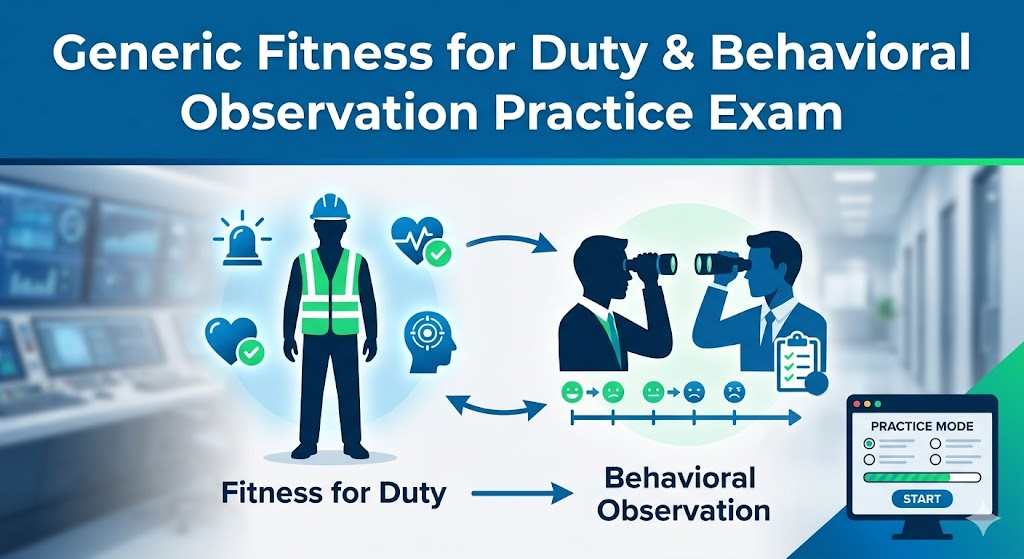
Additional Information
What the Course Entails and Exam Details
This training course provides the legal and practical framework for maintaining a safe and reliable workplace.
The primary goal of the syllabus is to teach you how to proactively identify human factors that increase risk.
You will cover mandatory elements, including:
The regulatory requirements of a Fitness for Duty program (e.g., DOT, FAA, or local equivalents).
How to detect physiological and behavioral indicators of impairment.
Techniques for managing fatigue, stress, and mental health in high-pressure environments.
Procedures for reasonable suspicion testing, cause testing, and follow-up.
Recognizing and preventing the impacts of illegal drug use and alcohol misuse.
What to Expect in the Final Exam
You must prepare for a comprehensive test of both your knowledge of regulatory standards and your ability to apply those standards to real-world workplace scenarios.
The exam is typically delivered in a computer-based format.
You should expect the final exam to feature between 50 and 80 multiple-choice and scenario-based questions.
You will typically have between 90 and 120 minutes to complete the exam.
To pass, you must demonstrate a deep understanding, with a required passing score that is usually 80% or higher.
Many exams for FFD certifications are "closed book," prohibiting external references.
How to Study and Exam Centers
The most effective study strategy for this exam combines strong conceptual understanding with consistent practice.
Start by thoroughly reviewing the core study materials, training guides, and regulatory regulations.
Your most powerful tool, however, will be a high-quality "Fitness for Duty & Behavioral Observation Training Practice Test."
Using this practice exam will help you:
Identify knowledge gaps.
Simulate the time pressure and difficulty of the real exam.
Get comfortable with the specific phrasing used in behavioral scenario questions.
To take the final certification exam, you will usually register through the authorized school or training provider that provided your coursework.
The exam itself is typically offered online via a secure testing portal.
In some cases, or for industry-specific certifications, the exam may also be proctored at physical testing centers, authorized schools, or professional association headquarters.
Job Opportunities from the Course
A certification in FFD and Behavioral Observation is a significant career differentiator.
It validates your competence in sophisticated workplace safety.
It opens doors to roles in industries where safety is paramount, including:
Site Supervisor / Safety Coordinator
High-Risk Work Environment Manager (e.g., for manufacturing, mining, or chemical plants)
Certified Safety Professional (CSP) specializing in FFD programs
Regulatory Compliance Officer for safety-sensitive industries
Fitness for Duty (FFD) Program Administrator
Substance Abuse Professional (SAP) support role (non-clinical)
Frequently Asked Questions
Reviews
5.0
Based on 0 reviews
Leave a Review
No reviews yet. Be the first to review!