
Generic Radiation Worker Training Practice Test
$69.00
- Buy to unlock unlimited access to all Quiz questions and Answers in this Quiz.
- After purchase you can print a PDF of the whole quiz at any point. The PDF will contain the questions and the correct answers.
About this Exam
The Generic Radiation Worker Training is a foundational safety program designed for individuals who will be working in environments where exposure to ionizing radiation is a potential occupational hazard. This essential training ensures that personnel understand the risks associated with radiation and are equipped with the knowledge and skills necessary to protect themselves, their colleagues, and the public. It is designed for a broad spectrum of workers, including laboratory technicians, industrial radiographers, nuclear power plant personnel, medical staff operating X-ray equipment, and research scientists. This training is often a mandatory prerequisite for accessing controlled areas and performing specific job functions involving radioactive materials or radiation-generating devices.
Ready to test your knowledge?
Buy Now to Access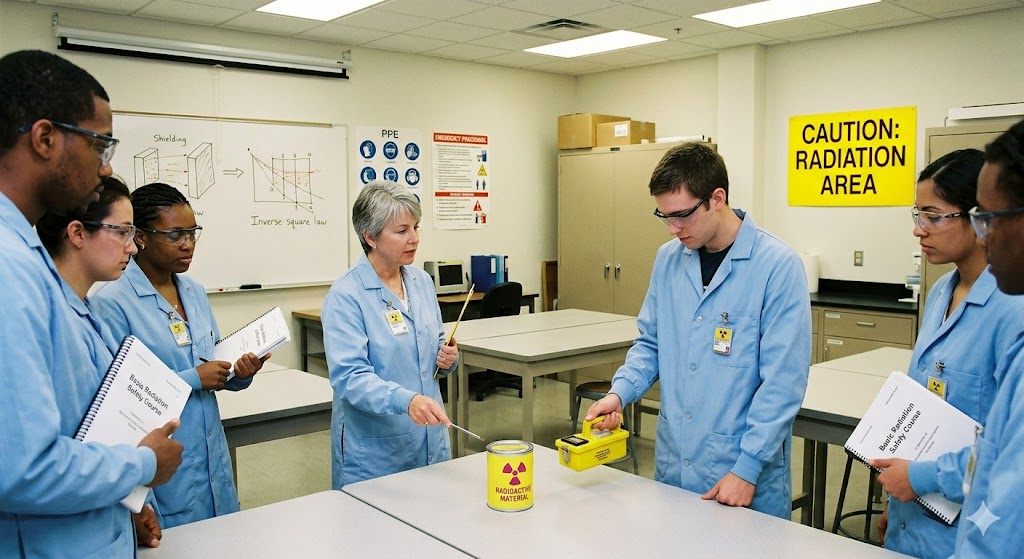
Additional Information
What the Course Entails and Exam Details
The comprehensive Radiation Worker Training course delves into the fundamental principles of radiation protection. The syllabus typically covers crucial topics, ensuring a well-rounded understanding of safety protocols.
Core curriculum areas often include:
Fundamentals of Radiation: Understanding the different types of ionizing radiation (alpha, beta, gamma, X-rays, neutrons), their sources, and properties.
Biological Effects: Learning how radiation interacts with living cells and potential health risks (both acute and chronic) associated with exposure.
Radiation Quantities and Units: Mastering the terminology and units used to measure radiation dose and activity (e.g., rem/sievert, curie/becquerel).
Radiation Protection Principles: Implementing the ALARA (As Low As Reasonably Achievable) concept through time, distance, and shielding strategies.
Contamination Control: Techniques for monitoring, preventing, and responding to the spread of radioactive contamination.
Personnel Dosimetry: The proper use and interpretation of dosimeters (e.g., TLDs, film badges) to track occupational exposure.
Regulations and Compliance: Understanding relevant regulatory requirements (e.g., NRC, OSHA, state regulations) and facility-specific safety procedures.
Emergency Response: Procedures to follow in the event of a radiation incident or emergency.
The specific exam details may vary depending on the certifying organization or employer, but candidates should expect a robust evaluation of these core competencies.
What to Expect in the Final Exam
The final examination is a critical step in verifying your comprehension of radiation safety protocols. It typically takes the form of a structured, proctored test.
Format: The exam predominantly consists of multiple-choice questions designed to assess factual knowledge, problem-solving abilities, and the application of safety principles to real-world scenarios. Some exams may incorporate true/false questions or short-answer components.
Passing Score: Organizations generally require a passing score of at least 70% to 80%, demonstrating a high level of proficiency in radiation safety.
Time Limit: Candidates are usually allotted a specific time frame, often ranging from 1 to 2 hours, to complete the examination.
Rules: The exam is strictly closed-book, prohibiting the use of outside materials, notes, or electronic devices unless otherwise specified (e.g., a simple calculator for dose calculations).
Upon successful completion of the training and examination, participants are typically issued a certificate of completion, often valid for a period of one to two years before retraining is required.
How to Study and Exam Centers
Achieving success on the Generic Radiation Worker Training exam requires dedicated preparation and strategic studying.
Proven Study Strategies:
Utilize Provided Materials: Thoroughly review the training manuals, lecture notes, and any handouts provided during the course. Pay close attention to definitions, formulas, and regulatory limits.
Practice with Purpose: Engage with practice questions and mock exams. This helps internalize information and identifies areas needing further review. Analyze incorrect answers to understand the underlying concepts.
Focus on ALARA: Revisit the core principles of Time, Distance, and Shielding, as these are fundamental to almost all radiation protection scenarios you will encounter.
Form Study Groups: Collaborating with peers can facilitate discussion, clarify complex topics, and enhance overall understanding.
Taking the Exam:
In-House Testing: For many employers, particularly in large facilities like hospitals, national labs, or nuclear power plants, the training and exam are administered directly by the organization's Radiation Safety Office (RSO) or training department.
Authorized Training Providers: Various private companies and educational institutions are authorized to deliver this training and administer the associated exams.
Online Portals: Many organizations now offer online modules for radiation worker training, followed by an online proctored exam. Verify that the online program meets the specific regulatory requirements for your jurisdiction or employer.
Always confirm the specific exam location and procedures with your supervisor or training coordinator.
Job Opportunities from the Course
Completing the Generic Radiation Worker Training is a crucial prerequisite that unlocks numerous career paths across diverse industries. This certification demonstrates a commitment to safety and compliance, making candidates highly attractive to employers.
This training is vital for roles such as:
Radiation Safety Technician / Health Physics Technician
Radiological Control Technician
Nuclear Medicine Technologist
Radiologic Technologist (X-ray, CT, Interventional)
Industrial Radiographer / NDT Inspector
Nuclear Power Plant Operator / Technician
Laboratory Technician (working with radioisotopes)
Environmental Health and Safety (EHS) Specialist
Research Scientist / Assistant (in physics, chemistry, biology, or medicine)
Well Logger (Oil and Gas Industry)
Irradiator Operator
By mastering the principles of radiation safety, you not only ensure your well-being but also position yourself for a rewarding and compliant career in a technical and vital field.
Frequently Asked Questions
Reviews
5.0
Based on 0 reviews
Leave a Review
No reviews yet. Be the first to review!