
Genetics Extensions of Mendelian Inheritance Practice Test
$69.00
- Buy to unlock unlimited access to all Quiz questions and Answers in this Quiz.
- After purchase you can print a PDF of the whole quiz at any point. The PDF will contain the questions and the correct answers.
About this Exam
The Genetics Extensions of Mendelian Inheritance Practice Exam is designed for students seeking a robust understanding of complex inheritance patterns that go beyond simple dominance. This self-assessment tool is ideal for undergraduate biology majors, pre-medical students, or individuals preparing for comprehensive genetics examinations.
Ready to test your knowledge?
Buy Now to Access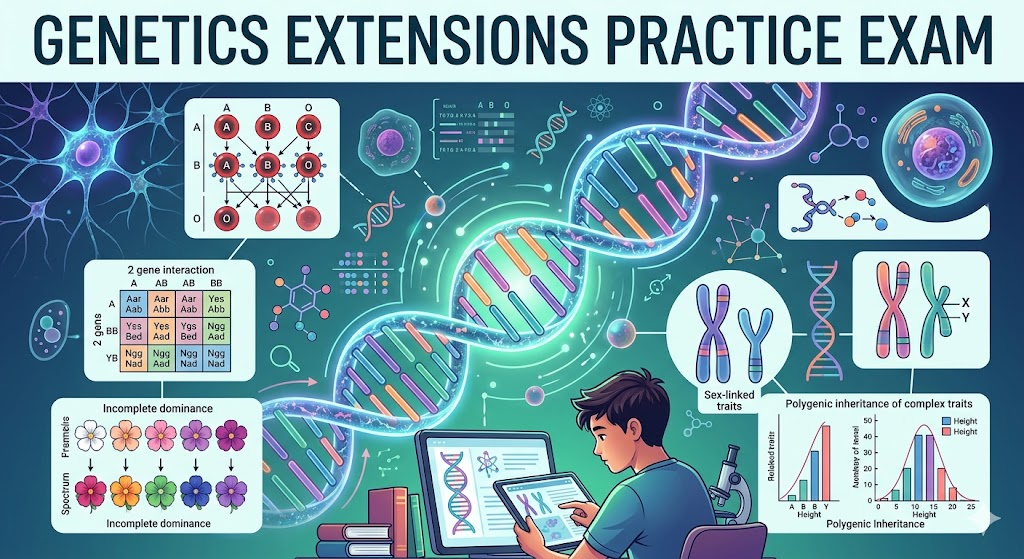
Additional Information
What the Course Entails and Exam Details
This practice test comprehensively covers the advanced concepts that refine and expand upon Gregor Mendel's initial laws. Students must demonstrate knowledge of multiple specific complex inheritance patterns. The assessment focuses on areas such as codominance (where both alleles are simultaneously expressed), incomplete dominance (which results in a blended phenotype), and multiple alleles (systems where more than two alleles exist for a gene, like human blood types). Furthermore, it evaluates understanding of epistasis (how one gene affects the expression of another), pleiotropy (a single gene affecting multiple traits), and polygenic inheritance (traits controlled by multiple genes, such as height and skin color). The practice exam also includes questions on sex-linked traits (including X and Y linkage), lethal alleles, and environmental effects on gene expression.
What to Expect in the Final Exam
The practice exam typically presents questions in a multiple-choice format, requiring the application of concepts to solve genetic problems and interpret data. You will encounter scenarios that test your ability to differentiate between various inheritance patterns and predict the outcomes of specific crosses. While this is a self-assessment tool and not a final, fixed-score exam, it is designed to mimic the difficulty and style of questions found in typical undergraduate genetics midterms or finals. Users should expect a test duration proportional to a real exam and can use their score percentage to gauge their readiness for a comprehensive final assessment.
How to Study and Exam Centers
To prepare effectively, start by thoroughly reviewing standard Mendelian genetics and key extensions such as incomplete dominance, epistasis, and sex linkage. Utilize textbooks, online resources, and problem sets to practice constructing and analyzing complex Punnett squares and pedigrees. Pay close attention to definitions of core concepts. As you approach the practice exam, simulate testing conditions by setting a timer. After completing the test, carefully review not just the correct answers, but also the detailed rationales for why alternative choices are incorrect. This focused approach highlights knowledge gaps. As this specific product is a practice test, it is accessed exclusively online via educational platforms, rather than through physical exam centers or standardized testing networks like Pearson VUE.
Job Opportunities from the Course
Proficiency in these genetics extensions forms the foundation for many diverse and expanding fields. Mastery of these concepts is essential for specific career paths. While a single practice test is only a stepping stone, completing a comprehensive genetics curriculum unlocks several professional roles. Relevant job opportunities and career paths include:
Genetic Counselor.
Clinical Laboratory Scientist with a focus on Molecular Genetics.
Biotechnology Researcher or Research Assistant.
Bioinformatics Analyst.
Medical Scientist specializing in translational genetics or oncology.
Science Educator or Professor in Biology and Genetics.
Forensic DNA Analyst.
Public Health Geneticist.
Agricultural and Food Scientist specializing in plant breeding and genetics.
Frequently Asked Questions
Reviews
5.0
Based on 0 reviews
Leave a Review
No reviews yet. Be the first to review!