
Geo Reviewer Surface Water Practice Exam
$69.00
- Buy to unlock unlimited access to all Quiz questions and Answers in this Quiz.
- After purchase you can print a PDF of the whole quiz at any point. The PDF will contain the questions and the correct answers.
About this Exam
The Geo Reviewer Surface Water Practice Exam is a crucial tool designed for professionals and students aspiring to specialize in hydrology, environmental science, and geospatial analysis. This practice test is specifically engineered to prepare candidates for the comprehensive [Geo Reviewer Surface Water Certification], validating expertise in surface water systems, data interpretation, and regulatory compliance. It is ideal for environmental scientists, geologists, civil engineers, and GIS specialists looking to enhance their credentials and demonstrate practical proficiency in managing and analyzing surface water resources. By simulating the actual exam environment, this practice guide helps identify knowledge gaps and build the confidence necessary to achieve certification.
Ready to test your knowledge?
Buy Now to Access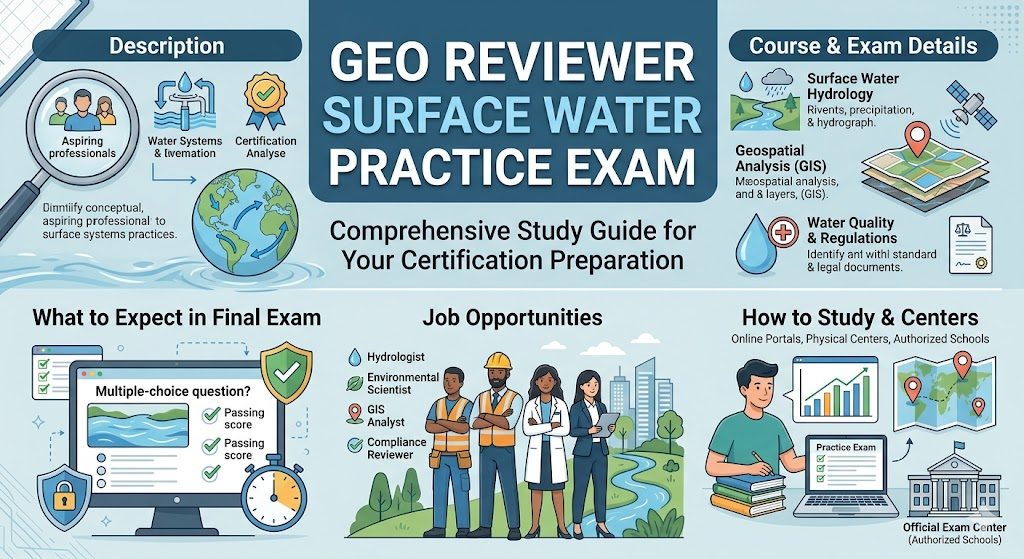
Additional Information
What the Course Entails and Exam Details
This practice exam covers the essential knowledge areas and technical skills required for effective surface water analysis and review. While specific course content may vary depending on the provider, the practice exam generally includes topics such as:
Principles of Surface Water Hydrology: Understanding the hydrological cycle, watershed characteristics, and the flow of water across land surfaces.
Data Acquisition and Analysis: Techniques for collecting and interpreting hydrological data, including streamflow measurements and water quality sampling.
Geospatial Tools in Hydrology: Utilizing Geographic Information Systems (GIS) and remote sensing for mapping watersheds, analyzing drainage patterns, and modeling surface water flow.
Water Quality Standards and Monitoring: Familiarity with parameters used to assess water health, pollutants affecting surface water, and monitoring methodologies.
Regulatory Frameworks: Key environmental laws and regulations governing surface water management, including the Clean Water Act and local ordinances.
Best Management Practices (BMPs): Strategies for controlling erosion, managing stormwater runoff, and protecting surface water quality.
What to Expect in the Final Exam
When you move from this practice test to the actual certification exam, you can expect a rigorous assessment of your knowledge. The final exam typically follows a structured format:
Question Format: The exam usually consists of multiple-choice questions designed to test both conceptual understanding and practical application. Some exams may also include scenario-based questions or case studies requiring data interpretation.
Passing Score: The passing score is generally set around 70-75%, although this can vary by certifying body. It is essential to aim for a high level of proficiency in all subject areas.
Time Limit: Candidates are typically allotted a specific time frame, often between 2 to 3 hours, to complete the exam. Time management is critical.
Exam Rules: The actual exam is proctored, whether taken online or at a testing center. Standard academic integrity rules apply, and unauthorized materials are strictly prohibited.
How to Study and Exam Centers
Preparation is the key to passing any professional certification. Here are effective strategies for using this practice exam and studying for the final test:
Actionable Study Strategies:
Simulate the Exam Environment: When taking this practice test, do so under exam-like conditions. Set a timer, sit in a quiet room, and avoid checking your notes. This helps build stamina and improves time management.
Analyze Your Results: Carefully review the questions you got wrong on the practice exam. Don't just look for the correct answer; understand why the correct answer is right and why your choice was incorrect. This highlights specific areas needing more focus.
Cross-Reference with Study Materials: Use textbooks, online courses, and official study guides to reinforce the topics covered in the practice exam. This broadens your understanding and prepares you for varied question formats.
Focus on Practical Application: Surface water analysis is a practical field. Practice using GIS software if the exam includes geospatial components, and ensure you can interpret hydrological data charts and maps effectively.
Form Study Groups: Collaborating with peers can provide new insights and help clarify complex concepts.
Exam Centers and Access:
The final certification exam can usually be accessed in multiple ways, depending on the certifying organization:
Online Portals: Many certifications are now offered online through secure, proctored platforms. This allows you to take the exam from your own home or office, provided you meet the technical requirements (e.g., webcam, stable internet connection).
Physical Testing Centers: Some organizations partner with established testing networks like Pearson VUE or Prometric. These centers provide a controlled environment for taking the exam in person at various locations worldwide.
Authorized Schools and Organizations: In some cases, specific universities or professional organizations are authorized to administer the exam to their students or members.
Be sure to check the specific requirements and available options provided by your certifying body well in advance.
Job Opportunities from the Course
Earning the Geo Reviewer Surface Water Certification can significantly enhance your career prospects in the environmental and engineering sectors. This credential unlocks numerous opportunities, including:
Hydrologist: Analyzing the distribution, circulation, and physical properties of surface water.
Environmental Scientist: Conducting research and investigations to identify, minimize, or eliminate sources of pollutants affecting surface water.
GIS Analyst (Water Resources): Using geospatial data to map watersheds, analyze water flow patterns, and support water management decisions.
Civil Engineer (Water Resources): Designing infrastructure projects related to water supply, flood control, and wastewater treatment.
Water Quality Specialist: Monitoring and assessing the chemical, physical, and biological characteristics of surface water to ensure compliance with standards.
Environmental Consultant: Advising clients on regulatory compliance, permitting, and best practices for surface water management.
Natural Resource Manager: Overseeing the conservation and sustainable use of surface water resources for government agencies or non-profit organizations.
This guide provides the foundation you need to prepare effectively. Utilize the practice exam as a cornerstone of your study plan, and you will be well-equipped to achieve your certification and advance your career in surface water management.
Frequently Asked Questions
Reviews
5.0
Based on 0 reviews
Leave a Review
No reviews yet. Be the first to review!