
Geodetic Engineers Pre-board Practice Test
$69.00
- Buy to unlock unlimited access to all Quiz questions and Answers in this Quiz.
- After purchase you can print a PDF of the whole quiz at any point. The PDF will contain the questions and the correct answers.
About this Exam
Are you an aspiring geodetic engineer preparing for your licensure exam?
The Geodetic Engineer Pre-board Practice Exam is your essential stepping stone to success.
This comprehensive practice test is meticulously designed for individuals gearing up for the official licensure examination.
It offers a realistic simulation, allowing candidates to assess their knowledge, identify areas for improvement, and build the confidence needed to conquer the final hurdle.
Ready to test your knowledge?
Buy Now to Access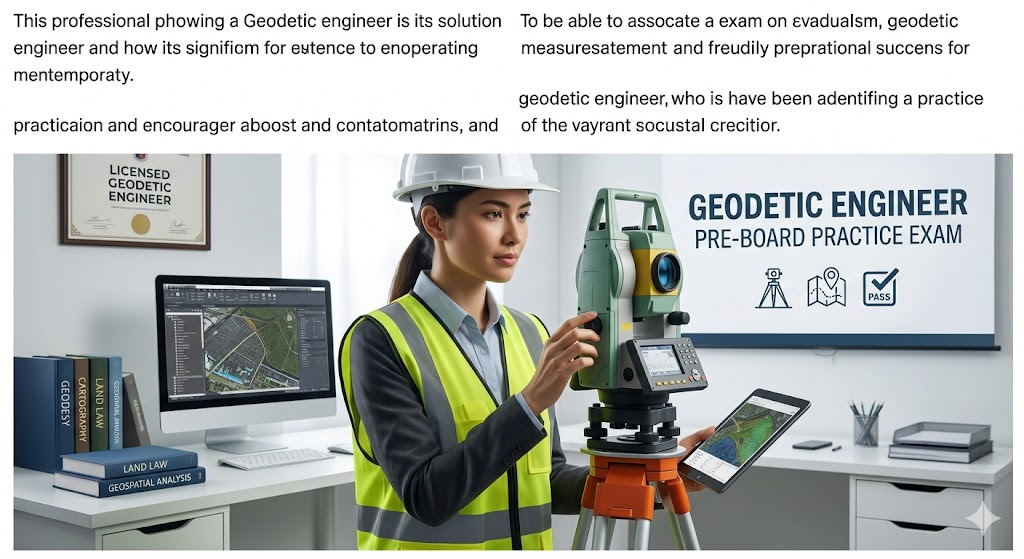
Additional Information
What the Course Entails and Exam Details
This comprehensive practice exam rigorously evaluates your understanding of the foundational and advanced concepts essential for geodetic engineering professionals.
Key domains typically covered include: Advanced Geodesy and Geodetic Astronomy; Cartography, Map Projections, and Mapping Standards; Surveying Principles and Methodologies (including Topographic, Hydrographic, Engineering, and Cadastral Surveys); Photogrammetry and Remote Sensing Techniques and Applications; Geographic Information Systems (GIS) and Spatial Data Analysis; Land Laws, Property Registration, and Professional Ethics; and Applied Mathematics for Engineering and Surveying.
The practice test mirrors the breadth of the actual syllabus to ensure thorough preparation across all critical areas.
What to Expect in the Final Exam
Candidates taking the actual Geodetic Engineer Licensure Exam can typically anticipate a multi-day testing experience consisting primarily of multiple-choice questions designed to assess theoretical knowledge.
The exact passing score requirements and total time allowed fluctuate significantly by region and jurisdiction, often requiring achieving percentages in individual subjects as well as an overall percentage (e.g., perhaps around 70-75% total, with no score below a certain point in individual sections).
For precise details, you must consult the official licensing board website for your specific location.
Strict adherence to exam rules, including permitted calculator models and standard prohibited items, is always mandatory to ensure fairness and integrity.
How to Study and Exam Centers
To maximize your chances of success on both the practice test and the actual licensure exam, consistent and structured study is paramount.
Actively engage with comprehensive review materials, focusing deeply on the topics outlined above.
Utilize flashcards for formulas, definitions, and key concepts, and work through numerous problems.
Crucially, practice under simulated exam conditions: time yourself, create a quiet space free from distractions, and use only approved resources.
Review your practice test performance meticulously, analyzing both correct and incorrect answers to pinpoint areas for targeted improvement.
Dedicate significant effort to multiple practice iterations to refine your exam-taking strategy and speed.
Regarding the official licensure exam, delivery methods vary, typically including secure computer-based testing via authorized centers globally (like Pearson VUE or Prometric) or potentially designated physical locations organized by local licensing authorities.
Always verify the specific testing centers and registration processes with your jurisdiction's engineering board.
Job Opportunities from the Course
Successfully passing your licensure exam and becoming a registered Geodetic Engineer unlocks a multitude of fulfilling career opportunities in various fields.
With this qualification, you can pursue diverse roles such as:
Geodetic Engineer / Licensed Surveyor
Geospatial Data Analyst
GIS (Geographic Information Systems) Manager
Cartographer
Hydrographic Surveyor
Remote Sensing and Photogrammetry Specialist
Construction / Engineering Surveyor
Land Administration Officer
Urban and Regional Planner (with geospatial expertise)
Mining Surveyor
Environmental Scientist (focused on mapping and data analysis)
University Lecturer or Researcher in Geomatics
Frequently Asked Questions
Reviews
5.0
Based on 0 reviews
Leave a Review
No reviews yet. Be the first to review!