
Geography Bee – United States Geography Practice Test
$69.00
- Buy to unlock unlimited access to all Quiz questions and Answers in this Quiz.
- After purchase you can print a PDF of the whole quiz at any point. The PDF will contain the questions and the correct answers.
About this Exam
The US Geography Bee Practice Exam is a dynamic study tool meticulously designed for K-12 students preparing for competitive geography bees, specifically focusing on the rich and diverse landscape of the United States. Preparing for such a competition is a challenging yet rewarding experience, demanding dedication and a deep understanding of our country's physical and political features. This practice exam provides an excellent opportunity to test and expand a student's knowledge across all aspects of US geography, including states, capitals, major physical features, diverse cultures, and historical context. It is designed to mirror the style and depth of questions found in official bees, helping young geographers build crucial knowledge, improve speed, and gain the confidence necessary to succeed. Whether aiming for school-level success or a place in regional or national competitions, this practice exam is a foundational step on the journey.
Ready to test your knowledge?
Buy Now to Access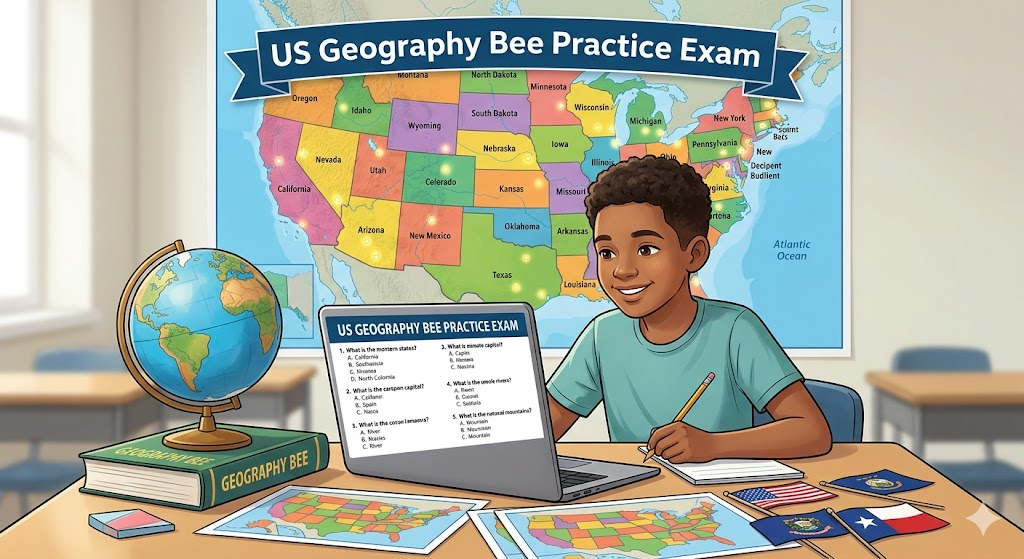
Additional Information
What the Course Entails and Exam Details
This comprehensive practice tool covers a broad and engaging array of US geographical topics, ensuring a well-rounded and detailed understanding. While the specific number of questions can vary by the exact version of the practice material, students can expect diverse questions across several key areas:
All 50 US States & Capitals: A fundamental component, testing recall and recognition of every state and its seat of government.
Major Cities & Landmarks: Questions identify prominent American cities, their locations, and significant natural and man-made landmarks.
Physical Geography: In-depth coverage of major mountain ranges (e.g., Rockies, Appalachians), rivers (e.g., Mississippi, Colorado), lakes (the Great Lakes), deserts, and other distinct physical features.
US Territories: Knowledge of United States territories like Puerto Rico, Guam, and the US Virgin Islands.
Historical & Cultural Context: Many questions connect geographical locations to key historical events or unique cultural aspects of different regions.
Regional Diversity: An understanding of the distinct regions of the US (e.g., Northeast, South, Midwest, West) and their varying characteristics.
The practice exam typically employs a variety of question formats often found in geography bees, such as multiple choice, matching, map identification (pointing to states, rivers, etc.), and potentially short written responses. It aims to develop a holistic spatial awareness and a detailed knowledge base rather than just memorization.
What to Expect in the Final Exam
It is important to understand that the US Geography Bee Practice Exam is a preparatory tool, and the "final exam" refers to the actual competition. Actual geography bees can have specific, slightly varying formats, but general expectations include:
Multiple Rounds: Competitions often proceed through preliminary rounds (which may be written or oral multiple choice), leading to state, regional, or national finals.
Written & Oral Questions: Questions can be posed orally, requiring quick, confident spoken answers, or in written formats, sometimes with visual aids.
Time Limits: Speed is a key factor in many bees. Questions typically have a response limit, ranging from 15 to 30 seconds, encouraging rapid recall.
Point System & Elimination: Points are awarded for correct answers, and in later rounds, a wrong answer can lead to elimination. The competition intensifies at higher levels.
Strict Rules: No external help is permitted. Contestants must strictly follow the moderators' instructions and competition rules. Specific requirements like spelling might also apply in certain situations.
Progressive Difficulty: Questions get progressively harder as the competition advances, moving from general knowledge to more detailed, obscure facts.
How to Study and Exam Centers
Studying effectively for the US Geography Bee requires consistent effort and a diverse set of methods. The US Geography Bee Practice Exam is an invaluable resource in this process, but it should be supplemented by other approaches:
Map Study is Key: Dedicate time every day to examining detailed maps of the United States. Learn the relative locations of states, major rivers, and landforms. Practice with blank maps, labeling states and features by hand.
Flashcards: Use digital or physical flashcards for states and capitals, major cities, and key facts. Online platforms like Quizlet often have pre-made sets.
Read Broadly: Explore children's books, encyclopedias, and news articles focused on US geography and history. The official National Geographic Bee study guide (while for a discontinued specific bee) can offer structure and tips.
Take Timed Practice Tests: Regularly use resources like this practice exam and others found on educational sites or provided by competition organizers. Mimic the pressure of a competition by timing your answers.
Educational Apps & Websites: Explore interactive geography apps and websites designed for students, offering quizzes, games, and map challenges. Seterra, Kahoot, and other geography platforms can make learning interactive and fun.
Explore & Travel (Virtually): Use online mapping tools (like Google Earth) to virtually visit and explore locations you are studying. This brings geography to life.
Exam Centers: The US Geography Bee Practice Exam itself is typically accessed online through various educational platforms, school programs, or can be downloaded as printable material. The actual geography bee competition structure is as follows:
School Rounds: These are held within the student's own school, often organized by teachers or school coordinators.
State & Regional Competitions: These organized events for qualified students from different schools are usually held at designated centers, such as university campuses, school districts, or specific event spaces. The competition coordinators provide details about these locations to qualifying students and schools.
National Level: For competitions that have a national championship, these are held in a specific host city at a significant event center, organized by the national body. Specific logistics and locations are provided well in advance.
Details about the exact locations, times, and qualifying procedures for any official competition are always provided by the competition organizers.
Job Opportunities from the Course
While participating in a geography bee is primarily an educational experience for students, the skills and knowledge developed can build a strong foundation for various future career paths. Early success can spark a lifelong interest in geography, spatial analysis, and global cultures. While this list is illustrative of general potential long-term careers and not an immediate job opportunity for a child, here are some fields and specific job titles that geography skills can help unlock:
Geographer: Directly uses the core skills and knowledge to study the Earth's lands, features, inhabitants, and phenomena.
Cartographer: Specializes in the art and science of creating and analyzing maps.
GIS (Geographic Information Systems) Specialist: Uses technology to gather, manage, analyze, and map spatial data for various purposes, from urban planning to environmental conservation.
Urban/Regional Planner: Develops plans for land use in cities, suburbs, and rural areas, incorporating knowledge of geographic patterns and resource management.
Environmental Consultant: Assesses environmental issues and recommends sustainable solutions, requiring understanding of physical geography and ecosystem interactions.
International Relations Specialist: Applies knowledge of global geography, culture, and demographics to analyze and manage relations between countries.
Tourism & Travel Professional: Guides, travel writers, and tourism development officers leverage extensive geographical and cultural knowledge.
Historian (with a Geographical focus): Explores how geography has shaped historical events.
Educational Publisher: Works on creating geography textbooks, digital learning resources, and educational materials.
Geoinformatics professional: Integrates geography with computer science for diverse applications.
Roles in Journalism or Government Agencies (e.g., State Department, Intelligence Agencies, Census Bureau): Jobs requiring detailed geographical analysis, regional knowledge, or demographic interpretation.
Remember that this competition is a stepping stone. A passionate geographer can follow many paths to an impactful and rewarding career, and early achievements provide an exceptional base.
Frequently Asked Questions
Reviews
5.0
Based on 0 reviews
Leave a Review
No reviews yet. Be the first to review!