
Georgia Certified Beekeeper Practice Exam
$69.00
- Buy to unlock unlimited access to all Quiz questions and Answers in this Quiz.
- After purchase you can print a PDF of the whole quiz at any point. The PDF will contain the questions and the correct answers.
About this Exam
The Georgia Certified Beekeeper certification is the vital first step in the prestigious Georgia Master Beekeeper Program, a multi-level educational series administered by the University of Georgia (UGA) Bee Program. This entry-level certification is designed for individual beekeepers who want to validate their fundamental knowledge and practical skills. It is perfect for competent hobby beekeepers, serious sideline beekeepers, and aspiring industry leaders who have completed at least one full year of hands-on beekeeping experience. Earning this certification demonstrates to the public, local associations, and potential employers that you possess the core competencies required to manage a colony safely, ethically, and effectively.
Ready to test your knowledge?
Buy Now to Access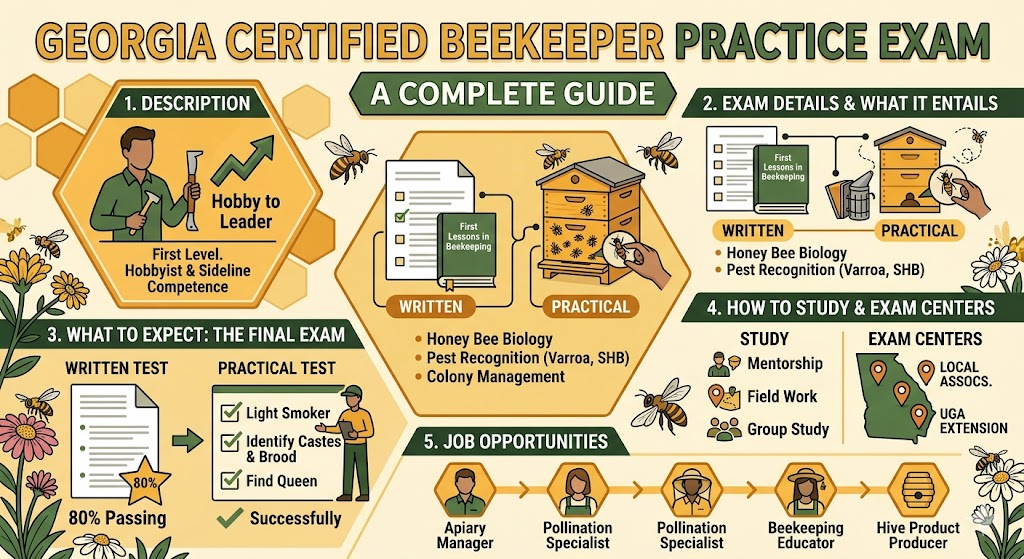
Additional Information
What the Course Entails and Exam Details
The pathway to becoming a Georgia Certified Beekeeper is not a traditional "course" with a fixed curriculum, but rather a self-guided journey supported by official study resources and verified by a rigorous two-part examination. To sit for the exam, candidates must first meet the prerequisite of having one year of practical beekeeping experience. The exam tests a comprehensive understanding of foundational apiculture. While there is no mandatory class, candidates are encouraged to study the core textbook, "First Lessons in Beekeeping," and utilize the official study guides provided by the UGA Bee Program.
Core topics covered in the syllabus and tested in the exam include:
Honey Bee Biology: Understanding the life cycle, developmental stages of the three castes (worker, drone, queen), and the fundamental anatomy and physiology of honey bees.
Colony Management: Mastering basic hive manipulation techniques, lighting and properly using a smoker, and recognizing the functions of propolis and the layout of a brood nest (placement of honey, pollen, and brood).
Pest and Disease Recognition: Identifying common disorders and pests, such as Varroa mites, Small Hive Beetles, American Foulbrood (AFB), and European Foulbrood (EFB).
Equipment: Describing the components of a modern beehive.
Pollinator Conservation: Demonstrating an understanding of basics of pollinator conservation, including identifying common native Georgia plants that attract pollinators.
What to Expect in the Final Exam
The final exam is a structured evaluation that tests both theoretical knowledge and hands-on proficiency. Candidates must pass both components to receive their certification. The exam is divided into two sections:
Written Examination: This part of the test consists of multiple-choice or short-answer questions. The content is drawn directly from the text "First Lessons in Beekeeping" and official study materials. It assesses your understanding of biology, behavior, and management practices.
Practical Examination: This is a hands-on field test conducted in an active apiary. You will be observed and evaluated on your ability to perform essential beekeeping tasks. A passing score on the visual diagnostics section is particularly crucial.
During the practical exam, you must be prepared to:
Describe all parts of a standard beehive.
Light and use a smoker correctly.
Manipulate frames without excessive agitation.
Find the queen or describe her appearance and likely location.
Distinguish between the different castes of bees and stages of brood.
Differentiate between brood, pollen, and capped honey.
Visually recognize common diseases and pests, such as Varroa, SHB, and wax moth larvae.
How to Study and Exam Centers
Preparation is key to succeeding in the Georgia Certified Beekeeper Exam. A blend of study and hands-on practice is highly recommended.
Study Strategies:
Master the Core Text: Read and thoroughly understand "First Lessons in Beekeeping." It is the definitive source for the written exam.
Utilize UGA Study Guides: Access and work through the official study guides available on the UGA Bee Program website.
Hands-on Field Work: The one-year experience prerequisite is foundational. Use your apiary time to practice the skills listed in the practical exam requirements. Practice finding the queen and identifying brood stages regularly.
Join a Local Association: Connect with a local Georgia beekeeping association. Many offer mentorship, host study groups, or conduct field days specifically designed to help members prepare for the Certified level.
Exam Centers and Locations: The Georgia Certified Beekeeper exams are typically hosted and proctored by authorized local beekeeping associations in partnership with the UGA Extension service. Testing occurs at various physical locations throughout the state, such as local UGA Extension offices or dedicated "Bee Barns." These are not offered at commercial testing centers like Pearson VUE. Candidates must register and prepay in advance for a specific testing date and location. Dates and registration details are announced periodically by the hosting local associations and are often listed on the central UGA Master Beekeeper Program website.
Job Opportunities from the Course
Earning the Georgia Certified Beekeeper designation unlocks a range of unique job titles and career paths. While many become certified to improve their own operations or to serve as recognized ambassadors for the industry, this credential can be a strong asset for diverse roles.
Specific job titles and career paths this certification can unlock include:
Apiary Manager (Small to Mid-Scale)
Sideline Beekeeper / Honey Producer
Crop Pollination Specialist
Agricultural Extension Agent (Beekeeping Specialist)
Beekeeping Educator or Mentor
Honey and Hive Products Retailer
Pollinator Habitat Restoration Technician
Zoo Beekeeper / Exhibit Curator
Commercial Apiary Technician
Bee Swarm Removal Technician
This certification validates your core competencies, making you a more effective beekeeper and a more credible expert in the field of apiculture. Good luck with your studies and your journey into professional beekeeping.
Frequently Asked Questions
Reviews
5.0
Based on 0 reviews
Leave a Review
No reviews yet. Be the first to review!