
Georgia DMV Permit Practice Test
$69.00
- Buy to unlock unlimited access to all Quiz questions and Answers in this Quiz.
- After purchase you can print a PDF of the whole quiz at any point. The PDF will contain the questions and the correct answers.
About this Exam
The Georgia DDS (Department of Driver Services) Knowledge Exam, commonly referred to as the DMV permit test, is the essential first step for new drivers in the state of Georgia to obtain their learner's permit. This exam is designed for individuals of various ages, but most commonly teenagers (15 and older) who are ready to begin their journey towards a full driver's license. The primary purpose of this test is to ensure that prospective drivers have a solid understanding of Georgia's road rules, traffic signs, signals, and pavement markings, all of which are crucial for safe and responsible driving. Passing this knowledge exam allows applicants to receive their Class CP Instructional Permit and begin behind-the-wheel practice under supervision.
Ready to test your knowledge?
Buy Now to Access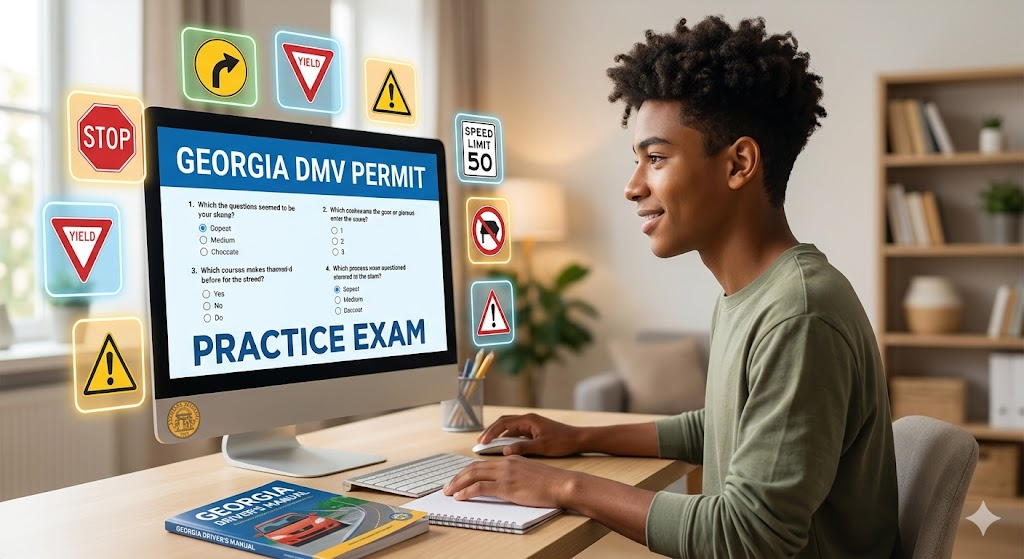
Additional Information
What the Course Entails and Exam Details
While there isn’t a specific "course" for the practice test itself, the comprehensive range of topics you must master is covered in the official Georgia Driver’s Manual.
The exam content is split into two primary areas:
Road Signs:
This section tests your ability to identify and understand a wide variety of standard road signs, including warning signs, regulatory signs, guide signs, and the significance of different sign shapes and colors. You must demonstrate that you know what each sign means and how to respond to it correctly on the road.
Road Rules:
This comprehensive section covers the fundamental principles of safe and legal driving in Georgia. It includes topics such as right-of-way rules (especially at intersections and for pedestrians), lane usage, parking regulations, proper use of signals, safety belts and child restraint laws, blood alcohol limits, and general safe driving practices under various conditions.
Your preparation with a practice exam ensures you are familiar with the type of questions you will face in both of these critical categories. The practice test will present you with scenario-based questions that challenge your knowledge and judgment.
What to Expect in the Final Exam
The official Georgia DDS Knowledge Exam is a computer-based, multiple-choice test. Here are the key details you can expect:
Format: The exam consists of two separate tests: Road Rules and Road Signs. Both sections are multiple-choice, with questions drawn directly from the Georgia Driver’s Manual.
Question Count: You will typically be asked 20 questions in the Road Rules section and 20 questions in the Road Signs section, totaling 40 questions for the complete knowledge exam.
Passing Score: To pass the overall knowledge exam, you must achieve a score of at least 75% on each section independently. This means you need to correctly answer a minimum of 15 out of 20 questions on the Road Rules test AND 15 out of 20 questions on the Road Signs test. Failing to meet the minimum score on either single section will result in failing the entire exam, even if you did very well on the other.
Time Limits: While there is no official, strict time limit for completing the knowledge exam, candidates are generally given a reasonable amount of time to read and answer each question. It’s always best to arrive with plenty of time.
Prerequisites & Rules: Before you can take the knowledge exam, you must first pass a visual acuity test. You will not be allowed to use any study materials, including the driver’s manual, during the exam itself. Assistance from others is also prohibited. You must bring acceptable identification and complete any required documentation (like a vision report, if necessary).
Retakes: If you do not pass, you are eligible to retake the test. For the first failure, you can typically retake it the next business day, depending on location and available appointments. For subsequent failures, there may be a 7-day waiting period.
How to Study and Exam Centers
To ensure you are fully prepared to ace the Georgia permit test on your first attempt, follow these actionable study strategies:
Read the Georgia Driver’s Manual Thoroughly: This is your primary resource. The entire test is based on the information contained in this manual. Read it multiple times, pay attention to the details, and make sure you understand the 'why' behind each rule and sign. A physical copy or a PDF version is available from the Georgia DDS.
Use Comprehensive Practice Exams Multiple Times: Leverage online resources and practice test platforms designed specifically for the Georgia DMV permit test. These practice exams are structured similarly to the official test and are populated with questions that closely mimic the real thing. Taking multiple versions will expose you to a wider variety of questions and scenarios. After each practice session, carefully review your incorrect answers and go back to the manual to study those specific topics. Aim to consistently get 90% or higher on practice tests to build your confidence and ensure a safe passing margin for the real exam.
Focus on Troublesome Topics: Analyze which types of questions consistently trip you up. Is it right-of-way, blood alcohol limits, or specific warning signs? Dedicate extra study time to these areas until you have a firm grasp on the rules.
Create Flashcards for Road Signs: This is an excellent way to memorize the meanings of all the signs. Use visuals on one side and the definition or rule on the other. Quizzing yourself regularly is a fast and effective way to ensure sign recognition.
Practice Active Learning: Don’t just read the manual passively. Take notes, draw diagrams, explain rules out loud to yourself, or discuss them with a friend or family member.
The actual knowledge exam must be taken in person at a Georgia Department of Driver Services (DDS) Customer Service Center. You can find a complete list of DDS locations throughout Georgia on their official website. With convenient centers in major cities like Atlanta, Savannah, Augusta, Columbus, and many other locations, you can likely find a testing site near you. Many DDS locations allow you to schedule an appointment online for services like the knowledge exam, which can significantly reduce your wait time. Walk-ins are also an option at some locations, but check their specific policies before visiting.
Job Opportunities from the Course
While a learner’s permit itself does not directly open professional driving positions, it is the critical first step that unlocks numerous job opportunities requiring a valid driver's license in the future. Obtaining your learner’s permit and then continuing the process to secure your full license allows you to pursue careers such as:
Delivery Driver: (Food, groceries, packages, etc., once fully licensed and often over 18/21 depending on the company)
Ride-Share Driver: (For platforms like Uber, Lyft – requires a full license and often has age minimums and background checks)
Sales Representative: (Many roles involve significant travel between clients)
General Transportation & Logistics Roles: (Jobs involving moving materials or people within a defined area)
Step Toward CDL (Commercial Driver's License): Successfully obtaining your class C license is a prerequisite for many professional commercial driving jobs. This includes heavy truck driving (CDL Class A), bus driving (CDL Class B), and passenger transport (CDL Class C).
Achieving your permit is the prerequisite for all these future career paths. We wish you the best of luck with your Georgia DMV permit preparation! Stay focused, practice consistently, and you will be on the road to success.
Frequently Asked Questions
Reviews
5.0
Based on 0 reviews
Leave a Review
No reviews yet. Be the first to review!