
Georgia Road Rules Practice Test
$69.00
- Buy to unlock unlimited access to all Quiz questions and Answers in this Quiz.
- After purchase you can print a PDF of the whole quiz at any point. The PDF will contain the questions and the correct answers.
About this Exam
The Georgia Road Rules Practice Test is an essential study tool designed for anyone preparing to take the official Georgia Department of Driver Services (DDS) knowledge exam. This exam is a mandatory step for obtaining a Georgia learner’s permit or a Class C driver's license. The practice test, and the official exam it replicates, evaluates a potential driver's understanding of traffic laws, road safety regulations, and the responsibilities that come with operating a motor vehicle on Georgia roads. It is specifically tailored for first-time drivers, new residents transferring a license, and individuals looking to refresh their knowledge before a renewal or reinstatement.
Ready to test your knowledge?
Buy Now to Access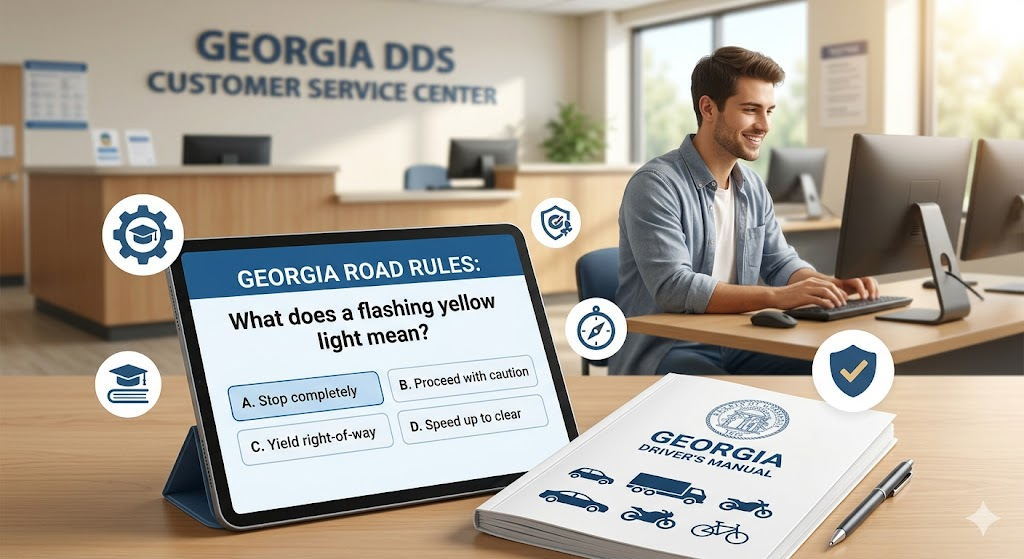
Additional Information
What the Course Entails and Exam Details
The foundation for this exam is the official Georgia Driver's Manual. The core knowledge exam is actually comprised of two distinct, equally important components:
Road Signs Test: This section assesses your ability to identify and interpret standard highway signs, signals, and pavement markers. You must demonstrate an understanding of sign shapes (e.g., octagon for stop, triangle for yield) and colors, which convey specific types of information.
Road Rules Test: This section covers a wide range of legal and practical aspects of driving. Key topics include:
Right-of-way rules at various intersections and situations.
Speed limits, including absolute, prima facie, and specific rules for school and work zones.
Traffic control signals and lane markings.
Safe driving practices, such as proper following distances, changing lanes, and navigating curves.
Georgia-specific laws regarding DUI (driving under the influence), distracted driving (hands-free law), and littering.
Procedures for sharing the road with other users, including pedestrians, bicycles, motorcycles, and large commercial vehicles.
Rules for seatbelt and child safety restraint usage.
What to Expect in the Final Exam
When you arrive at the Georgia DDS for your official knowledge exam, here is what you should expect:
Format: The official Georgia knowledge exam is administered via a computer and consists of multiple-choice questions.
Structure: The test is split into two separate 20-question sections. One section focuses exclusively on Road Signs, and the other section focuses on Road Rules.
Passing Score: To pass, you must correctly answer at least 15 out of 20 questions (75%) in each section. Note that these are treated as separate sub-tests; failing one section means you fail the entire knowledge exam, regardless of how well you scored on the other section.
Time Limits: While there is no official, rigid time limit to complete the test once you start, all applicants must begin their test at least 30 minutes before the Customer Service Center’s scheduled closing time. This ensures you have adequate time to read and answer every question.
Language and Specific Rules: The Road Rules test is available in several non-English languages; however, the Road Signs test and the behind-the-wheel driving test are conducted in English only. Be aware that no outside aid—such as phones, notes, or talking to other test-takers—is permitted during the examination. A mandatory vision screening must be passed prior to taking the written exam.
How to Study and Exam Centers
Effective preparation is the key to success. Use these actionable strategies to master the material:
The Driver’s Manual is Your Textbook: Start by thoroughly reading the latest version of the Georgia Driver’s Manual, which can be found online at the Georgia DDS website or as a physical copy.
Take the Official Practice Test: The Georgia DDS provides a free, official practice knowledge test online. This is the single best resource to familiarize yourself with the question style and format you will encounter.
Use Third-Party Study Tools: Supplement your learning with reputable online practice test websites and mobile apps. Look for those with high ratings and up-to-date questions. Focus not just on memorizing answers but on understanding the concepts.
Test Centers: Knowledge exams are given on a walk-in basis at all Georgia DDS Customer Service Centers statewide. Appointments are required for the behind-the-wheel road test, but they are not needed for the computer-based knowledge test. Remember to bring required documentation, including proof of identity, Social Security number, residential address, and U.S. citizenship or lawful presence. For teen applicants, proof of school enrollment (Form DS-1) is also necessary.
Job Opportunities from the Course
While the Georgia Road Rules Practice Test itself is not a professional certification, successfully passing the resulting official knowledge exam and obtaining a valid Georgia Driver’s License is a critical prerequisite for countless career paths. A driver's license is a basic requirement for employment in sectors that depend on transportation.
Here are some specific job opportunities and career fields that are unlocked or significantly advanced by holding a basic driver's license:
Local Delivery Driver: For companies like Amazon, UPS, FedEx, or local courier services.
Rideshare Driver: Including Uber, Lyft, and alternative transportation services.
Food Delivery Courier: For services like DoorDash, Uber Eats, Grubhub, and local restaurants.
Service Technician/Field Sales: Jobs in HVAC, plumbing, telecommunications, or sales that require traveling to client locations.
Property Manager or Real Estate Agent: Positions requiring constant travel between different properties.
Entry-Level Transportation Roles: The foundational knowledge gained sets the stage for pursuing commercial driving roles (CDL), including Commercial Truck Driver (Class A or B) and Bus Driver (School or Transit).
Frequently Asked Questions
Reviews
5.0
Based on 0 reviews
Leave a Review
No reviews yet. Be the first to review!