
Georgia Secured Transactions Practice Test
$69.00
- Buy to unlock unlimited access to all Quiz questions and Answers in this Quiz.
- After purchase you can print a PDF of the whole quiz at any point. The PDF will contain the questions and the correct answers.
About this Exam
Mastering the intricate rules of Georgia Secured Transactions is a vital step for legal professionals and law students aiming for success in the state. This comprehensive study guide and practice test are specifically designed to help you prepare for assessments covering Georgia’s adoption and unique modifications of Article 9 of the Uniform Commercial Code (UCC). Whether you are a bar candidate finalizing your prep, a law student tackling your secured transactions course, or a practicing attorney refining your commercial law expertise, this material provides critical practice. It is designed to evaluate and enhance your understanding of how security interests are created, perfected, prioritized, and enforced within the Georgia legal framework, ensuring you are well-prepared for any official exam or real-world scenario.
Ready to test your knowledge?
Buy Now to Access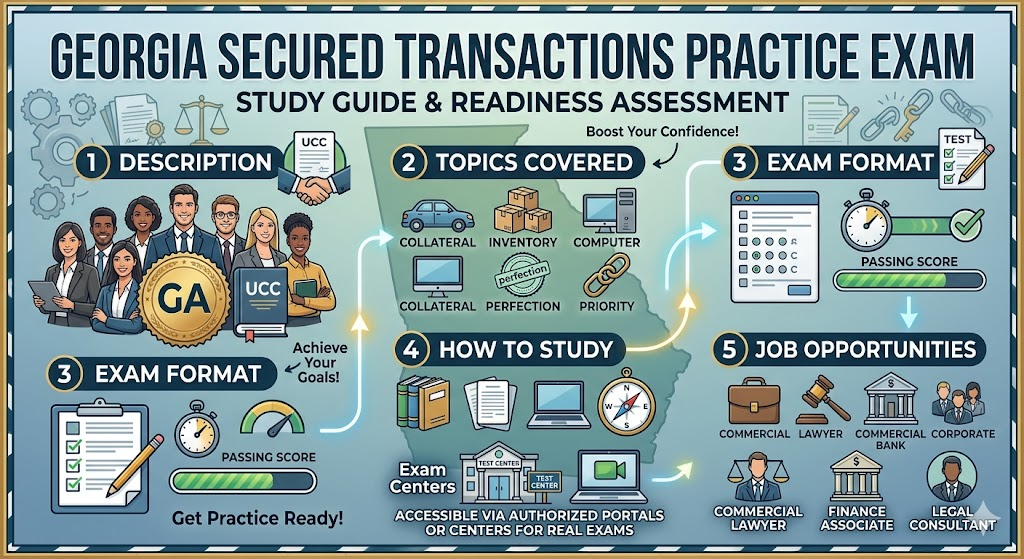
Additional Information
What the Course Entails and Exam Details
This practice material delves deeply into the core concepts and Georgia-specific application of Secured Transactions law. Topics typically covered include:
Introduction to Article 9: Understanding the scope, definitions, and types of collateral.
Creation and Attachment: The detailed requirements for a security interest to attach to collateral, including valid security agreements and the debtor having rights in the collateral.
Perfection of Security Interests: All methods of perfection within Georgia, such as filing financing statements, possession, control, and automatic perfection in specific scenarios. You will also cover fixture filings and filings for special collateral.
Priorities: The crucial rules for determining which creditor has the first claim to collateral, including the first to file or perfect, the Purchase Money Security Interest (PMSI) exceptions, and how conflicts between different secured parties and judicial lien creditors are resolved.
Default and Enforcement: Procedures for default, repossession methods (including self-help and judicial), sale requirements, and the consequences of non-compliance with the UCC.
Georgia Specifics: Filing locations and procedures, particular state rules regarding real estate-related collateral (like security deeds), and any unique local rules affecting commercial transactions.
The accompanying practice exam typically mimics the style, difficulty, and structure of questions you might encounter on professional legal assessments in Georgia.
What to Expect in the Final Exam
While this is a practice test, the final assessment scenario it prepares you for typically follows a rigorous format. You should expect:
Format: A mix of rigorous, multiple-choice questions, detailed case study analysis, and sometimes short-answer questions. These assess your ability to not only recall rules but also apply complex legal principles to diverse factual patterns common in commercial law.
Simulated Testing Environment: Online versions often include a timer and require you to complete the test in one sitting to mirror real exam conditions. Proctored versions or simulations will have specific rules against accessing external resources.
Passing Score Requirements: Though this is for practice and not an official certification itself, the material often establishes a benchmark score, often around 70-75%, to indicate a strong understanding and readiness for real-world application or professional licensing exams. It's an excellent way to gauge your progress.
Time Limits: A final practice test often imposes a time constraint, generally allowing 2 to 3 hours, matching the intensity of actual legal exams.
How to Study and Exam Centers
Effective preparation for this kind of specialized exam demands a multi-faceted approach. Focus your efforts on:
Deep-Dive Study: Review the Uniform Commercial Code (UCC) Article 9 specifically as adopted in Georgia, along with authoritative legal commentaries, case law examples, and state practice guides.
Coursework & Study Materials: Utilize online bar preparation courses, law school secured transactions texts, flashcards for key definitions and rules, and detailed logic outlines to solidify concepts.
Regular Practice Tests: Consistently take practice questions and full-length exams. Replicate exam conditions as much as possible to improve your speed, accuracy, and confidence.
Analyze Your Answers: After each practice session, meticulously review not only the correct answers but also the detailed explanations for every question. Understanding why an answer is correct is more beneficial than simply getting it right.
Accessing the Practice Material and Real Exams:
Online Portals: This specific Georgia Secured Transactions Practice Test is typically accessed through authorized online legal education platforms, commercial bar review company portals, or approved law school student resources. After registering, you will usually log into a secure system to launch the exam.
Testing Centers (Real Exams): It is important to remember that while practice tests are typically accessed online, actual professional licensing exams (like the Georgia Bar Exam) or specific specialist certifications will require you to register and schedule your test at authorized physical testing centers or follow official online proctoring procedures. Always consult the official body for your final exam for the most up-to-date and accurate information on locations and required procedures.
Job Opportunities from the Course
A strong grasp of Georgia Secured Transactions law is a highly valued asset and a prerequisite for success in various career paths, unlocking diverse and rewarding opportunities including:
Commercial Real Estate Attorney
Banking & Finance Associate (Law Firm)
Corporate Transactional Attorney
Secured Financing Consultant
In-House Counsel for Banks & Financial Institutions
Bankruptcy and Creditors' Rights Lawyer
Contract Analyst/Negotiator in Commercial Law
Commercial Loan Officer (with legal understanding)
Paralegal specializing in Commercial Real Estate/Finance in Georgia
Frequently Asked Questions
Reviews
5.0
Based on 0 reviews
Leave a Review
No reviews yet. Be the first to review!