
GERTC Hydraulics, Pneumatics, and Geotechnical Engineering (HPGE) Practice Test
$69.00
- Buy to unlock unlimited access to all Quiz questions and Answers in this Quiz.
- After purchase you can print a PDF of the whole quiz at any point. The PDF will contain the questions and the correct answers.
About this Exam
Embark on a path to mastering critical engineering concepts with the GERTC Hydraulics, Pneumatics, and Geotechnical Engineering (HPGE) Practice Test. This comprehensive study tool is specifically designed for ambitious civil and mechanical engineering students, as well as professionals preparing for licensure or promotional exams administered by the Gillesania Engineering Review & Training Center (GERTC) and similar bodies. This practice test provides an invaluable opportunity to gauge your understanding, identify knowledge gaps, and build the confidence needed to excel in the high-stakes world of fluid mechanics and soil engineering. Whether you are aiming for a career in infrastructure development, water resource management, or advanced manufacturing, this test is your essential preparation partner.
Ready to test your knowledge?
Buy Now to Access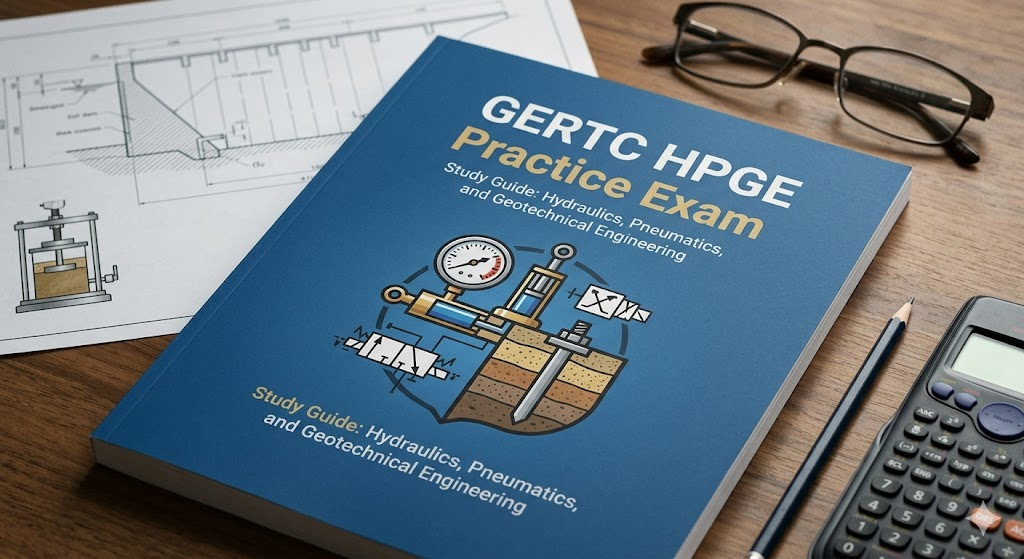
Additional Information
What the Course Entails and Exam Details
The HPGE curriculum forms the backbone of essential engineering practice. By engaging with this practice test, you are reinforcing your command over a wide array of interconnected topics.
Hydraulics & Pneumatics
Fluid Properties: Understanding density, viscosity, surface tension, and compressibility.
Hydrostatics: Calculating fluid pressure, center of pressure, and buoyancy on submerged and floating bodies.
Hydrodynamics: Applying the Bernoulli equation, energy equation, and momentum principle.
Pipe Flow: Analyzing laminar and turbulent flow, head loss, and complex pipe systems.
Open Channel Flow: Designing efficient channels, calculating flow depth, and understanding hydraulic jumps.
Pneumatic Systems: Principles of gas laws, compressed air generation, distribution, and control components like valves and actuators.
Geotechnical Engineering
Soil Composition and Classification: Mastering the Unified Soil Classification System (USCS) and AASHTO methods.
Permeability and Seepage: Analyzing water flow through soil and designing drainage systems.
Stresses in Soil: Calculating effective stress, total stress, and pore water pressure.
Compressibility and Consolidation: Predicting soil settlement under load over time.
Shear Strength: Determining soil strength parameters (cohesion and friction angle) through triaxial and direct shear tests.
Lateral Earth Pressure: Designing retaining walls by calculating active, passive, and at-rest pressures.
Slope Stability and Bearing Capacity: Evaluating the safety of slopes and designing secure foundations for structures.
What to Expect in the Final Exam
While the exact structure can vary, the GERTC HPGE final exam is typically designed to rigorously test both conceptual understanding and problem-solving ability.
Format: You should expect a series of multiple-choice questions (MCQs). These questions often present a mix of theoretical concepts, definition-based queries, and, most prominently, complex computational problems that require a step-by-step application of engineering formulas.
Passing Score: The required passing score is generally aligned with local professional licensure standards, often set around 70%. It is crucial to check the specific requirements for your exam cohort.
Time Limit: The exam is timed, typically offering a window of 3 to 4 hours per session. Managing your time effectively between reading questions and performing calculations is a critical skill.
Specific Rules: Only standard, non-programmable engineering calculators are allowed. You will be provided with a scratch booklet for calculations, and standard reference tables (such as unit weights or specific fluid properties) may be included in the exam booklet or provided online.
How to Study and Exam Centers
Preparation is the key to success. Here are actionable strategies to optimize your study time for the HPGE exam.
Strategic Study Methods
Use GERTC-Specific Materials: Prioritize GERTC review books, lecture notes, and pre-board exam compilations. These are tailored to the types of problems you will encounter.
Solve Problems Retently: Do not just read through solutions. Actively solve as many past exam problems as possible. The goal is to build speed and accuracy.
Create 'Formula Flowcharts': For complex topics like Geotechnical consolidation or multi-reservoir hydraulic problems, create visual flowcharts that show which formula to apply at each step.
Form Study Groups: Collaborating with peers allows you to discuss difficult concepts, share shortcuts, and keep each other motivated.
Simulate Exam Conditions: Regularly take timed practice tests, including this GERTC HPGE Practice Test, in a quiet, distraction-free environment to build mental stamina.
Exam Centers and Access
GERTC offers flexible options for taking their review and refresher exams.
Online Portal: Most initial assessment tests, achievement tests, and weekly exams are conducted online via the dedicated GERTC Virtual Learning Environment. This allows you to take tests from the comfort of your home.
Physical Testing Centers: For major examinations, such as physical pre-board exams, GERTC utilizes its primary branches. The main locations are in Manila and Cebu City, Philippines. You must register in advance for these on-site exams.
Job Opportunities from the Course
A strong performance in Hydraulics, Pneumatics, and Geotechnical Engineering opens doors to a diverse and rewarding array of career paths.
Geotechnical Engineer: Specializing in soil and rock mechanics to design foundations, retaining walls, tunnels, and assess slope stability for all types of infrastructure.
Water Resources Engineer: Focusing on the design of hydraulic structures, including dams, canals, levee systems, and water distribution networks.
Structural Engineer: While focused on buildings and bridges, a deep understanding of soil-structure interaction is vital for designing safe foundations.
Coastal or Marine Engineer: Designing and analyzing structures in coastal environments, managing erosion, and understanding tidal and wave forces.
Pneumatics/Fluid Power Engineer: Working in manufacturing or automation to design and maintain systems that use compressed gas or liquids for power transmission.
Civil Engineering Consultant: Providing expert advice on a wide range of projects, from initial site investigation to final design and construction supervision.
Project Manager: Overseeing construction projects, where a working knowledge of HPGE is essential for making informed technical and logistical decisions.
Frequently Asked Questions
Reviews
5.0
Based on 0 reviews
Leave a Review
No reviews yet. Be the first to review!