
GERTC Master of Science in Sanitary Engineering (MSTC) Practice Exam
$69.00
- Buy to unlock unlimited access to all Quiz questions and Answers in this Quiz.
- After purchase you can print a PDF of the whole quiz at any point. The PDF will contain the questions and the correct answers.
About this Exam
The GERTC Master of Science in Sanitary Engineering (MSTC) Practice Exam is an advanced, specialized assessment designed for graduate-level engineering students.
It is specifically tailored for individuals pursuing or planning to undertake a Master of Science program with a focus on sanitary engineering, often known as MSTC, at institutions affiliated with GERTC.
This practice test is an invaluable resource for engineers aiming to elevate their careers from general practice to specialized roles in environmental protection, water resource management, and public health infrastructure.
It serves as a critical diagnostic tool, enabling candidates to evaluate their readiness for the demanding final or comprehensive examinations within their graduate studies.
Ready to test your knowledge?
Buy Now to Access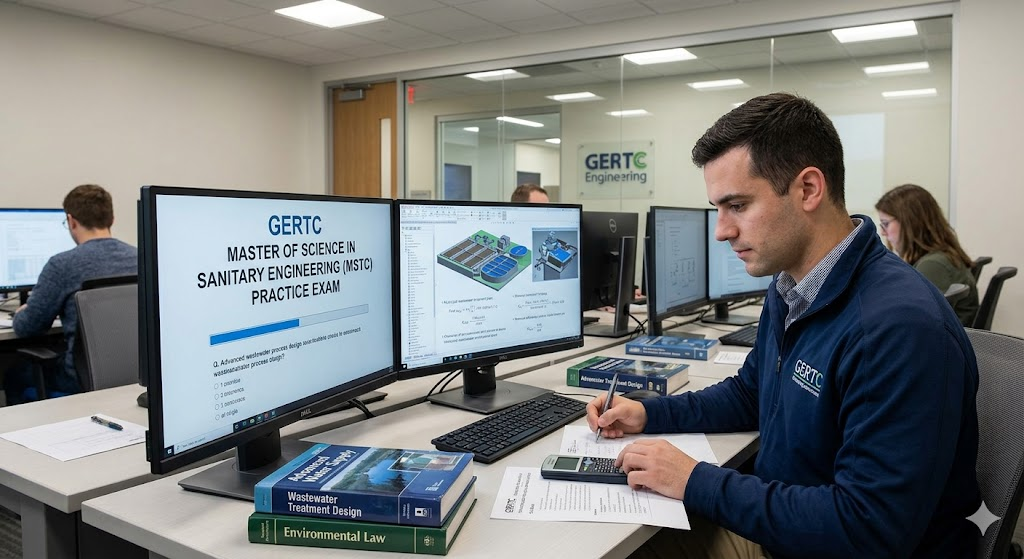
Additional Information
What the Course Entails and Exam Details
The MSTC curriculum is rigorous, moving beyond foundational engineering principles to advanced, design-oriented, and managerial concepts.
The practice exam is structured to reflect this breadth and depth, assessing core competencies across key modules of the graduate-level syllabus.
Key topics covered by the course and the exam include:
Advanced Water Supply and Process Design: Including membrane filtration, desalination, and removal of emergent contaminants.
Wastewater Engineering & Reuse: Focused on nutrient removal, sludge treatment, industrial wastewater, and decentralized systems.
Solid & Hazardous Waste Management: Covering lifecycle analysis, waste-to-energy, and remediation of contaminated sites.
Environmental Law & Public Health Policy: An in-depth review of national and international regulations, and epidemiological principles.
Environmental Impact Assessment (EIA): Methodologies for predicting and mitigating the ecological and social impacts of engineering projects.
What to Expect in the Final Exam
While a practice test, this assessment accurately simulates the structure, complexity, and time constraints of the actual comprehensive final exam of the Master of Science program.
You should expect a hybrid format that tests both your theoretical knowledge and your ability to apply it to real-world engineering challenges.
The examination will typically be split into multiple parts over a set duration, often a full day.
Expect approximately 50-60% of the exam to be in an advanced multiple-choice or short-answer format, requiring rapid, accurate recall of detailed technical facts and regulations.
The remaining 40-50% will be comprehensive design-based problems or case studies, where you will need to perform detailed quantitative calculations, design process flow diagrams, or propose integrated sanitary solutions.
A passing score of 70% is standard for an MS-level comprehensive exam, reflecting a mastery of the complex subject matter.
How to Study and Exam Centers
Preparation for an MS-level exam demands structured, long-term commitment.
Begin by performing a detailed review of all core course materials, lecture notes, and recommended graduate textbooks in sanitary and environmental engineering.
Don't just review theory; actively solve previous final exams and quantitative problems, focusing on process design calculations for water and wastewater treatment.
Create integrated summary sheets that connect engineering principles to public health outcomes and environmental regulations.
Forming or joining study groups with peers is highly effective for discussing complex case studies and design challenges.
The physical taking of the final exam, for which this practice test prepares you, typically occurs within the authorized GERTC partner institution or its satellite testing centers.
You should contact your GERTC program coordinator for precise details on physical testing centers or any available proctored online exam options.
Job Opportunities from the Course
A Master of Science in Sanitary Engineering, validated by passing your comprehensive final exam, opens doors to leadership, research, and high-impact career paths.
It signifies that you possess the advanced knowledge required to manage large-scale environmental projects and shape public policy.
Earning this advanced qualification unlocks prestigious job opportunities such as:
Senior Sanitary Engineer: Designing complex municipal and industrial systems.
Environmental Engineering Consultant: Advising on sustainability, compliance, and design for private and public sector clients.
Water Resources Manager: Overseeing critical water supply networks and sustainability strategies for government agencies.
Director of Public Health Engineering: Leading infrastructure projects at the intersection of urban planning and disease prevention.
Environmental Scientist / Research Engineer: Conducting cutting-edge research in advanced wastewater treatment or solid waste management.
University Lecturer / Academic: Educating the next generation of engineers in a rapidly evolving field.
Frequently Asked Questions
Reviews
5.0
Based on 0 reviews
Leave a Review
No reviews yet. Be the first to review!