
GFA Lighting and Electric Practice Test
$69.00
- Buy to unlock unlimited access to all Quiz questions and Answers in this Quiz.
- After purchase you can print a PDF of the whole quiz at any point. The PDF will contain the questions and the correct answers.
About this Exam
The GFA Lighting and Electric course is a specialized program provided by the Georgia Film Academy (GFA). It is specifically designed to train students for entry-level positions within the professional motion picture and television set lighting and electrical departments. This course, often delivered in close partnership with IATSE Local 479, the union representing film and TV professionals in these crafts, focuses heavily on practical, hands-on skills, safety protocols, and industry etiquette. The program aims to create "assets to the industry" by providing real-world training with professional-grade equipment. It is designed for aspiring crew members who want to build a career in a specialized and in-demand area of production.
Ready to test your knowledge?
Buy Now to Access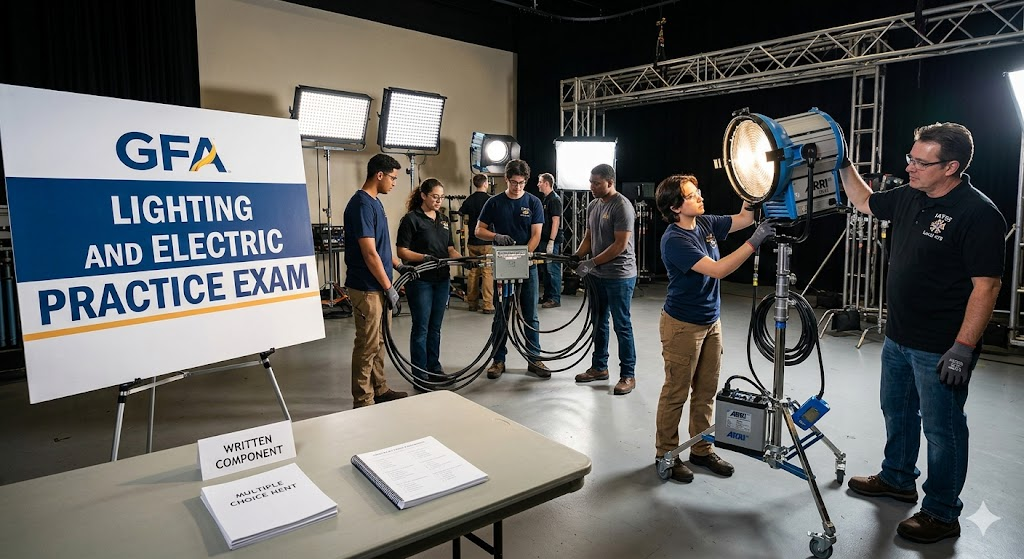
Additional Information
What the Course Entails and Exam Details
The comprehensive syllabus for the GFA Lighting and Electric course covers a wide array of technical and practical skills. Students can expect to delve into electric theory with a specific focus on on-set applications, complex power distribution, and set protocol. The core topics include:
Electric Theory and Power Distribution: Understanding electrical principles, voltage, amperage, wattage, and the safe distribution of three-phase power on sets and locations.
Equipment and Lamps: Mastery of various lighting fixtures (HMIs, LEDs, Tungsten), their proper handling, setup, and maintenance.
Essential Lighting Techniques: Creating specific aesthetic styles for feature film standards.
Set Protocol and Etiquette: Understanding the hierarchical structure of the set lighting department, communication, and professional conduct.
Lighting Plots, Location Scouting, and Crew Management: Planning and execution of lighting in common production scenarios.
Camera Exposure and Aesthetic Stylization: Learning how to manipulate and control light to achieve desired visual outcomes.
Rigging and Troubleshooting: Practical skills for rigging lights in diverse scenarios, including day/night exteriors, interiors, on stage, and on location.
A grade of "C" or better is typically required to successfully complete this course. The exam process assesses mastery of these critical competency areas.
What to Expect in the Final Exam
While the exact nature of the final GFA evaluation can vary, it generally consists of a combination of a final comprehensive written assessment and a rigorous final practical exam.
The Written Component: Expect a multiple-choice, matching, and short-answer exam. This section will test your understanding of:
Electrical theory (specifically for film) and calculations for load balancing.
Industry terminology and definitions.
Specific equipment names, types, and functions.
Safety protocols and standard practices.
Department hierarchy and communication procedures.
The Practical Component: The practical exam is a crucial element and often carries significant weight. Students are required to demonstrate hands-on proficiency, which might include:
Successfully and safely distributing power for a specific lighting scenario.
Setting up, powering, and striking multiple types of lighting fixtures.
Implementing a complex lighting setup based on a provided plot or instructions.
Demonstrating efficient and correct set communication and teamwork.
Troubleshooting a failed lighting or power setup.
To pass, you must demonstrate a safe and competent execution of all practical tasks, showing that you can be an asset on a real film set.
How to Study and Exam Centers
Effective preparation requires a blend of hands-on practice, technical knowledge, and mental rehearsal. Use these actionable strategies:
Utilize the Practice Exam: The GFA Lighting and Electric Practice Test is your single most valuable tool. Use it to identify knowledge gaps, practice time management, and become familiar with the question types. Take it multiple times to build your score.
Focus on Hands-On Practice: Do not underestimate the importance of practical skills. Whenever possible, access a studio or workshop to practice the core tasks. Work on rigging, power distribution, and fixture setup.
Review GFA Course Materials: Thoroughly study all lectures, handouts, and equipment manuals provided during your GFA course. Re-watch any available technique videos.
Form a Study Group: Collaborate with your classmates. You can quiz each other on technical definitions and work through practical scenarios together.
Create Safety Flashcards: Memorize critical safety procedures. Make flashcards for different types of power connections, maximum load calculations, and handling protocols.
Exam Centers: The final exams for GFA courses are not conducted in standard online portals or Pearson VUE locations. They are held in-person at specific GFA hub locations, professional studios, or authorized school partners where the hands-on training takes place. Your instructor or GFA advisor will provide the specific location, date, and requirements for both the written and practical components.
Job Opportunities from the Course
Upon successful completion of the course and passing the necessary evaluations, a wide range of entry-level and career paths become available. The GFA program is highly respected, and its certifications can unlock opportunities such as:
Set Lighting Technician
Electrician (Film and Television)
Best Boy Electric (after gaining experience)
Gaffer (long-term career path)
Grip/Electric (Swing Crew)
Basecamp Electrician
Rigging Electrician
The goal of this course is to prepare you to walk onto a professional set with confidence, knowing you have the skills to make an immediate, positive contribution to the production.
We wish you the best of luck in your studies for the GFA Lighting and Electric Practice Exam!
Frequently Asked Questions
Reviews
5.0
Based on 0 reviews
Leave a Review
No reviews yet. Be the first to review!