
GFL Financial Literacy Practice Test
$69.00
- Buy to unlock unlimited access to all Quiz questions and Answers in this Quiz.
- After purchase you can print a PDF of the whole quiz at any point. The PDF will contain the questions and the correct answers.
About this Exam
The General Financial Literacy (GFL) certification is a vital credential designed to equip individuals, particularly high school students, with essential personal finance skills. It is typically a component of state-level Career and Technical Education (CTE) programs, aiming to develop fundamental financial and economic reasoning. The course empowers participants to make informed decisions about managing their income, savings, and investments, fostering a foundation for lifelong financial well-being. This certification is ideal for students preparing for independent living, seeking to enhance their employability, or wanting a head start in understanding the complexities of modern personal finance.
Ready to test your knowledge?
Buy Now to Access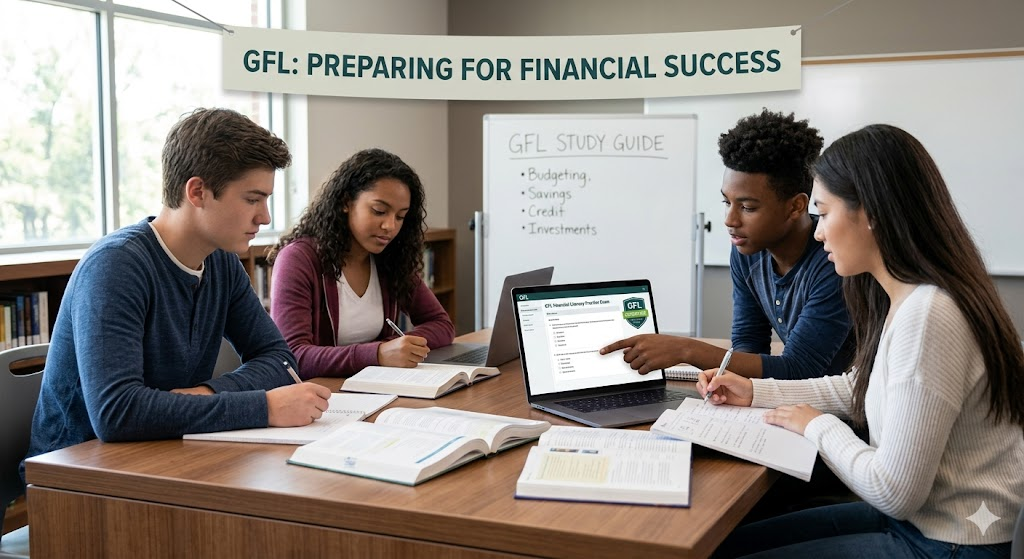
Additional Information
What the Course Entails and Exam Details
The GFL course provides a comprehensive overview of critical personal finance topics, often broken down into several core strands or standards. Students will delve into understanding income and career preparation, including sources of income, employability skills, and the impact of taxes. A significant portion of the course focuses on money management, teaching practical budgeting techniques, how to manage personal accounts, and the responsible use of credit. Participants also explore strategies for saving and investing, learning about different investment options, risk management, and long-term retirement planning. Furthermore, the curriculum emphasizes personal financial priorities, exploring how scarcity, rational decision-making, and consumer behavior influence financial choices. The course details generally align with state or national standards for financial education.
What to Expect in the Final Exam
The final exam for the GFL certification is typically structured to test conceptual knowledge and practical application of financial principles. In most administrations, the test consists of approximately 50 to 100 multiple-choice questions. The exam is often proctored and taken digitally, with a typical time limit ranging from 60 to 90 minutes. A passing score, often around 70 percent, is required to achieve certification. Students should expect questions that evaluate their understanding of terms like annual percentage rate (APR), net worth, opportunity cost, and various insurance types. Some exams may also include scenarios requiring basic financial calculations or the ability to analyze a simple budget or credit report.
How to Study and Exam Centers
Preparation for the GFL exam should combine theoretical study with practical application. Actively engage with course materials, such as textbooks, online modules, or classroom notes, paying close attention to definitions of key financial terms. Creating flashcards for vocabulary and formulae is a highly effective study strategy. We strongly recommend taking multiple practice tests to familiarize yourself with the question format and identify areas needing further review. Practical methods include creating a personal budget, tracking your spending, or simulating investment scenarios to reinforce the concepts. Regarding exam centers, the GFL test is usually administered directly within high schools as part of their curriculum. Alternatively, it may be available through authorized testing portals, specialized physical testing centers, or via approved online proctoring systems provided by organizations like YouScience (formerly Precision Exams) or educational institutions.
Job Opportunities from the Course
While the GFL certification itself does not always lead directly to specialized, high-level financial careers, it provides a solid foundation that enhances a candidate’s profile for a wide range of entry-level positions and sets the stage for further advancement. It demonstrates a desirable level of responsibility and competence that employers value across all industries.
Potential career paths and job opportunities that benefit from GFL-level financial literacy include:
Bank Teller
Customer Service Representative in Banking or Insurance
Financial Services Assistant
Entry-Level Retail Associate (with cash handling responsibilities)
Administrative Assistant
Small Business Entrepreneur
Bookkeeping Clerk
Account Management Support
Data Entry Clerk in Finance or Accounting
Improved Success in Any Workforce Role through better personal finance management and understanding of employer benefits.
Frequently Asked Questions
Reviews
5.0
Based on 0 reviews
Leave a Review
No reviews yet. Be the first to review!