
GFOA Certified Public Finance Officer (CPFO) Capital and Operating Budgeting Practice Exam
$69.00
- Buy to unlock unlimited access to all Quiz questions and Answers in this Quiz.
- After purchase you can print a PDF of the whole quiz at any point. The PDF will contain the questions and the correct answers.
About this Exam
The Certified Public Finance Officer (CPFO) designation, granted by the Government Finance Officers Association (GFOA), stands as the premier credential for public sector finance professionals across the United States and Canada. This rigorous, self-study program is meticulously crafted for individuals dedicated to mastering the complexities of government finance. It is ideal for finance directors, managers, budget analysts, and other key personnel within state, local, and provincial governments and non-profit organizations.
Achieving the CPFO title signals to employers, colleagues, and the public a deep, verified expertise in the multiple disciplines required for effective public fiscal management. The program’s modular structure allows you to build comprehensive knowledge while focusing on specific, critical areas of public finance.
Ready to test your knowledge?
Buy Now to Access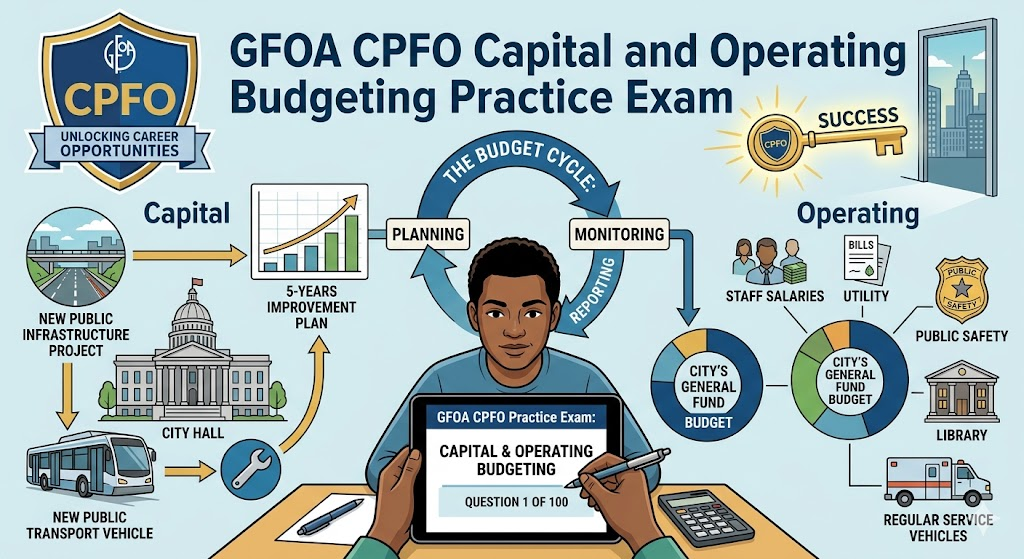
Additional Information
What the Course Entails and Exam Details
The CPFO program is composed of seven distinct, required examinations that cover the breadth of the public finance profession. While candidates must pass all seven to earn the full designation, you can approach them individually. The specific focus of this study guide is the Planning and Budgeting exam, which is universally recognized as the CPFO Capital and Operating Budgeting Practice Exam.
This component of the CPFO program delves into the very core of government operations: how public money is allocated, monitored, and managed. Your preparation for this exam will equip you with a mastery of the following critical skills and knowledge areas, as outlined in the official GFOA candidate guide:
Approaches to the Budget Process: Understanding different methods like line-item, performance-based, program, and zero-based budgeting.
Budget Projections and Analysis: Utilizing tools for revenue and expenditure forecasting, fiscal impact analysis, and cost-benefit analysis to make informed decisions.
Priority Setting and Goal Definition: Mastering the art of linking financial resources to strategic organizational goals and service-level objectives.
Budget Monitoring and Outcomes: Developing systems to track actual performance against budgetary goals and evaluating the effectiveness of spending.
Capital Improvement Planning (CIP): Learning to create a multi-year plan for major, long-term capital projects, separate from daily operating costs.
Budget Communication and Governance: Acquiring strategies to clearly and transparently present complex budgetary information to elected officials, the public, and internal stakeholders.
What to Expect in the Final Exam
While GFOA provides practice tests as part of their online learning management system, it is vital to know that these are supplementary. The official CPFO Capital and Operating Budgeting final exam is a significant hurdle. Here is what you should expect on test day:
Format: The exam consists entirely of multiple-choice questions. Each question has four options, with only one correct answer. Some questions will be straight knowledge recall, but a significant portion will be scenario-based, requiring you to apply concepts to real-world public finance challenges.
Number of Questions: The Planning and Budgeting exam is one of the four "major" topics and typically includes 100 questions.
Time Limit: You will have 90 minutes to complete the exam.
Passing Score: To pass, you must achieve a minimum score of 80%. This high standard underscores the program’s value and ensures that all CPFO holders demonstrate a superior level of competence.
Delivery: The exam is administered through GFOA's partnership with Pearson VUE. It can be taken either at a physical, proctored Pearson VUE test center or remotely from your own home or office using the OnVUE online proctoring system.
How to Study and Exam Centers
Preparation is the absolute key to success for the CPFO examinations. GFOA’s program is self-study, giving you flexibility but demanding discipline. A successful study strategy should include the following:
Study Strategies:
Use Official GFOA Materials: Your primary resources are the suggested reading lists, content outlines, and "study terms and concepts" handouts provided on the GFOA website. The ultimate resource for many of the CPFO exams is the GFOA’s "Governmental Accounting, Auditing, and Financial Reporting" (the "Blue Book"), though the budgeting exam leans more heavily on best practices and research articles.
Access the GFOA Learning Management System (LMS): Your program enrollment grants you access to an LMS containing over 130 hours of recorded training seminars. Watching these, alongside reading the official text, is crucial.
Utilize the Practice Tests: While not exhaustive, the practice tests available in the LMS are an invaluable tool. Use them early to identify your weak points and late in your preparation to build pacing confidence and reduce test-day anxiety. Treat them as timed, simulated exams.
Focus on Scenario-Based Application: Do not just memorize definitions. The exam will test your ability to synthesize information and make sound decisions in a complex environment. Always consider the long-term, cross-functional implications of any single choice (e.g., how a compensation change affects the multi-year budget projection).
Exam Centers and Scheduling: The official CPFO exams must be taken through Pearson VUE.
Step 1: Enrollment: You must first be a member of GFOA and enrolled in the CPFO program.
Step 2: Scheduling: Once you are ready, you will schedule your exam appointment directly on the Pearson VUE website. You will select whether to take the exam in person or via remote proctoring.
Step 3: Taking the Exam:
Remote: If you choose remote proctoring (OnVUE), you will need a reliable computer, a webcam, a strong internet connection, and a quiet, private room. You will be monitored live by a human proctor.
In-Person: If you prefer a physical testing environment, you will choose an authorized Pearson VUE testing center. These centers are located in almost every major city and at many colleges and professional training schools throughout North America.
Job Opportunities from the Course
Earning the CPFO designation is a powerful way to accelerate your career in public finance. It is a signal to employers that you possess both the broad conceptual knowledge and the specific technical skills required for senior-level leadership.
A CPFO certification is often a key differentiator and a requirement for advancement to the following roles within state and local government:
Finance Director / Chief Financial Officer (CFO)
Budget Director / Budget Manager
Comptroller / Controller
Treasury Manager / Treasurer
Senior Budget Analyst / Fiscal Analyst
Debt Manager / Capital Finance Manager
Director of Procurement
Risk Manager
City Manager / Assistant City Manager (in jurisdictions focused on fiscal management)
Consultant specialized in public finance management and budgeting software.
By investing in the CPFO Capital and Operating Budgeting practice exam and the official certification, you are unlocking a pathway to meaningful, high-impact careers dedicated to the responsible stewardship of public resources.
Frequently Asked Questions
Reviews
5.0
Based on 0 reviews
Leave a Review
No reviews yet. Be the first to review!