
GFOA Financial Planning and Budgeting Certification Practice Exam
$69.00
- Buy to unlock unlimited access to all Quiz questions and Answers in this Quiz.
- After purchase you can print a PDF of the whole quiz at any point. The PDF will contain the questions and the correct answers.
About this Exam
The GFOA Certified Public Finance Officer (CPFO) program is a broad, self-study educational and verification program designed for public finance professionals.
It recognizes individuals who demonstrate comprehensive knowledge and competence across all disciplines of public finance.
This specific exam module, dedicated to Planning and Budgeting, is designed for government finance officials, budget directors, analysts, and other public servants heavily involved in the financial planning process.
Achieving this certification demonstrates commitment to best practices, enhances professional credibility, and equips you with the tools to lead effectively within your organization and community.
Ready to test your knowledge?
Buy Now to Access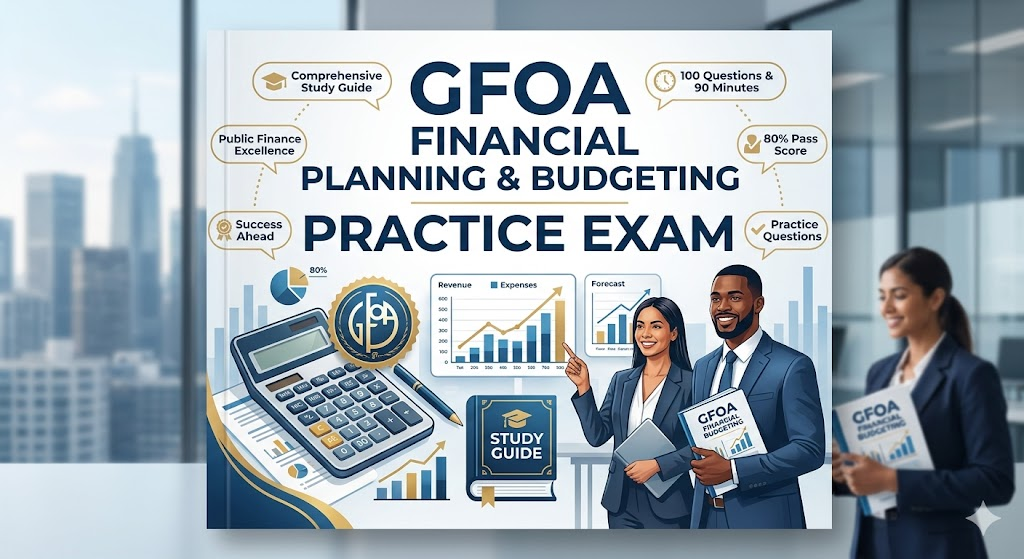
Additional Information
What the Course Entails and Exam Details
This examination requires mastery of the entire public budgeting cycle and fundamental financial planning principles. The core topics, which align with the current GFOA CPFO exam framework for this module, include:
Strategic Planning: Understanding the integration of long-term goals and organizational vision into the budgeting process.
Operating Budget Development: Mastering the techniques for formulating a government's annual or biennial operating budget, including resource allocation, department requests, and revenue and expenditure estimation.
Capital Budgeting and Forecasting: Planning and managing major, long-term capital expenditures and infrastructure projects, and developing reliable long-term financial forecasts.
Revenue Forecasting: Analyzing historical data and economic trends to project revenues from various sources.
Expenditure Forecasting: Predicting future service demands, costs, and commitments.
Performance Measurement and Management: Creating and utilizing meaningful indicators to evaluate program effectiveness and efficiency, and linking budget decisions to outcomes.
Financial Policies: Developing and implementing robust financial policies to guide fiscal decisions.
Public Involvement and Communication: Best practices for engaging the public in the budgeting process and clearly communicating complex financial information.
What to Expect in the Final Exam
The actual GFOA CPFO Planning and Budgeting exam is a critical component of the certification. Here’s what you can generally expect:
Exam Format: The exam is computer-based and primarily multiple-choice. This includes standard questions that test technical knowledge and principles, as well as scenario-based items where you must apply your judgment and reason through realistic public finance situations.
Number of Questions: You will typically face around 100 multiple-choice questions. This number can fluctuate, so always check official GFOA updates.
Passing Score: The minimum required passing score for this examination is generally 80%. You must pass each of the seven CPFO modules with this score to achieve the designation.
Time Limit: You will have approximately 90 minutes to complete the examination. Practice your pacing carefully.
Exam Rules: The exam is proctored, whether you take it online or at a physical center. Specific rules, such as what to bring and forbidden items, will be provided during registration. No unscored questions are typically included; every question counts towards your final result. Online test-takers will have access to a digital whiteboard.
How to Study and Exam Centers
Effective preparation is key. Leverage the following strategies and resources, including this study guide and practice exam:
GFOA Study Materials: Utilize GFOA’s official CPFO candidate guides, suggested reading lists, recorded seminars, and webinars. These are primary resources specifically tailored to the exam syllabus.
Practice with this Resource: The GFOA Budgeting Practice Exam is designed to simulate the format, types of questions (both standard and scenario-based), and pacing of the actual test. Use it to identify knowledge gaps and build stamina.
Structured Study Plan: Map out your study timeline, allocating sufficient time to each core domain based on your existing knowledge and its weight in the exam framework. Shift focus from purely learning new content to targeted practice in the final weeks.
Timed Practice: Take full-length, timed practice tests to build your pacing confidence and reduce test-day anxiety. Review not just what you got wrong, but also why the correct answer is right.
Scenario Focus: Since scenario-based questions measure judgment, dedicate time to practicing with realistic cases, case studies, and practical applications within the study materials.
Exam Centers
The GFOA partners with Pearson VUE for exam delivery. Candidates can choose between two main options:
Online Proctored Exams (OnVUE): You can take the exam from the convenience of your home or workplace. A live proctor will monitor your session via a webcam and ensure a secure exam environment. Before registering, run the system test on your device and network to ensure compatibility.
Physical Pearson VUE Test Centers: You can also schedule an appointment to take the exam in person at an authorized Pearson VUE testing center. GFOA eligibility is required before registration. Use the Pearson VUE website to find and schedule a suitable location.
Job Opportunities from the Course
Earning your Certified Public Finance Officer (CPFO) designation, with demonstrated expertise in Planning and Budgeting, can unlock numerous career paths and leadership opportunities in the public sector. Relevant job titles and roles include:
Finance Director: Oversight of all municipal, county, state, or other governmental finance operations.
Budget Director / Manager: Leading the entire public budgeting process, from forecasting to monitoring and reporting.
Budget Analyst: Analyzing departmental budget requests, forecasting revenues and expenditures, and preparing budget documents.
Chief Financial Officer (CFO): Top financial leadership roles within smaller governments or specific public agencies.
Financial Planner (Government): Developing long-term financial strategies and capital improvement plans.
Treasurer: Managing public funds, investments, and cash flow.
Controller / Comptroller: Ensuring compliance with accounting standards, internal controls, and financial reporting.
Public Administrator / Manager: The CPFO credential is highly valued for leadership roles across various departments, not just finance, as it verifies foundational government finance knowledge.
Management & Budget Analyst: Working to integrate performance management and budget processes.
Consultant in Public Finance: Providing expertise to various public sector clients.
Investing in this certification confirms your expertise, shows dedication, and can significantly accelerate your career progression within state and local governments. Good luck with your study and upcoming examination!
Frequently Asked Questions
Reviews
5.0
Based on 0 reviews
Leave a Review
No reviews yet. Be the first to review!