
GIA Diamonds Do Good (DDG) Practice Test
$69.00
- Buy to unlock unlimited access to all Quiz questions and Answers in this Quiz.
- After purchase you can print a PDF of the whole quiz at any point. The PDF will contain the questions and the correct answers.
About this Exam
The GIA Diamonds Do Good (DDG) program represents a vital, forward-thinking initiative within the gem and jewelry industry, developed to bridge the gap between technical expertise and global responsibility. It is a specialized educational pathway designed for professionals across the pipeline—from retail sales associates and buyers to marketing specialists and corporate social responsibility (CSR) managers. This course, often in collaboration with the non-profit 'Diamonds Do Good,' goes beyond traditional grading to focus on the human impact of natural diamonds, ethical sourcing, sustainable practices, and community development. The GIA Diamonds Do Good Practice Test is an essential tool for any individual aiming to formalize their knowledge of a responsible diamond supply chain and prepare for the associated final certification assessment.
Ready to test your knowledge?
Buy Now to Access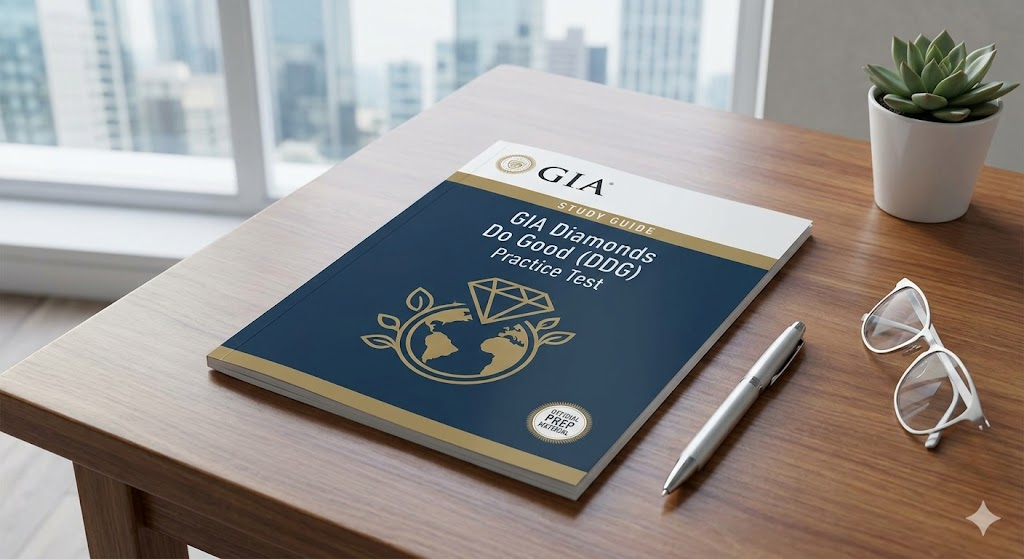
Additional Information
What the Course Entails and Exam Details
The Diamonds Do Good curriculum focuses on the concept of 'the diamond’s journey' with an emphasis on transparency and positive impact. The course content generally covers several core themes. It starts with the history of Diamond Development, examining how the industry has evolved. A major section is dedicated to Ethical Sourcing and Traceability, providing an in-depth understanding of international standards and compliance protocols, including the Kimberley Process, the System of Warranties, and the Responsible Jewellery Council (RJC) code of practices.
Students also explore the Environmental and Social Impact, learning about the community initiatives, infrastructure development, healthcare, and educational programs supported by natural diamond mining regions. The course provides actionable information on Sustainable Business Practices, which allows professionals to articulate the ethical story of a diamond.
The GIA Diamonds Do Good (DDG) Practice Test is a digital, self-assessment tool designed to parallel the structure and content of the final GIA certification exam. It focuses on the application of knowledge to real-world scenarios.
What to Expect in the Final Exam
The final assessment for this specialization is typically a closed-book, timed digital exam. While precise details can vary with updates to the GIA curriculum, it generally consists of multiple-choice and true/false questions. The exam is designed to test a candidate's comprehensive synthesis of the core topics, rather than just simple recall.
You can expect questions that present case studies on sourcing, asking you to identify compliant and non-compliant scenarios according to the standards learned. You will need to demonstrate understanding of specific industry terminologies related to social responsibility and sustainable mining. A passing score, often around 75% to 80%, is required to earn the credential. Candidates should plan to complete the online exam in a single setting, within the permitted timeframe, which is typically 60 to 90 minutes.
How to Study and Exam Centers
Preparation is key to succeeding on the final certification exam. Leveraging the GIA Diamonds Do Good Practice Test is the most effective way to start. Take the practice test early in your study cycle to identify knowledge gaps. This allows you to focus your review on the modules where you struggle most.
Your primary study materials are the GIA’s official course modules, provided within their eLearning environment. Treat the learning material as a comprehensive text: take detailed notes, create flashcards for key terms like 'Kimberley Process' or 'provenance,' and review case studies multiple times. Form study groups with other students to debate ethical scenarios and reinforce understanding. After thorough review, take the practice test again to measure your improvement.
Regarding exam delivery, the final certification is conducted through GIA's standard Online Education Portal. It is a digital, proctored experience, allowing you to take the test from the comfort of your home or office, provided you meet the proctoring requirements (e.g., a quiet room, a webcam, and a stable internet connection). There is no need to visit a physical Pearson VUE testing center; rather, you access the exam through the same portal where you complete your GIA Diamonds Do Good coursework.
Job Opportunities from the Course
A certification in GIA Diamonds Do Good provides a powerful differentiator in a competitive market. It demonstrates a commitment to ethical fluency, a quality increasingly sought by consumers and top-tier jewelry companies. It opens diverse career paths across the industry, including:
Diamond Sourcing and Compliance Manager
Ethical Diamond Auditor
Responsible Jewellery Retail Sales Associate
Sustainability (CSR) Officer for Jewelry Brands
Marketing Specialist: Ethical Luxury
Diamond Buyer (Specializing in Provenance-verified goods)
Supply Chain Traceability Specialist
Frequently Asked Questions
Reviews
5.0
Based on 0 reviews
Leave a Review
No reviews yet. Be the first to review!