
Glute Specialist Practice Exam
$69.00
- Buy to unlock unlimited access to all Quiz questions and Answers in this Quiz.
- After purchase you can print a PDF of the whole quiz at any point. The PDF will contain the questions and the correct answers.
About this Exam
The illustrative Certified Glute Specialist (CGS) exam represents a comprehensive assessment for fitness professionals and enthusiastic individuals committed to mastering the complexities of one of the body’s most crucial muscle groups. This specialized qualification validates deep knowledge in gluteal anatomy, function, common dysfunctions, specific exercise science, and effective training programming.
Whether you're an experienced personal trainer looking to niche down, a strength and conditioning coach focused on optimizing athletic performance, or a fitness influencer striving for authority and safety, a Glute Specialist qualification signifies your expert status in an exceptionally popular and functional area. Earning a credential of this type demonstrates your ability to train clients for both aesthetic and functional success in this specific area, all while prioritizing safety and scientific principles. Note: The details provided here illustrate the typical structure and content of a robust comprehensive exam for a glute specialization. Always consult the specific organization you are certifying with for their exact syllabus, structure, and logistical details.
Ready to test your knowledge?
Buy Now to Access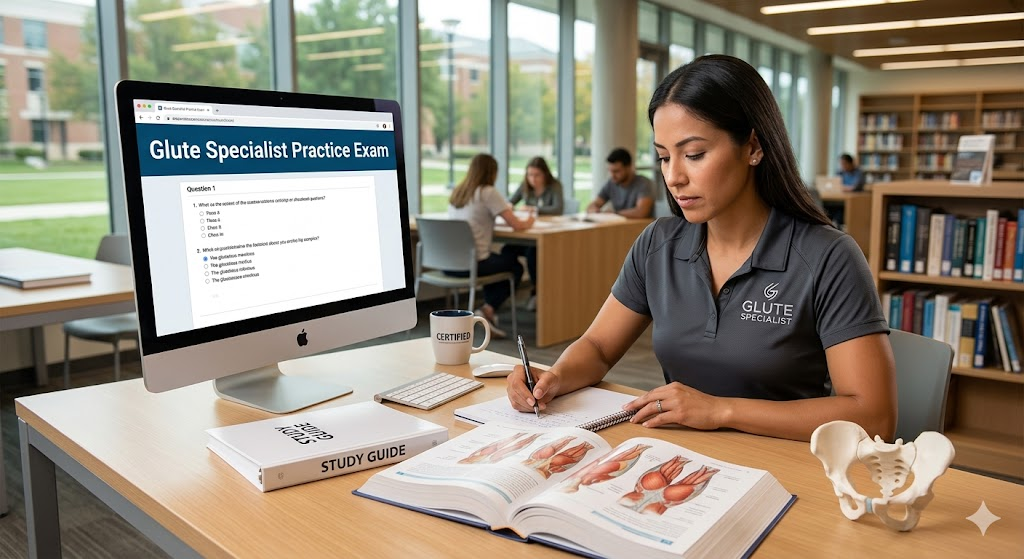
Additional Information
What the Course Entails and Exam Details
A comprehensive illustrative Glute Specialist course leading to such an exam involves a deep dive into several interconnected pillars of glute training. The structure of the course is typically online, with various modules and assessments. While exact syllabi vary by provider, a comprehensive illustrative course will cover and expect you to master topics including:
Anatomy & Physiology: Extensive focus on the gluteus maximus, medius, and minimus, their origin, insertion, and specific actions. Also, understanding the surrounding musculature, the kinetic chain, the pelvis, and the lower back’s relationship with the glutes.
Kinetic Chain & Function: Understanding the critical roles glutes play in dynamic movement (walking, running, jumping), athletic performance, stability, and injury prevention. Topics include hip extension, abduction, rotation, and pelvic stability.
Assessment & Common Dysfunctions: Learning how to identify inactive, weak, or imbalanced glutes through physical screens and movement patterns. Identifying conditions like "dead glute syndrome," anterior pelvic tilt, tight hip flexors, piriformis syndrome, and ITB issues, along with corresponding correction strategies.
Targeted Exercise Techniques: Master specific techniques for foundational compound movements (squats, deadlifts, hip thrusts, lunges) and isolation exercises (clam shells, kickbacks, abductions). Understanding correct form, common pitfalls, and effective cueing for maximum glute engagement is critical.
Programming for Success: Principles of designing effective gluteal development programs, including considerations for volume, intensity, periodization, and progressive overload to match individual client goals, whether aesthetic, performance, or functional.
Client Management & Ethics: Basic professional communication, setting boundaries, and ensuring safety when prescribing exercises, always working within your professional scope of practice.
The associated illustrative final exam is designed to be a significant knowledge check, ensuring you are capable of applying this comprehensive understanding to real-world client scenarios safely and effectively. It often features a comprehensive online testing format, predominantly using objective question styles like multiple choice to test knowledge and simple practical application scenarios. A high standard is typically maintained to ensure competence.
What to Expect in the Final Exam
While exact details are always organization-dependent, an illustrative comprehensive Glute Specialist final exam is designed to rigorously assess your mastery. Here is a general breakdown of what to typically expect for a high-standard illustrative exam of this type:
Exam Format:
Multiple-Choice Questions: A substantial part of the exam, potentially 50-100 or more questions, to test theoretical knowledge, anatomical definitions, functional concepts, and standard exercise applications.
Scenario-Based Questions/Case Studies: You may be presented with illustrative client scenarios (e.g., a client presenting with a specific posture, weakness, or goal) and asked to select the most appropriate assessment, exercise, or programming adjustment.
Potential Practical Element: Depending on the organization's standards, there might be a small practical component where you demonstrate exercise technique or cueing via video submission or a live online assessment. This is less common in pure specializations compared to general personal training certifications, which are most often assessed via online written methods. Always confirm the structure with your chosen provider.
Passing Score: The passing score typically ranges from 70% to 80% for multiple-choice style exams, reflecting a need for thorough understanding.
Time Limit: Most exams have a specified time limit, typically 1 to 2 hours for comprehensive knowledge tests, to ensure you can find and accurately process information quickly and are not reliant on extended reference. Some online, open-book style exams might have more generous time windows or even be untimed.
Rules and Delivery:
Online Exam: The illustrative CGS exam is typically delivered online, allowing for access from almost anywhere with a reliable internet connection.
Testing Environment: While not always strictly proctored with software, most exams are unproctored but require acknowledgement of an integrity policy and might be time-bound once started.
Open vs. Closed Book: This depends heavily on the illustrative standards of the particular organization. Many high-standard illustrative specializations might use an unproctored, open-book or resource approach, focusing more on complex application scenarios. Conversely, other providers might strictly enforce a closed-book, proctored environment to test knowledge recall. The provider's rules are absolute.
Retake Policies: Generally, at least one free or low-cost retake is provided if you do not pass, though policies vary.
How to Study and Exam Centers
Successfully passing an illustrative rigorous Glute Specialist exam requires diligent preparation that moves beyond simple memorization to genuine understanding and practical application.
Review Course Material Thoroughly: Study the provider's course modules, textbook, videos, and any assigned research or articles diligently. Take notes, summarize key points, and don't skip over difficult sections.
Utilize Practice Quizzes and Exams: Take all practice quizzes provided within your course and seek out reputable illustrative practice exams to familiarize yourself with the question style and identify weak areas. Focus not just on finding the correct answer, but understanding the rationale behind all options.
Practical Application: Apply the concepts! Practice the exercises yourself to truly understand correct form and feeling, perform assessments on willing individuals (always with permission and safely), and design sample programs based on various illustrative client profiles. This practical work solidifies theoretical knowledge.
Flashcards and Study Groups: Create digital or physical flashcards for definitions, muscle details (origin, insertion, action), common dysfunctions, and exercise variations. If available, engage with study groups or forums to discuss challenging topics and diverse perspectives with fellow students.
Deep Anatomy Knowledge: Focus intensely on gluteal anatomy, but also its relationship with the surrounding structures (hips, lower back, pelvic floor, kinetic chain). Know the origin, insertion, and action of every muscle in the posterior chain complex.
Understand Dysfunctions & Corrections: Be extremely clear on common postural and functional glute issues, their underlying causes, and practical, scientifically-backed correction strategies. This illustrative practical knowledge is typically heavily emphasized.
Check Exam Centers / Delivery:
Online Portal: For nearly all modern glute specializations, your "exam center" is simply your own computer. The illustrative exam is administered directly through the provider’s online learning management system (LMS). Ensure you have a stable internet connection and a comfortable, distraction-free environment before starting. Always follow the specific instructions and system requirements provided by your certification body.
Physical Centers (Unlikely): While some major, general fitness certifications use physical testing centers (like Pearson VUE), it is quite unlikely you will need to go to one for a niche specialization exam, as these tend to be complete, digital offerings within the provider's specific test ecosystem. Always confirm the actual logistical details with the certifying organization.
Job Opportunities from the Course
A specialized qualification of this type provides a strong foundation and authoritative credential that can lead to diverse and rewarding career paths within the fitness and wellness industry. Here is a clear illustrative list of specific job titles and career paths you can unlock:
Glute Specialist Coach: Focusing strictly on glute training with clients who have specific aesthetic (shaping/building) or functional goals in this area.
Specialized Personal Trainer: Enhancing your personal training offerings by providing more in-depth, scientifically-informed glute training for all your clients.
Strength & Conditioning Coach (Glute Focus): Incorporating targeted gluteal training into complete programs for athletes, improving explosive power, speed, agility, and mitigating injury risk.
Group Fitness Instructor: Creating and leading specialized glute-focused classes (e.g., Booty Boot Camps, Posterior Chain classes) or integrating specialized glute techniques and safety into general group formats.
Rehabilitation / Physical Therapy Aide: While not a licensed therapist, this specialized illustrative knowledge can be highly valuable in assisting clients in the recovery phase, following specific illustrative exercise prescription under the supervision of a therapist. (Note: Always operate within the legal scope of your role).
Fitness Content Creator (Blogger, Vlogger, Social Media Influencer): Establishing yourself as an authoritative expert, generating highly specific illustrative educational content and training plans to build your following and monetize your expertise.
Online Fitness Coach: Designing and implementing targeted illustrative glute-focused coaching programs for clients worldwide.
Achieving expert status in glute training will differentiate you in the crowded fitness market, positioning you to attract niche clients, command higher rates for specialized services, and potentially increase your overall income and career satisfaction. Good luck with your study, and your final exam!
Frequently Asked Questions
Reviews
5.0
Based on 0 reviews
Leave a Review
No reviews yet. Be the first to review!