
GMDSS FCC Element 7 Practice Test
$69.00
- Buy to unlock unlimited access to all Quiz questions and Answers in this Quiz.
- After purchase you can print a PDF of the whole quiz at any point. The PDF will contain the questions and the correct answers.
About this Exam
The FCC GMDSS Radio Operator's License (DO), which requires passing the Element 7 exam, is a vital qualification for maritime professionals working on commercial vessels.
GMDSS stands for Global Maritime Distress and Safety System, an international system that uses terrestrial and satellite technology to ensure rapid, automated alerting of shore-based rescue authorities and nearby vessels in the event of a distress incident.
This certification is specifically designed for radio operators on "compulsory" vessels, including all passenger ships and cargo ships of 300 gross tons and upwards, that travel in Sea Areas A3 and A4. It ensures they possess the detailed practical knowledge required to operate all essential GMDSS sub-systems and equipment effectively, transitioning maritime communication from older manual methods to sophisticated, automated digital systems.
Ready to test your knowledge?
Buy Now to Access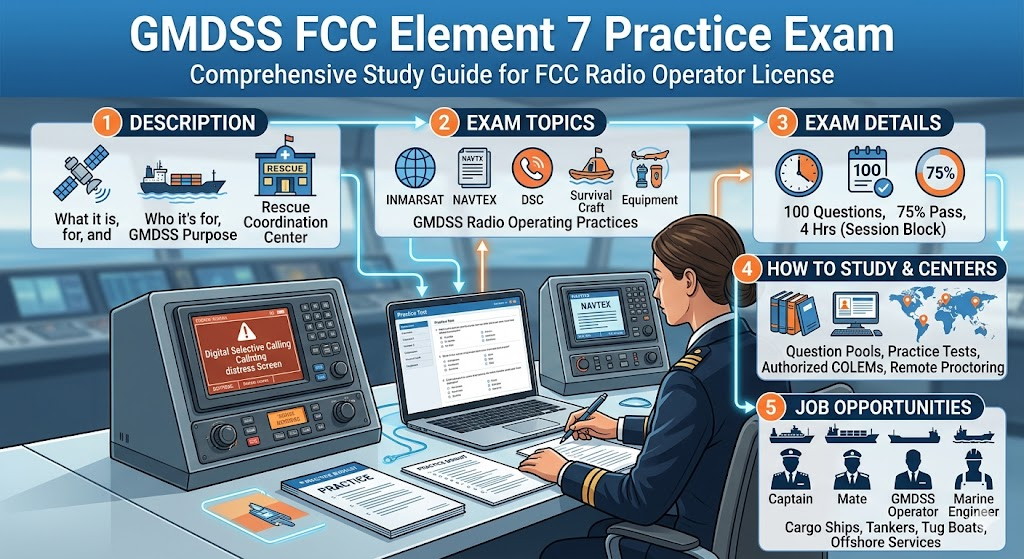
Additional Information
What the Course Entails and Exam Details
To prepare for the FCC GMDSS Element 7 exam, candidates must master the "GMDSS Radio Operating Practices." The scope of knowledge is extensive, covering the detailed practical operation of all GMDSS sub-systems and equipment.
The core syllabus includes, but is not limited to, the following key areas:
General Information: Understanding the fundamental concepts, history, and regulations of GMDSS.
Narrow-Band Direct-Printing (NBDP): Operating procedures and technical aspects of telex-over-radio systems.
INMARSAT: In-depth knowledge of operating and managing safety services via the International Maritime Satellite Organization systems.
NAVTEX: Interpreting and managing navigational telex maritime safety information broadcasts.
Digital Selective Calling (DSC): Expertise in the use of DSC for distress, urgency, and safety communication on VHF, MF, and HF bands.
Survival Craft: Correct operating procedures for survival craft transceivers and other GMDSS equipment in an emergency.
Equipment Operations: Practical knowledge of VHF, MF/HF equipment, antennas, power sources, EPIRBs (Emergency Position Indicating Radio Beacons), SARTs (Search and Rescue Transponders), and more.
What to Expect in the Final Exam
The FCC GMDSS Element 7 is a comprehensive written examination designed to verify a candidate's readiness to operate life-saving equipment.
Here are the specific details of the exam format:
Exam Type: Written, multiple-choice examination.
Number of Questions: 100 questions.
Passing Score: 75% (must correctly answer at least 75 questions).
Time Limit: While some test sessions are scheduled for four hours to accommodate multiple elements, the standard expectation is a sufficient, but managed, period to complete the 100 questions.
Rules: It is a proctored exam. Candidates are usually required to present a government-issued photo ID. Non-programmable calculators are generally permitted, but books, reference materials, programmable calculators, or any device capable of communication or printing are strictly prohibited in the exam room.
Immediately upon completion, you will typically know if you have passed. Successful examinees will receive a Proof of Passing Certificate (PPC) from the administrator.
How to Study and Exam Centers
Effective preparation is the key to success on the GMDSS FCC Element 7 exam, as it is a testing, professional qualification. Here are actionable study strategies:
Utilize the Official Question Pool: The FCC releases the exact pool of questions from which the exam is drawn. Your primary study method should be to review and understand every question and answer in the official "GMDSS Radio Operating Practices" pool.
Take Multiple Practice Tests: Engage with online tools that offer FCC Element 7 practice tests. These simulate the real exam environment, help with time management, and identify areas where you need further study. Focus on tools that draw from the current, official FCC question bank.
Understand the 'Why': Don't just memorize answers; understand the underlying principles of the equipment, regulation, or procedure. This practical understanding will be invaluable in your career.
You cannot take the FCC exam directly at a government office; instead, it is administered by FCC-authorized Commercial Operator License Examination Managers (COLEMs). Here is how to locate a testing center and take the exam:
Authorized COLEMs: Major COLEMs include organizations like ETA International, ISCET (International Society of Certified Electronics Technicians), and iNARTE/Exemplar Global.
Exam Locations: These managers administer tests at hundreds of physical testing centers globally, often located within authorized schools, maritime academies, or dedicated testing facilities.
Online/Remote Proctoring: Many COLEMs now offer secure online remote proctoring. This allows you to take the exam from a computer with a webcam and microphone, from any private location, following strict proctoring guidelines.
Pre-registration: Before scheduling your exam, you must create an FCC user profile and obtain an FCC Registration Number (FRN) via the FCC's CORES system.
Job Opportunities from the Course
Earning your FCC GMDSS Radio Operator's License by passing Element 7, typically taken alongside Element 1, unlocks a wide range of essential careers within the maritime industry.
This license is a requirement for anyone operating GMDSS stations on a compulsory vessel. Specific job titles and career paths enabled by this certification include:
GMDSS Radio Operator: The direct position of managing a ship’s vital safety communication systems.
Mate / Third Mate / Second Mate: A standard requirement for deck officers responsible for bridge operations.
Captain / Master: Vital qualification for the commanding officer of any commercial vessel.
Deck Officer (on derrick barges, tug boats, cargo ships, or tankers): A mandatory skill for officers on specialized and general commercial vessels.
Marine Engineer / Communications Technician: Often a beneficial or required certification for those who maintain shipboard communications and navigation equipment.
Maritime Analyst / DOD Maritime Analyst: Required for shore-based roles that analyze maritime data and support system operations.
Your future at sea begins with a robust understanding of maritime safety. Best of luck with your GMDSS FCC Element 7 Practice Exam and your professional journey!
Frequently Asked Questions
Reviews
5.0
Based on 0 reviews
Leave a Review
No reviews yet. Be the first to review!