
GoMidwife Practice Exam
$69.00
- Buy to unlock unlimited access to all Quiz questions and Answers in this Quiz.
- After purchase you can print a PDF of the whole quiz at any point. The PDF will contain the questions and the correct answers.
About this Exam
The GoMidwife program offers a comprehensive pathway designed to equip aspiring midwives with the theoretical knowledge and practical skills necessary to provide safe, compassionate care in out-of-hospital settings.
This program, often serving as a foundation for achieving the Certified Professional Midwife (CPM) credential through the North American Registry of Midwives (NARM), caters specifically to students dedicated to community-based midwifery, home birth, and birth center care.
It bridges the gap between introductory training and autonomous practice, making it ideal for student midwives currently enrolled in a structured course of study who are preparing for their final academic benchmarks and the NARM written examination.
Ready to test your knowledge?
Buy Now to Access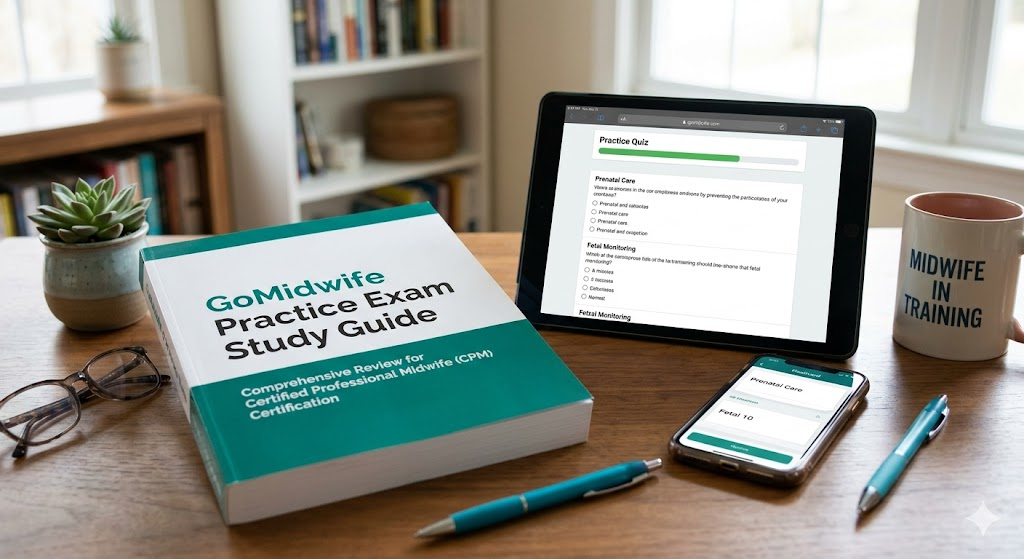
Additional Information
What the Course Entails and Exam Details
The GoMidwife course encompasses a rigorous curriculum that mirrors the core competencies required of a CPM. The training includes both theoretical coursework and documented clinical experience, often completed through an apprenticeship model.
The syllabus covers a vast array of topics essential to maternal and child health. Key core topics include:
Anatomy and Physiology: Detailed study of the female reproductive system and the fetal/newborn body.
Antepartum Care: Normal pregnancy progression, prenatal nutrition, laboratory analysis, risk assessment, and common complications.
Intrapartum Care: The stages of labor, mechanisms of normal birth, positioning, pain management, and emergency skill management.
Postpartum Care: Maternal recovery, breastfeeding support, and physical assessment up to six weeks postpartum.
Newborn Care: Neonatal transition, immediate newborn assessment, resuscitation skills, and physical examination of the neonate.
Midwifery Legalities and Ethics: HIPAA compliance, charting, informed consent, and professional conduct.
Pharmacology and Herbs: Safe use of medications and natural remedies in a midwifery context.
The exam serves as a final cumulative assessment of a student’s mastery over these subjects before they are cleared for graduation and recommended for the NARM certification process.
What to Expect in the Final Exam
The final exam is a comprehensive written assessment designed to test both knowledge recall and critical clinical judgment.
Exam Format
The exam is usually administered online through the GoMidwife learning management portal. It consists of multiple-choice questions, which frequently present clinical scenarios or "case studies." Students must read the situation and choose the best course of action, mirroring the decision-making processes of an active birth attendant.
Question Style
Questions are designed to simulate real-world situations, asking about diagnostic signs, appropriate monitoring frequencies, and immediate emergency responses.
Passing Score and Time Limits
Specific details regarding the number of questions, the exact passing score, and the time allowed are provided directly to students when they register for the exam. It is essential to check the latest candidate handbook as these details can be updated.
Special Rules
As this is a final academic exam leading toward a professional credential, strictly adhered-to proctoring rules are enforced. This often means the exam is closed-book, and strict time limits are applied once the session begins.
How to Study and Exam Centers
Effective study for this comprehensive exam requires a structured and diligent approach. Passive reading is rarely sufficient for a scenario-based test.
How to Study: Actionable Strategies
Utilize Practice Exams: This is the most effective study tool. Take multiple GoMidwife Practice Exams to familiarize yourself with the question format, identify areas of weakness, and practice pacing yourself.
Focus on the NARM Test Specifications: Because GoMidwife is aligned with NARM competencies, the NARM Test Specifications or Candidate Information Booklet (CIB) is your ultimate blueprint. Study the domains and the knowledge items listed there.
Active Learning Techniques: Create detailed flashcards for definitions, normal ranges (e.g., fetal heart rate, neonatal vitals), and medication dosages. Use diagrams for mechanisms of birth and pelvic anatomy.
Review Core Reference Texts: While GoMidwife modules are the primary source, NARM recommends over twenty texts. Ensure you are familiar with standard texts such as "Varney's Midwifery" and "Holistic Midwifery" by Anne Frye.
Form Study Groups: Collaborating with other students can help you vocalize your clinical reasoning and learn from different perspectives on scenario questions.
Testing Centers and Exam Delivery
The GoMidwife final exam is exclusively administered online via the student's personal learning portal on the GoMidwife website. There are no physical testing centers like Pearson VUE required for this specific academic exam. Students must ensure they have a stable internet connection and a private, distraction-free environment for the duration of the test.
Job Opportunities from the Course
Upon passing the final GoMidwife exam and completing all clinical requirements, graduates are eligible to receive their diploma and, critically, pursue their Certified Professional Midwife (CPM) credential. This certification unlocks several specific career paths:
Certified Professional Midwife (CPM)
Licensed Midwife (LM) – Depending on state licensure regulations
Home Birth Midwife
Birth Center Midwife
Birth Center Director/Administrator
Childbirth Educator
Doula Trainer
Maternal and Child Health Advocate
Global Health Midwife
Preceptor for Student Midwives
Frequently Asked Questions
This quiz contains a total of 0 practice questions carefully selected to test your knowledge on this subject.
Yes, you will have exactly 0 minutes to complete the exam. A countdown timer will be visible once you start.
Yes, you can retake this practice test as many times as you need. The questions and options may be randomized on subsequent attempts to ensure comprehensive learning.
Reviews
5.0
Based on 0 reviews
Leave a Review
No reviews yet. Be the first to review!