
Google Cloud DevOps Certification Practice Test
$69.00
- Buy to unlock unlimited access to all Quiz questions and Answers in this Quiz.
- After purchase you can print a PDF of the whole quiz at any point. The PDF will contain the questions and the correct answers.
About this Exam
The Google Cloud DevOps Certification, specifically the Professional Cloud DevOps Engineer designation, validates an individual's expertise in implementing DevOps principles and practices within the Google Cloud environment.
This certification is designed for cloud professionals responsible for implementing efficient software and infrastructure delivery, ensuring service reliability, and streamlining operations using Google's recommended methodologies and tools.
Ideal candidates typically have experience as a DevOps engineer, site reliability engineer (SRE), system administrator, or developer, with a strong focus on automation and cloud infrastructure management.
They are the experts who bridge the gap between development and operations, leveraging technologies like Google Kubernetes Engine (GKE), Cloud Build, and Terraform to accelerate delivery without sacrificing stability.
Ready to test your knowledge?
Buy Now to Access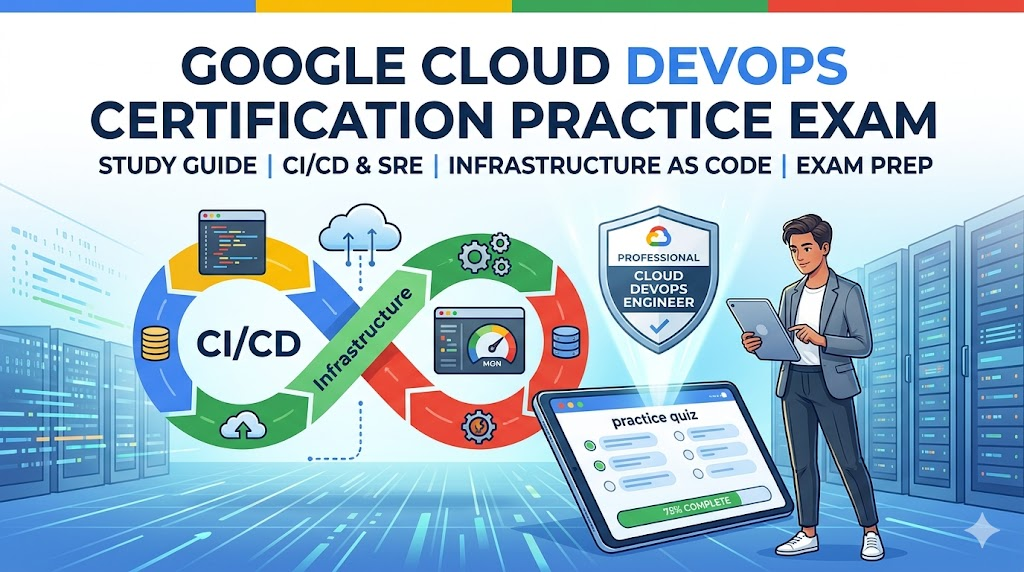
Additional Information
What the Course Entails and Exam Details
This comprehensive learning path and certification validate a wide array of skills essential for a modern DevOps professional on Google Cloud.
Key domains and skills covered include:
Implementing Site Reliability Engineering (SRE) Practices: Understanding the core principles of SRE to balance change velocity and reliability. Defining and monitoring Service Level Indicators (SLIs) and Service Level Objectives (SLOs) to manage service health and error budgets effectively.
Building and Implementing CI/CD Pipelines: Developing automated continuous integration (CI) and continuous delivery (CD) workflows using Google Cloud Build, Cloud Deploy, and integrated tools for artifact management and testing.
Managing Google Cloud Infrastructure as Code (IaC): Provisioning, maintaining, and scaling infrastructure using tools like Terraform and other automated configuration management solutions.
Implementing Observability: Designing and managing logging, monitoring, and tracing solutions with Google Cloud's operations suite (formerly Stackdriver) to gain deep insights into system performance and troubleshoot issues proactively.
Optimizing Performance and Cost: Identifying bottlenecks and applying best practices to maximize system efficiency and minimize infrastructure costs on Google Cloud.
Integrating Security and Compliance: Implementing security controls and automated compliance checks throughout the development and deployment lifecycle (DevSecOps).
What to Expect in the Final Exam
While the practice exam helps you prepare, understanding the structure of the final certification exam is vital for success.
The actual Google Cloud Professional Cloud DevOps Engineer exam typically features the following details:
Exam Duration: You will have 2 hours (120 minutes) to complete the test.
Exam Format: The test consists of approximately 50-60 multiple-choice and multiple-select questions.
Question Types: Some questions will be scenario-based, presenting a real-world DevOps challenge within the context of a hypothetical case study, requiring you to apply your knowledge to choose the best solution.
Language: The exam is available in English and Japanese.
Passing Score: Google does not publicly release a precise passing percentage. The scoring is scaled, and you will receive a result of "Pass" or "Fail" immediately after completing the exam.
Prerequisites: While there are no hard prerequisites, Google recommends approximately 3+ years of industry experience, with at least one year of designing and managing production systems on Google Cloud.
Certification Validity: Google Cloud professional certifications are valid for two years.
How to Study and Exam Centers
Successfully preparing for the Google Cloud Professional Cloud DevOps Engineer exam requires a combination of structured learning, practical experience, and strategic test preparation. Here's a recommended study approach:
How to Study:
Follow the Official Learning Path: Start with the official Google Cloud learning paths, which include a curated list of courses and hands-on labs specifically designed for this certification role.
Hands-on Practice with Labs: There is no substitute for practical experience. Leverage platforms like Qwiklabs or other interactive cloud learning environments to gain hands-on proficiency with Google Cloud services and the tools commonly used in DevOps workflows.
Review Official Documentation: The Google Cloud documentation is an invaluable resource. Deepen your understanding of key services and DevOps-related features by exploring the relevant product documentation.
Utilize Sample Questions: Review the sample questions provided on the official Google Cloud certification page to familiarize yourself with the question style and level of difficulty.
Take Practice Exams: Dedicate significant time to taking full-length practice exams like this one. Practice exams help you assess your readiness, identify knowledge gaps, practice time management, and build confidence.
Join Study Groups: Engage with the Google Cloud developer community and online forums. Connect with other candidates, share study tips, and discuss complex topics.
Focus on Key SRE and DevOps Concepts: Pay special attention to core SRE concepts like SLOs, SLIs, and error budgets, as well as CI/CD pipeline design, monitoring strategies, and infrastructure as code principles.
Where to Take the Final Exam:
Remote Online-Proctored Exam: You can take the certification exam from the comfort of your own home or office through a secure online platform. This option uses online proctoring, where a remote supervisor monitors you via webcam throughout the test.
Authorized Physical Testing Centers: For those who prefer a traditional testing environment, Google partners with globally recognized testing organizations, such as Pearson VUE, which have a network of physical testing centers available in many locations worldwide. You can search for the nearest testing center when scheduling your exam on the official Google Cloud certification portal.
Job Opportunities from the Course
Earning the Google Cloud Professional Cloud DevOps Engineer certification opens doors to a variety of in-demand and well-compensated career paths. This credential is highly respected in the industry and demonstrates your ability to design, implement, and manage automated, scalable, and resilient systems in a cloud-native environment.
Cloud DevOps Engineer
Site Reliability Engineer (SRE)
Cloud Infrastructure Engineer
Build and Release Engineer
Cloud Platform Engineer
DevOps Lead / Manager
Cloud Architect (with a focus on operational efficiency and automation)
Cloud Developer (specializing in cloud-native operational readiness)
These roles exist across diverse sectors, including technology, finance, e-commerce, healthcare, and any industry undergoing digital transformation or leveraging public cloud services. The skills validated by this certification are crucial for organizations looking to increase innovation velocity, enhance product quality, and achieve greater operational stability.
Frequently Asked Questions
Reviews
5.0
Based on 0 reviews
Leave a Review
No reviews yet. Be the first to review!