
GPSTC Criminal Procedure Practice Exam
$69.00
- Buy to unlock unlimited access to all Quiz questions and Answers in this Quiz.
- After purchase you can print a PDF of the whole quiz at any point. The PDF will contain the questions and the correct answers.
About this Exam
The GPSTC Criminal Procedure Practice Exam is a critical benchmark for law enforcement professionals and cadets in the state of Georgia. It is designed to evaluate a candidate's thorough understanding of the legal frameworks that govern police actions, ensuring they operate within the bounds of both state and federal law. This exam is a cornerstone of the training delivered by the Georgia Public Safety Training Center (GPSTC). While entry-level cadets encounter this material during their Basic Law Enforcement Training to earn their initial POST (Peace Officer Standards and Training) certification, the exam also serves experienced officers. It is required for those pursuing advanced specialized certifications, such as the Criminal Investigator or Narcotics Investigator pathways, or for those aiming for the POST Intermediate Certification.
Ready to test your knowledge?
Buy Now to Access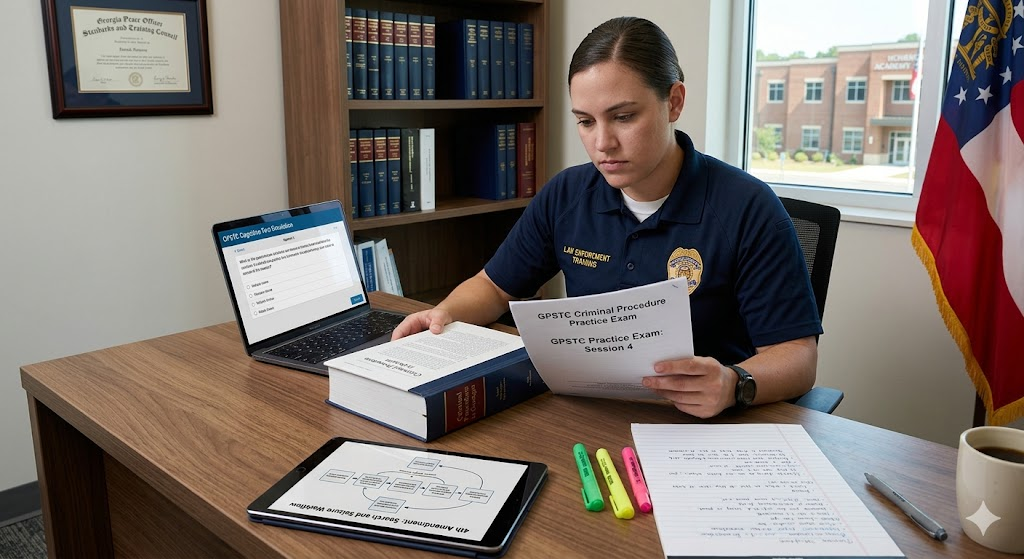
Additional Information
What the Course Entails and Exam Details
This course is focused less on "what is illegal" and more on "how law enforcement must act" to uphold the law legally. It covers the complex rules and constitutional restrictions that dictate daily police operations. The core curriculum is built around the United States Constitution and the Bill of Rights, with a heavy emphasis on the 4th, 5th, 6th, 8th, and 14th Amendments as they apply to law enforcement.
Specific key topics covered in depth include:
Legal Authority and Court Systems: Understanding the hierarchy and roles of State and Federal court systems and the sources of legal authority.
Police-Citizen Encounters: The legal standards for stops, frisks, detentions, and arrests.
Search and Seizure: Detailed study of the 4th Amendment, including search warrants, exceptions to the warrant requirement, Katz (reasonable expectation of privacy), and Jones (trespass) standards.
Interrogations and Confessions: Compliance with the 5th and 6th Amendments, including proper Miranda warnings, waivers, and the exclusion of coerced confessions.
Identification Procedures: Legal standards for lineups, photo arrays, and pre-trial identifications.
The Exclusionary Rule: Understanding the consequences of illegally obtained evidence and the "fruit of the poisonous tree" doctrine.
Georgia State Law: Relevant sections of Title 17 of the Official Code of Georgia Annotated (O.C.G.A.) on criminal procedure.
Case Law Updates: Application of landmark and recent Supreme Court and appellate court rulings.
What to Expect in the Final Exam
While the exact format of a "practice" exam can vary, the final comprehensive evaluation delivered by GPSTC is rigorous. For specialized pathways like Criminal Investigator, the final exam structure includes both a Cognitive Test and a Performance Test.
Cognitive Test: This is a written examination, typically multiple-choice, designed to assess your knowledge of legal terms, constitutional amendments, case law, and specific Georgia statutory codes.
Performance Test (Practical): This scenario-based component measures your ability to apply cognitive knowledge to real-world situations. You may be asked to draft a search warrant affidavit based on provided facts or to execute a legal stop and frisk in a simulated environment.
Passing Score: To succeed and receive certification in specialized programs, applicants must attain a minimum score of 80% on both the cognitive and performance test components for each topic area. If a candidate shows deficiency in a performance area, they are typically required to retake instruction in that topic before challenging the exam again.
How to Study and Exam Centers
Studying for the GPSTC Criminal Procedure exam requires a blend of rote memorization of constitutional principles and the practical application of these rules to scenarios.
Actionable Study Strategies:
Constitutional Breakdown: Master the exact language and scope of the 4th, 5th, and 6th Amendments. Know which amendment governs searches, interrogations, and the right to counsel.
Scenario-Based Practice: Create flashcards or use study groups to run through scenarios. For example: "You have reasonable suspicion to stop a person; when can you legally perform a frisk?"
Key Case Law Mnemonics: Create mnemonics for landmark cases (e.g., Terry v. Ohio for stop and frisk, Miranda v. Arizona for rights).
Review Georgia Title 17: Focus on the specifics of Georgia’s rules for arrest warrants, search warrants, and bail.
Simulate Performance Tests: Practice articulation. Write out clear, concise search warrant affidavits, ensuring you establish strong probable cause.
Exam Centers and Access:
Unlike some national certifications, GPSTC exams are not taken through independent third-party portals like Pearson VUE. Because these exams are tied directly to physical training and POST certification, they are administered at:
GPSTC Main Campus: Located in Forsyth, Georgia.
GPSTC Regional Academies: Multiple locations situated throughout the state to serve local agencies.
Registration for these courses and the associated exams is managed through the GPSTC Student Access portal for certified officers or coordinated directly by academy staff for cadets enrolled in basic training.
Job Opportunities from the Course
Successfully completing the GPSTC Criminal Procedure course and passing its evaluation is a vital step toward a fulfilling career in Georgia public safety. While it is rarely a standalone requirement for a job, it is a key component required to unlock the following professional roles and advancements:
Peace Officer
Police Officer (Municipal/County)
Deputy Sheriff
State Patrol Trooper
GPSTC Basic Mandate Training Cadet
Criminal Investigator
Detective
Narcotics Investigator
Crime Scene Technician (If proceeding to full certification)
Specialized Agency Investigator (e.g., GBI, Department of Revenue)
Frequently Asked Questions
Reviews
5.0
Based on 0 reviews
Leave a Review
No reviews yet. Be the first to review!