
GPSTC Supervision Level 3 Practice Test
$69.00
- Buy to unlock unlimited access to all Quiz questions and Answers in this Quiz.
- After purchase you can print a PDF of the whole quiz at any point. The PDF will contain the questions and the correct answers.
About this Exam
The GPSTC Supervision Level 3 certification is an essential credential for experienced public safety personnel in Georgia, including those in law enforcement, fire services, and emergency medical services (EMS), who are ascending to advanced supervisory and initial command-level positions. This comprehensive program, facilitated by the Georgia Public Safety Training Center (GPSTC), builds upon foundational leadership skills to prepare professionals for complex challenges in operational and administrative management. The corresponding practice exam is a critical tool for candidates, designed to simulate the final assessment and ensure mastery of the sophisticated leadership concepts and regulatory knowledge required to lead effectively in high-stakes public safety environments.
Ready to test your knowledge?
Buy Now to Access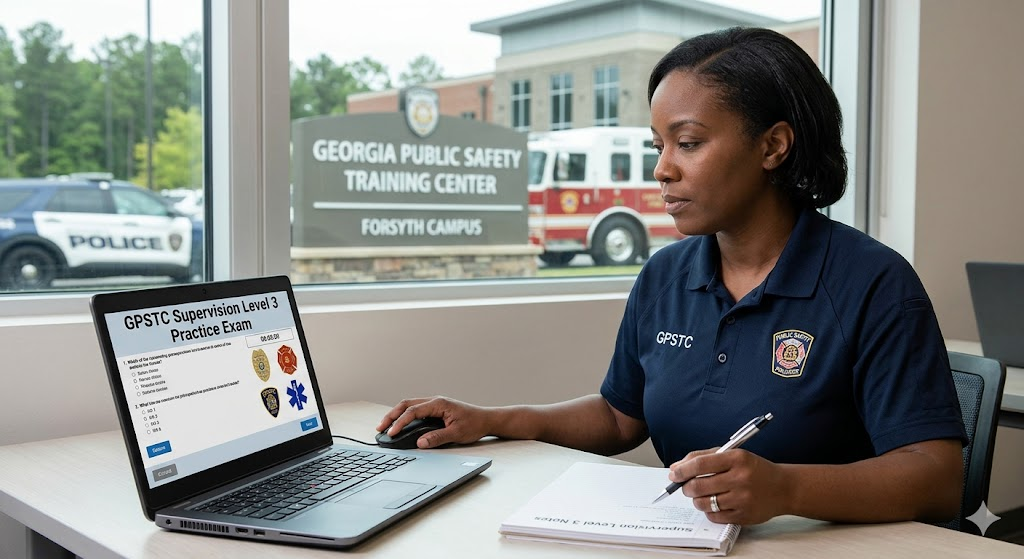
Additional Information
What the Course Entails and Exam Details
The GPSTC Supervision Level 3 course dives deeply into advanced leadership, management, and critical thinking. Key modules often include, but are not limited to, strategic communication for organizational success, conflict resolution in a multi-agency environment, advanced ethical decision-making and risk management, resource allocation and project management, and personnel development and succession planning. It also heavily features leadership models such as adaptive and transformational leadership. The practice exam mirrors these areas, testing understanding of complex scenarios involving interpersonal dynamics, legal liabilities specific to Georgia public safety, and the application of motivation theories like Maslow’s Hierarchy within a supervisory context. Candidates must demonstrate not just recollection, but the capacity to synthesize this information to make sound, defensible supervisory decisions.
What to Expect in the Final Exam
The final GPSTC Supervision Level 3 Exam is a rigorous, closed-book evaluation that rigorously assesses the candidate's readiness for advanced leadership. Typically, the exam is delivered in a multiple-choice format, designed to test a mix of factual knowledge and situational judgment. It includes scenarios that require applying supervisory principles to real-world public safety challenges. While specific details can vary slightly by program and delivery method, candidates should be prepared for a substantial time limit, often matching the length and intensity of a full training block. The passing score required is usually established at 70% or higher, reflecting the need for a strong grasp of the material to operate competently at this level. There are no practical, hand-on components; the focus is entirely on the cognitive skills required for effective supervision.
How to Study and Exam Centers
Effective preparation for the GPSTC Supervision Level 3 Exam requires a focused, multifaceted approach. To excel, candidates should begin with a thorough review of the entire GPSTC student manual and all lecture materials provided during the course. Using comprehensive practice exams is indispensable for identifying knowledge gaps, becoming familiar with the types of situational questions, and improving time management. Formation of study groups with peers allows for discussion of complex leadership scenarios, which can deepen understanding and improve critical thinking. To take the official exam, candidates must register through the GPSTC student portal and typically complete it at one of the GPSTC's primary facilities, such as the main campus in Forsyth, or at an authorized regional training center throughout the state of Georgia. Some components or re-tests may have online options, but the standard practice involves proctored, in-person testing to ensure academic integrity.
Job Opportunities from the Course
Successfully completing the GPSTC Supervision Level 3 training and passing its corresponding exam validates an individual's capability to lead at a superior level, making them a primary candidate for promotion and expanded responsibility. This certification unlocks a wide range of job opportunities and advances career paths within Georgia’s public safety sector. Key positions that often list this, or its subsequent management levels, as a prerequisite or highly desirable qualification include Law Enforcement Sergeant or Lieutenant, Fire Captain, Battalion Chief, EMS Shift Supervisor, and specialized Command Staff roles. Beyond direct line supervision, it is also highly valuable for positions in agency administration, training coordination, and specialized task force leadership.
Frequently Asked Questions
Reviews
5.0
Based on 0 reviews
Leave a Review
No reviews yet. Be the first to review!