
GPSTC Traffic Enforcement Practice Test
$69.00
- Buy to unlock unlimited access to all Quiz questions and Answers in this Quiz.
- After purchase you can print a PDF of the whole quiz at any point. The PDF will contain the questions and the correct answers.
About this Exam
The GPSTC Traffic Enforcement Practice Exam is an essential tool for current and aspiring law enforcement professionals in Georgia who are preparing for the official Georgia Public Safety Training Center (GPSTC) Traffic Enforcement certification. This certification validates an officer's understanding of state traffic laws, safety regulations, and operational procedures vital for maintaining public safety on the road. The practice test is designed to evaluate knowledge and readiness across all key areas covered in the actual exam, offering a comprehensive review and identifying areas where additional study is needed. It is a critical component for anyone aiming to serve in a specialized traffic enforcement capacity or enhance their general law enforcement credentials within the state of Georgia.
Ready to test your knowledge?
Buy Now to Access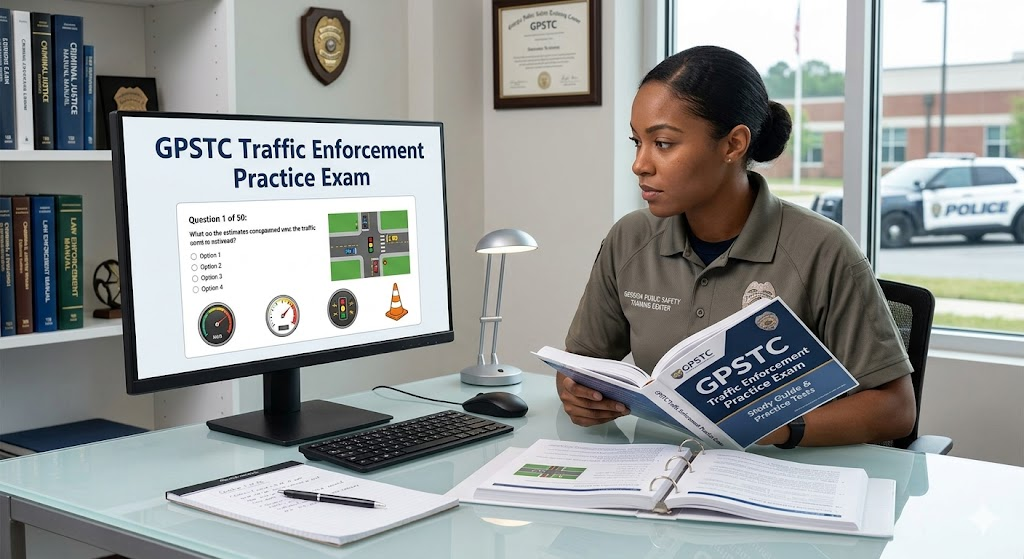
Additional Information
What the Course Entails and Exam Details
This practice exam covers a broad spectrum of topics essential for effective and compliant traffic enforcement in Georgia. While specific questions can vary, a robust practice test includes major areas of study and performance requirements such as:
Georgia Traffic Laws (O.C.G.A. Title 40): Extensive knowledge of the Official Code of Georgia Annotated relating to rules of the road, vehicle equipment, licensing, and insurance.
Speed Detection: Understanding of the legalities, technology (including RADAR/LIDAR), and procedural techniques for accurate speed measurement and enforcement.
DUI Enforcement: Practical and legal aspects of detecting, investigating, and prosecuting cases of driving under the influence of alcohol and/or drugs.
Traffic Stops: Proper and safe procedures for conducting traffic stops, interacting with drivers, and issuing citations.
Report Writing: Techniques for creating clear, accurate, and comprehensive reports for traffic incidents and violations.
Safety Practices: Crucial information on ensuring officer and public safety in various traffic enforcement scenarios.
Equipment Operation: Potential knowledge-based questions regarding the setup and safe use of common traffic enforcement tools.
What to Expect in the Final Exam
While the final GPSTC Traffic Enforcement Certification often involves both written and practical assessments (such as a skill demonstration for speed detection, though details must be verified by current GPSTC curriculum), the written portion, which this practice exam simulates, is typically structured as follows:
Format: The written exam primarily features multiple-choice and/or true/false questions, designed to objectively assess your knowledge base and critical thinking within the scope of traffic laws and enforcement.
Time Limit: Expect a strict time limit to complete the written portion, which can range from 1 to 2 hours, requiring efficient time management. The specific time is defined by the GPSTC at the time of scheduling.
Passing Score: Achieving a passing score is non-negotiable. While specific requirements can change, many public safety exams mandate a significant passing grade, often 70-80% or higher, to demonstrate competence. You should aim for a higher score on practice tests to account for exam-day conditions.
Practical Component: It is important to understand that a practice test only covers the cognitive portion. The final real-world certification process frequently includes a hands-on practical skills test, particularly for areas like speed detection equipment usage and application.
Official Rules: All officially administered exams strictly prohibit cheating, collaboration, and the use of external materials or devices, ensuring the integrity of the certification process. Be sure to understand all specific rules before taking the official final exam.
How to Study and Exam Centers
Preparation for the GPSTC Traffic Enforcement Practice Test should be methodical and thorough. Here are actionable study strategies and essential information about exam locations:
Utilize the Practice Test: The core of your study should be this practice exam. Take it multiple times, carefully review the correct answers and, crucially, understand why the incorrect answers are wrong. Use it as a diagnostic tool to focus your efforts.
Study official Georgia Law: Direct study of the Official Code of Georgia Annotated (O.C.G.A.) Title 40 is essential. Focus on key definitions, violations, and procedural requirements for the topics listed above.
Consult GPSTC Materials: If available, seek out official study guides, handbooks, and curriculum materials provided by the GPSTC to participating agencies and individuals. These resources are tailored specifically to the exam content.
Create Study Tools: Develop flashcards for key legal terms, violation codes, specific equipment operations, and safety checklists to reinforce memorization and recall.
Forms & Scenarios: Study sample report forms and practice writing clear, accurate, and detailed reports based on common traffic scenarios, ensuring a practical understanding of requirements.
Group Study: If possible, form a study group with colleagues also preparing for the exam. Discussing concepts and potential test scenarios can clarify understanding and improve retention.
Official Exam Locations: Final certification exams are conducted through the Georgia Public Safety Training Center (GPSTC). Authorized testing is often administered:
At a dedicated GPSTC campus location, such as the main campus in Forsyth, Georgia.
Through individual law enforcement agencies which are recognized as training facilities by the GPSTC, where instructors are certified to oversee the exam process.
Scheduling: Contact your agency or the GPSTC directly for information on scheduling your final exam and to confirm all current requirements and testing protocols. Do not solely rely on practice tests; ensure you have registered through the proper channels for the official certification.
Job Opportunities from the Course
A successful GPSTC Traffic Enforcement certification opens doors to various law enforcement roles within Georgia where specialized knowledge of traffic management and safety is highly valued. It enhances an officer's skill set, demonstrating proficiency in a fundamental public safety function. Potential job titles and career paths include:
Georgia State Patrol Trooper
Traffic Enforcement Officer (within local police or sheriff's departments)
Sheriff's Deputy (often with general patrol including traffic duties, or specific traffic division assignment)
Municipal Police Officer (often within a traffic or specialized patrol unit)
University Campus Police Officer
Public Safety Officer (in a combined police/fire/emergency setting with traffic responsibilities)
Specialized Accident Reconstruction Team Member (requires additional training beyond basic traffic enforcement)
Traffic Unit Supervisor (advancement from a specialized officer role)
Law Enforcement Training Instructor (specializing in traffic enforcement, potentially within a GPSTC context)
Frequently Asked Questions
Reviews
5.0
Based on 0 reviews
Leave a Review
No reviews yet. Be the first to review!