
Grade 10 Optics Practice Test
$69.00
- Buy to unlock unlimited access to all Quiz questions and Answers in this Quiz.
- After purchase you can print a PDF of the whole quiz at any point. The PDF will contain the questions and the correct answers.
About this Exam
The Grade 10 Optics Practice Test is an essential study tool designed for high school students aiming to excel in their physics curriculum. It serves as a comprehensive review of fundamental concepts concerning light, its properties, and how it interacts with different materials. This practice exam is specifically created to help students in Grade 10 science classes gauge their understanding, identify areas for improvement, and build confidence before taking their actual classroom assessments or standardized tests. It is an ideal resource for anyone looking to master the basics of geometric optics and light behavior.
Ready to test your knowledge?
Buy Now to Access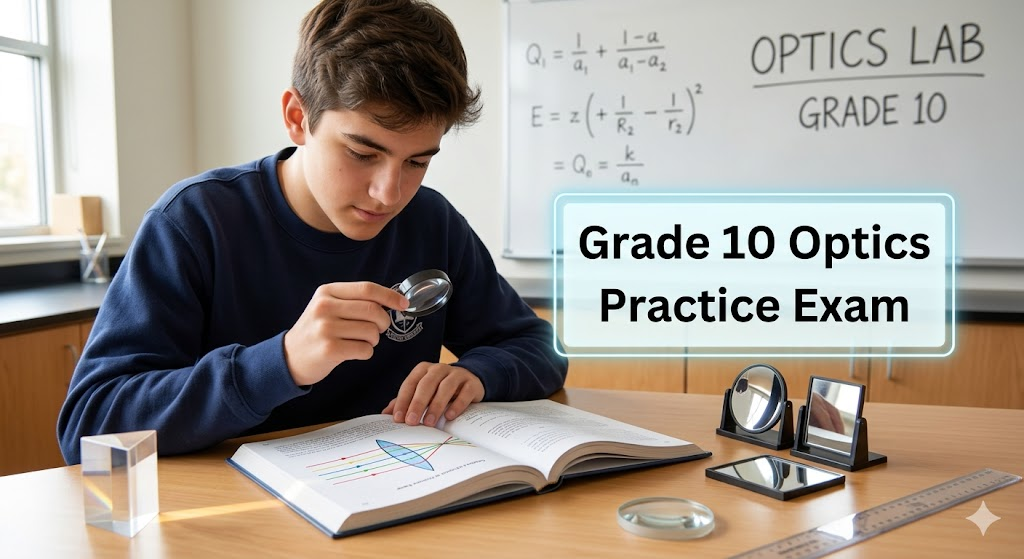
Additional Information
What the Course Entails and Exam Details
This study guide and accompanying practice test cover the core topics typically found in a Grade 10 unit on optics. By engaging with this material, students will review:
The Nature of Light: Properties of light, the electromagnetic spectrum, and the speed of light.
Reflection: Law of reflection, plane mirrors, concave and convex mirrors (including ray diagrams and mirror equations).
Refraction: The bending of light as it passes between media, the index of refraction, and Snell’s Law.
Lenses: Converging (convex) and diverging (concave) lenses, ray diagrams for lenses, and the thin lens equation.
Total Internal Reflection: Critical angle and applications like fiber optics.
The Human Eye and Optical Instruments: How the eye perceives light, common vision defects (myopia, hyperopia), and how lenses are used to correct them. Magnifying glasses, microscopes, and telescopes.
What to Expect in the Final Exam
While this is a study guide and practice test, the structure reflects a typical Grade 10 science exam. Users can expect:
Format: A mix of multiple-choice questions, true/false statements, short-answer questions, and problem-solving tasks requiring calculations. A significant portion focuses on the ability to correctly draw and interpret ray diagrams for mirrors and lenses.
Content: Questions will test both conceptual understanding (e.g., "Describe the image formed by a concave mirror...") and mathematical application (e.g., "Calculate the image distance...").
Time Limit and Passing Score: Unlike a formal certification, the time and score required are determined by the individual teacher or school. However, a typical practice session should be completed within 60-90 minutes, and students should aim for a score above 70% to demonstrate proficiency.
How to Study and Exam Centers
Effective preparation for an optics exam requires a combination of reviewing theoretical concepts and hands-on practice.
Actionable Study Strategies:
Master Ray Diagrams: This is critical. Practice drawing ray diagrams for all types of mirrors and lenses with different object locations until you can do them quickly and accurately.
Solve Problems Daily: Work through numerical problems involving the mirror equation, lens equation, magnification, and Snell's Law.
Use Visual Aids: Utilize online simulations and animations to visualize how light refracts and reflects.
Form Study Groups: Explaining concepts to peers is one of the best ways to solidify your own understanding.
Practice with this Guide: Take the practice questions under timed conditions to simulate the exam environment.
Exam Centers:
This practice test is an educational resource intended for self-study. There are no official external "exam centers" for this specific product. The official assessments for which this prepares you (e.g., end-of-unit tests, final exams) are typically administered directly within your registered high school classroom by your science teacher.
Job Opportunities from the Course
While a Grade 10 exam is an early step, a strong foundation in optics can lead to a diverse range of exciting and rewarding career paths. Advancing knowledge in this field unlocks job opportunities such as:
Optometrist
Ophthalmologist
Ophthalmic Technician
Optical Engineer
Photonics Technician
Lens Designer
Laser Systems Engineer
Laboratory Technician (in physics, biology, or materials science)
Science Teacher
Astronomer
Frequently Asked Questions
Reviews
5.0
Based on 0 reviews
Leave a Review
No reviews yet. Be the first to review!