
Grade 9 Biological Diversity Unit Practice Exam
$69.00
- Buy to unlock unlimited access to all Quiz questions and Answers in this Quiz.
- After purchase you can print a PDF of the whole quiz at any point. The PDF will contain the questions and the correct answers.
About this Exam
The Grade 9 Biological Diversity Unit Practice Exam is an essential study resource designed for junior high students. It offers a comprehensive review of the foundational concepts of biology, focusing specifically on the variation of life. This practice exam is tailored for students currently enrolled in Grade 9 Science who are preparing for their unit final or seeking to solidify their understanding of ecological principles. It aims to build confidence, identify knowledge gaps, and familiarize students with the testing format they will encounter in their actual assessment.
Ready to test your knowledge?
Buy Now to Access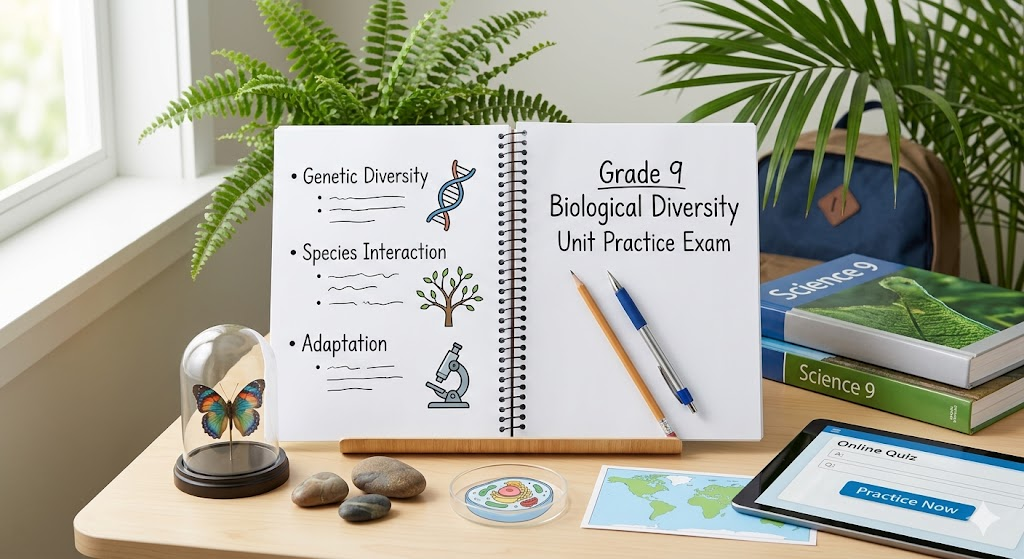
Additional Information
What the Course Entails and Exam Details
This unit investigates the variety of living things on Earth and the critical interconnections between them. Students exploring this course material delve into the classification systems that scientists use to organize the vast number of species. The syllabus covers the core principles of genetics, including the role of DNA, chromosomes, and genes in determining inherited traits. Learners examine variations within species and discrete versus continuous traits. The course details natural selection, the mechanisms of evolution, and the impact of human activity on ecosystems and global biodiversity.
What to Expect in the Final Exam
When sitting for the actual unit final, students can generally expect a standardized academic format. The exam often utilizes multiple-choice questions to test broad knowledge and retention of terminology. Numerical response or short-answer questions are common for assessing a deeper understanding of genetics problems or ecological concepts. A passing score typically aligns with the school district’s standard grading scale, often requiring 50% or higher for a passing grade. The time limit is usually contained within a single class period, ranging from 60 to 90 minutes. Students must adhere to standard academic integrity rules; electronic devices, open textbooks, and unauthorized notes are strictly prohibited during the assessment.
How to Study and Exam Centers
Active review is the most effective way to prepare for the Grade 9 Biological Diversity final. Students should create flashcards for key terms like "alleles," "commensalism," and "speciation." Drawing and labeling diagrams of DNA structure or cellular division can also reinforce memory. Practicing Punnett squares is crucial for mastering genetic inheritance questions. Forming study groups allows classmates to quiz each other on difficult concepts. Regarding exam centers, the actual unit final is almost always administered in the student’s regular Grade 9 Science classroom at their authorized junior high or middle school.
Job Opportunities from the Course
While a single Grade 9 unit exam does not provide direct entry-level employment certification, mastering this material is the essential first step toward several rewarding career paths in the life sciences. Excelling in high school biology opens the doors to further post-secondary education. The skills and knowledge initiated in this unit eventually unlock numerous professional job opportunities in science, conservation, and health.
The foundational knowledge unlocked by this course is the first step toward the following careers:
Wildlife Biologist
Conservation Officer
Veterinarian
Genetic Counselor
Environmental Scientist
Marine Biologist
Zoologist
Ecologist
Lab Technician
Science Educator
Botanist
Frequently Asked Questions
Reviews
5.0
Based on 0 reviews
Leave a Review
No reviews yet. Be the first to review!