
Graduate Management Admission Test (GMAT) Practice Test
$69.00
- Buy to unlock unlimited access to all Quiz questions and Answers in this Quiz.
- After purchase you can print a PDF of the whole quiz at any point. The PDF will contain the questions and the correct answers.
About this Exam
The Graduate Management Admission Test (GMAT) is a globally recognized, standardized exam specifically designed for prospective business school students. It serves as a critical benchmark for admissions committees at top-tier universities worldwide to assess a candidate's readiness for rigorous graduate-level business and management programs. Whether you are aiming for a Master of Business Administration (MBA), a Master of Accountancy, or a Master of Finance, securing a strong score on this test is an essential step in your academic journey. Taking a GMAT practice exam is the most effective way to gauge your current abilities, familiarize yourself with the unique computer-adaptive format, and identify areas requiring further study before your official test day.
Ready to test your knowledge?
Buy Now to Access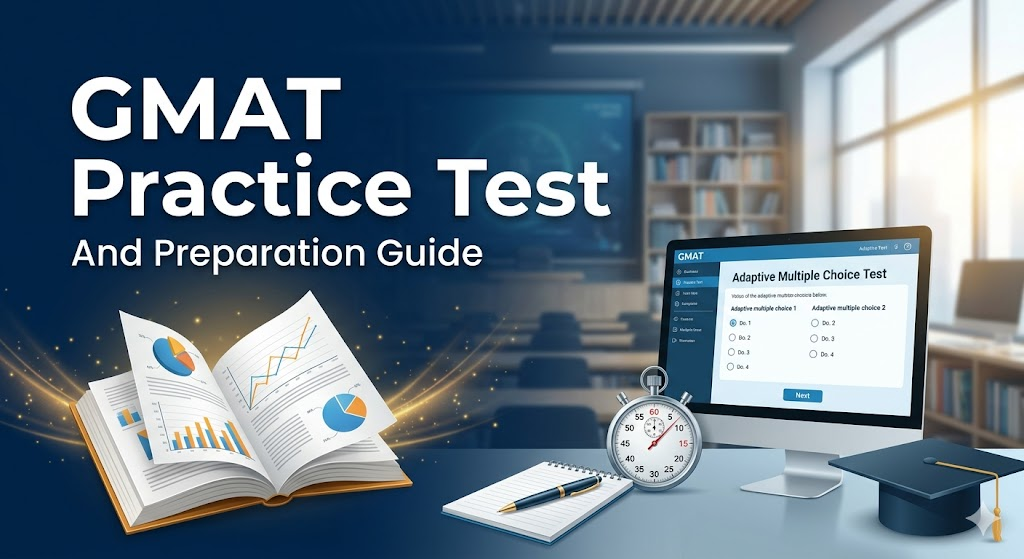
Additional Information
What the Course Entails and Exam Details
Preparing for the GMAT requires a comprehensive understanding of several distinct skill sets, all of which are essential for success in a demanding corporate environment. The modern exam structure, recently updated to the GMAT Focus Edition, streamlines the testing process by focusing purely on higher-order reasoning. The syllabus is divided into three core sections: Quantitative Reasoning, Verbal Reasoning, and Data Insights.
The Quantitative Reasoning section rigorously tests your mathematical foundations, focusing on algebra, arithmetic, and problem-solving abilities without the use of a calculator. The Verbal Reasoning section evaluates your reading comprehension and critical reasoning skills, requiring you to analyze complex arguments and draw logical conclusions from written text. Finally, the newly introduced Data Insights section measures your digital and data literacy. This section requires you to interpret information from multiple sources, analyze complex tables and graphical data, and apply mathematics to real-world business scenarios.
What to Expect in the Final Exam
The actual GMAT exam is a Computer Adaptive Test (CAT), meaning the difficulty of the questions adjusts in real-time based on your previous answers. If you answer a question correctly, the next one will likely be harder; if you answer incorrectly, the next one will be slightly easier. This sophisticated testing mechanism allows the exam to pinpoint your exact skill level accurately.
The total duration of the exam is approximately 2 hours and 15 minutes, broken down into three 45-minute sections, with an optional 10-minute break that you can take whenever you need it. You are expected to answer a total of 64 questions across the three categories. The scoring scale ranges from 205 to 805, with scores ending in a 5 to distinguish them from the older, traditional GMAT scoring system. There is no strictly defined "passing" score, as requirements vary significantly between universities. However, top-tier business schools typically look for candidates scoring in the upper percentiles, making rigorous practice an absolute necessity.
How to Study and Exam Centers
A strategic approach is the key to conquering the GMAT. Start by taking a full-length, timed practice exam to establish your baseline score and identify your weakest subjects. Build a strict study schedule that dedicates time to reviewing core mathematical concepts, enhancing your reading speed, and practicing data interpretation. Time management is highly critical; practice pacing yourself to ensure you do not run out of time during the actual test. Utilize official study materials from the Graduate Management Admission Council (GMAC) to ensure you are practicing with authentic, retired questions.
When you are ready to take the test, you have flexible options to suit your preferences. You can take the exam in person at specialized, highly secure Pearson VUE testing centers located in major cities across the globe. Alternatively, you can opt for the GMAT Online exam, which allows you to take the test from the comfort and privacy of your own home or office. The online version is continuously proctored by a live invigilator via your webcam and microphone to ensure strict testing integrity.
Job Opportunities from the Course
While the GMAT itself is not a certification that directly guarantees employment, it is the primary gateway to an MBA or advanced business degree. Acquiring that degree unlocks a wide array of highly lucrative and prestigious career paths across multiple industries. Below are some of the key job titles you can pursue after completing your graduate management education:
Management Consultant: Advising organizations on how to improve efficiency, solve complex problems, and maximize profitability.
Investment Banker: Guiding corporations and government entities through complex financial transactions, mergers, and acquisitions.
Product Manager: Overseeing the development, marketing, and lifecycle of a product within tech companies and consumer brands.
Financial Manager or Director: Directing investment activities, developing financial strategies, and ensuring the long-term financial health of an organization.
Marketing Executive (CMO): Leading marketing campaigns, brand strategy, and consumer outreach on a global scale.
Operations Manager: Streamlining supply chains, improving production processes, and ensuring business operations run smoothly and cost-effectively.
Frequently Asked Questions
Reviews
5.0
Based on 0 reviews
Leave a Review
No reviews yet. Be the first to review!