
Green Belt Phase 1 Practice Test
$69.00
- Buy to unlock unlimited access to all Quiz questions and Answers in this Quiz.
- After purchase you can print a PDF of the whole quiz at any point. The PDF will contain the questions and the correct answers.
About this Exam
The Green Belt Phase 1 certification serves as a fundamental stepping stone within the Lean Six Sigma methodology, focusing primarily on the initial, foundational stages of process improvement. This designation is meticulously designed for business professionals across all departments—ranging from operations, supply chain, and manufacturing to finance, healthcare, and human resources—who are eager to play an active role in enhancing organizational efficiency. The Green Belt Phase 1 course is ideal for quality assurance analysts, project team members, junior process engineers, and anyone aspiring to eventually lead data-driven improvement projects as a full Green Belt. By earning this certification, you demonstrate to employers that you have a core understanding of how to identify process waste, define problem areas, and begin the journey of measuring process performance for impactful change.
Ready to test your knowledge?
Buy Now to Access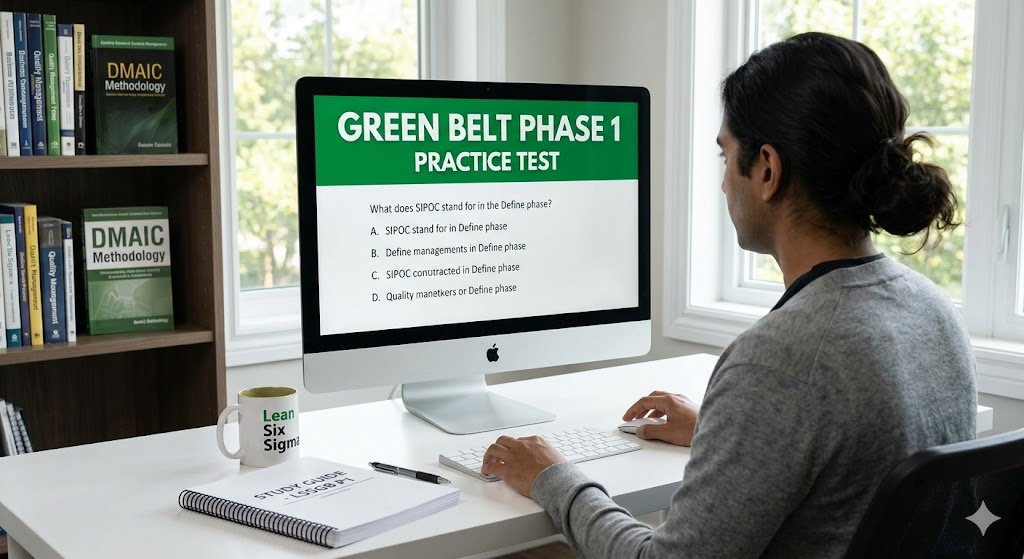
Additional Information
What the Course Entails and Exam Details
The Green Belt Phase 1 syllabus is focused intensely on the introductory components of the DMAIC (Define, Measure, Analyze, Improve, and Control) framework. Candidates are expected to master the techniques needed to clearly articulate business problems and map existing processes accurately before delving into advanced statistical analysis. While a full Green Belt course covers the entire DMAIC spectrum, Phase 1 establishes the rock-solid base required to support that advanced work.
Core Topics and Syllabus Covered:
Introduction to Lean Six Sigma Fundamentals: Understanding the history, key differences between Lean and Six Sigma, and how they work synergistically to reduce waste and variation.
The DMAIC Framework Overview: Gaining a clear perspective on the five-phase process, with a specific, deep dive into the first two phases.
The Define Phase: Master class in creating robust Project Charters, conducting Stakeholder Analysis, determining the Voice of the Customer (VOC), and defining Critical-to-Quality (CTQ) requirements.
The Measure Phase Basics: Learning how to identify process input, process, and output variables. This includes understanding different data types (attribute vs. variable data) and the basics of data collection planning.
Process Mapping and Visualization: Developing expertise in creating high-level process maps, such as SIPOC diagrams (Supplier, Input, Process, Output, Customer) and fundamental flowcharts.
Introduction to Waste Identification: Recognizing the eight types of waste (DOWNTIME) within any business process.
What to Expect in the Final Exam
Knowing what to expect format-wise significantly reduces test anxiety. The Green Belt Phase 1 final exam is generally designed to test your comprehension of the core concepts and your ability to apply basic tools within scenarios. Unlike a full Green Belt or Black Belt exam, it typically focuses less on complex statistical calculations and more on definitions, methodology, and elementary tool application.
Typical Exam Format and Rules:
Question Type: The vast majority of Green Belt Phase 1 exams utilize a Multiple Choice format, occasionally supplemented by True/False or basic drag-and-drop sequencing questions.
Total Questions: You should expect between 50 and 75 questions on the final test. The Green Belt Phase 1 Practice Test will mirror this length to simulate the actual testing environment.
Time Limit: Most testing bodies allow candidates 90 to 120 minutes to complete the exam. Pacing yourself is crucial.
Passing Score: The required passing score usually falls within the range of 70% to 80%. This ensures you have a strong grasp of the material rather than just a superficial familiarity.
Exam Mode: Exams are almost exclusively proctored. This means they will be supervised, either in person or remotely via webcam and screen-sharing software.
Open vs. Closed Book: This varies widely by the certification provider. Organizations like the American Society for Quality (ASQ) often hold closed-book exams, while others might allow specific handbooks or notes. Refer strictly to your specific provider's guidelines.
How to Study and Exam Centers
Effective preparation requires a structured approach that moves beyond simple reading into active application. When utilizing a practice test for Green Belt Phase 1, treat it as a diagnostic tool rather than just another hurdle. It’s an invaluable way to pinpoint exactly where your knowledge is strong and where you need further review.
Actionable Study Strategies:
Engage in Active Learning: Don’t just passively read your study guide. Take notes, create flashcards for key definitions (e.g., CTQ, SIPOC, DOWNTIME), and explain concepts out loud to test your own understanding.
Master the Vocabulary: Lean Six Sigma has a unique language. Ensure you can differentiate between similar terms, such as VOC and Critical to Quality (CTQ) characteristics.
Use Practice Tests Strategically: Take your first Green Belt Phase 1 Practice Exam about midway through your study plan to identify weak points. Save the last few practice tests for the final week of prep to refine your timing and build endurance. Analyze every incorrect answer to understand the logic behind the correct choice.
Focus on the ‘Why’ and ‘How’: For each tool (e.g., SIPOC), don't just memorize the acronym. Understand why it is used in the Define phase and how to construct one given a basic process description.
Form Study Groups: Collaborating with peers can provide new perspectives on difficult topics and offers accountability.
Exam Centers and Testing Methods:
The method of taking the exam depends on which certifying body you have chosen (e.g., ASQ, IASSC, CSSC, or a specific university program).
Online Proctored Exams: This is the most common and convenient method. You take the exam from your own home or office computer, monitored remotely by a live proctor through your webcam and microphone.
Pearson VUE Testing Centers: Many major certifying bodies partner with Pearson VUE. This requires you to schedule a time and travel to a secure, physical Pearson VUE facility to take the computer-based exam.
University or Training Provider Centers: If you are part of a corporate training program or a university course, the exam might be administered on-site at their dedicated testing facilities.
Job Opportunities from the Course
Earning your Green Belt Phase 1 certification demonstrates a formalized commitment to quality and efficiency that is highly valued by employers globally. While it is a foundational certification, it immediately qualifies you for roles where process awareness and basic improvement skills are required, and it positions you perfectly for advancement into lead improvement roles upon completing your full Green Belt.
Job Titles and Career Paths Unlocked:
Process Improvement Analyst: Specifically roles focusing on documenting workflows, identifying bottlenecks, and collecting baseline data.
Quality Assurance Coordinator: Applying measurement basics and process mapping skills to enhance QA protocols.
Junior Project Manager: Integrating Lean Six Sigma Define phase tools (like the Project Charter) into project planning and execution.
Continuous Improvement Specialist (Entry-Level): Supporting larger DMAIC projects led by Black Belts or full Green Belts.
Operational Excellence Coordinator: Helping to track key performance indicators (KPIs) and visualize process performance across the organization.
Data Analyst (Process Focus): Using the measurement basics to improve the quality and relevance of data collection for business intelligence.
Supply Chain Junior Analyst: Identifying waste within logistical or inventory management processes.
Investing time in preparing for your Green Belt Phase 1 exam is an investment in your career trajectory. Be disciplined in your studies, utilize your practice tests effectively, and approach the exam with confidence in your understanding of these transformative methodologies. Good luck!
Frequently Asked Questions
Reviews
5.0
Based on 0 reviews
Leave a Review
No reviews yet. Be the first to review!