
Greenhand Conduct of Meetings Practice Test
$69.00
- Buy to unlock unlimited access to all Quiz questions and Answers in this Quiz.
- After purchase you can print a PDF of the whole quiz at any point. The PDF will contain the questions and the correct answers.
About this Exam
The Greenhand Conduct of Meetings Leadership Development Event (LDE) is specifically designed for first-year, or "Greenhand," members of FFA, typically those in the 7th, 8th, or 9th grades. The primary goal of this event is to introduce students to the fundamentals of conducting a formal business meeting and applying parliamentary law, while also fostering teamwork, public speaking, and critical thinking.
Participants work as a team of seven, filling the traditional officer roles (President, Vice President, Secretary, Treasurer, Reporter, Sentinel, and an adult Advisor part), to demonstrate their ability to open a meeting, handle business, and close the meeting with efficiency and order. It’s an engaging introduction to the essential leadership skills that will serve them throughout their academic and professional careers.
Ready to test your knowledge?
Buy Now to Access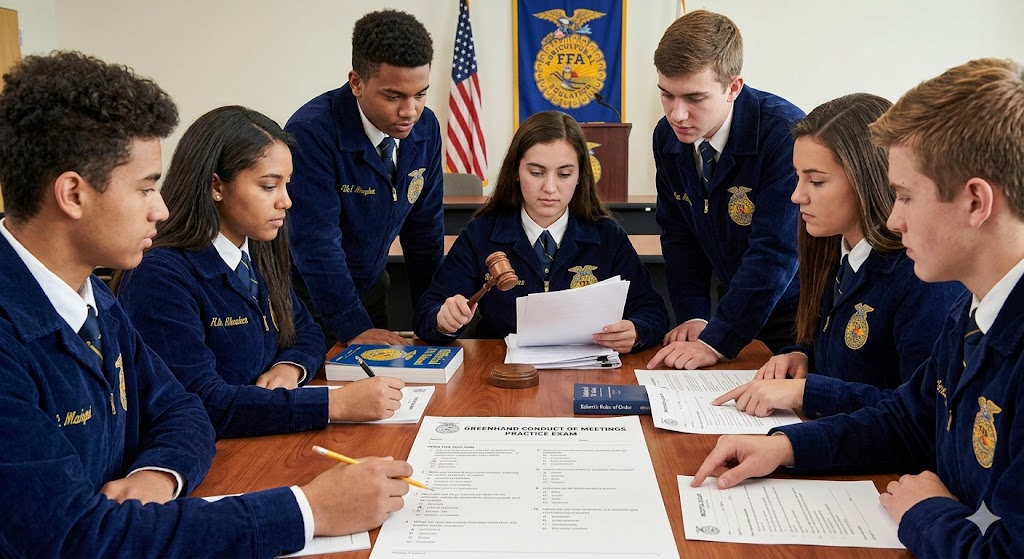
Additional Information
What the Course Entails and Exam Details
This event is not a traditional "course" you take in a classroom, but rather a team-based leadership development activity that you prepare for through study and practice. The overall LDE assesses a team's competence in three key areas:
FFA Opening and Closing Ceremonies: Teams must memorize and flawlessly perform the official ceremonies as prescribed in the latest edition of the Official FFA Manual. This requires knowledge of officer stations, specific rituals, and symbolic gestures.
Conducting Business: Using a scenario provided at the competition, the team must demonstrate correct parliamentary procedure to introduce, discuss, and dispose of motions. A pre-set list of "permissible motions" defines the scope of their demonstration. These typically include motions to Amend, Lay on the Table, Commit or Refer, Postpone to a Certain Time, Postpone Indefinitely, Recess, Raise a Question of Privilege, Call for a Division of the Assembly, Rise to a Point of Order, and Parliamentary Inquiry.
Written Exam: Each individual team member also completes a separate written examination. This exam is a critical component and often covers a blend of:
The Official FFA Manual: Questions regarding the history, structure, and principles of the FFA, as well as the specific duties of each officer and proper meeting room preparation.
Parliamentary Procedure: Understanding the classifications, characteristics, purposes, and proper handling of all permissible motions, as well as the rules governing debate and the order of business.
What to Expect in the Final Exam
When you arrive at the competition for the Greenhand Conduct of Meetings LDE, you can expect a two-part evaluation process:
Part A: The Written Examination
This is a standard multiple-choice test taken individually. The specific number of questions and time limit can vary by state or region, but common formats include:
Number of Questions: Anywhere from 25 to 50 questions is typical for the Greenhand level.
Content Split: Roughly 25-50% on FFA Manual material and officer duties, and 50-75% on Parliamentary Procedure principles and motion characteristics.
Time Limit: Usually 30 to 60 minutes.
Scoring: Each question is worth one point. The individual scores of all seven team members are typically averaged to contribute a portion of the overall team score (e.g., 25% to 50% of the total points).
Part B: The Team Demonstration and Oral Questions
After the written exam, your team will perform a demonstration in front of judges. This part includes:
Preparation Time: Teams may receive a five-minute period in a preparation room to review the items of business they must cover and to plan their strategy for the mock meeting.
Presentation: A team of seven demonstrates the opening ceremony, handles a main motion and several assigned permissible motions using debate, and concludes with the closing ceremony. The presentation is timed, typically around 12 to 13 minutes total. Penalties are given for exceeding the time limit.
Oral Questions: Immediately following the demonstration, judges will ask one or more predetermined oral questions to each team member. These questions are specific to the motion that member was assigned or to the general purpose and handling of parliamentary principles, including the effects of certain motions. The "Advisor" member is often included in these questions.
How to Study and Exam Centers
Preparation is key to success in both parts of the competition. Here are actionable study strategies and information on how the event is administered:
How to Study
Master the Official FFA Manual: This is your primary source. Memorize your officer part for the ceremonies and thoroughly understand the duties of all seven stations. Study the FFA history and structure section.
Utilize Parliamentary Law Resources: Use a simplified guide like Dunbar’s Parliamentary Procedure or the standard Robert's Rules of Order Newly Revised (RONR). Focus on the permissible motions list for Greenhands.
Take Practice Tests: Seek out previous Greenhand Conduct of Meetings exams, CDE question banks, and online quizzes. Practice analyzing motions to understand their rank, precedence, debatability, amendability, and required vote.
Simulate Oral Questions: Have your team members practice asking each other questions about assigned motions and general parliamentary rules to prepare for the judges' interrogation.
Practice as a Team: Regularly conduct full-length mock meetings, timing yourselves and ensuring smooth transitions between motions and proper debate formatting.
Exam Centers and Testing Locations
This exam and demonstration are part of an official agricultural youth organization competition and do not take place at public testing centers like Pearson VUE. Instead:
Location: The event is hosted at the district, regional, and state levels at predetermined locations, which are often high schools, career and technical education centers, or university agricultural campuses that are authorized and equipped to host such competitions.
Registration: Your FFA chapter advisor will handle all registration and details for the team's participation at each competitive level. The written exam is typically administered on-site during the day of the competition.
Job Opportunities from the Course
While you won't get a job directly with "Greenhand Conduct of Meetings Certification" on your resume, the concrete skills you develop in this LDE are highly marketable and directly transferable to a wide range of career paths. By mastering these skills, you are building a foundation for success in any field that requires leadership, structure, and communication.
Specific job titles and career paths this certification unlocks include:
Business Administrator / Office Manager: Overseeing corporate or non-profit office operations, where running efficient board and staff meetings is crucial.
Public Relations Specialist: Managing communication and maintaining the public image for organizations, using strong verbal and written communication skills.
Non-Profit Program Director or Executive Director: Leading and managing mission-driven organizations, ensuring order and compliance in board of directors meetings.
Corporate Trainer: Developing and delivering professional development courses, where public speaking and group dynamic skills are essential.
Agricultural Law Attorney: Utilizing precise language, logical reasoning, and procedural rules in legal proceedings and advocacy.
Political Campaign Manager: Organizing and leading teams and volunteer groups to achieve campaign objectives, a high-stakes environment requiring effective decision-making.
Educational Administrator: Running school board and parent-teacher organization meetings in an organized and fair manner.
Event Planner / Coordinator: Planning and managing complex logistics, timelines, and meeting agendas for conferences and conventions.
The confidence, organizational prowess, and ability to think on your feet that you gain from this competition will set you apart from your peers and provide a serious advantage in any of these competitive careers. Prepare well, and good luck!
Frequently Asked Questions
Reviews
5.0
Based on 0 reviews
Leave a Review
No reviews yet. Be the first to review!