
Guam Driving Practice Test
$69.00
- Buy to unlock unlimited access to all Quiz questions and Answers in this Quiz.
- After purchase you can print a PDF of the whole quiz at any point. The PDF will contain the questions and the correct answers.
About this Exam
The Guam Driving Practice Exam is a comprehensive study aid designed to prepare individuals for the written knowledge portion of the Guam driver's license examination. This test is a critical step for anyone seeking to obtain their learner's permit or a full driver's license in the Territory of Guam. It is specifically tailored for first-time applicants, including teenagers entering the graduated licensing program and adults who need to demonstrate their understanding of local traffic laws and safe driving practices. Our guide provides an interactive and highly relevant resource to build confidence, reinforce knowledge, and ensure applicants can successfully navigate the official exam with ease.
Ready to test your knowledge?
Buy Now to Access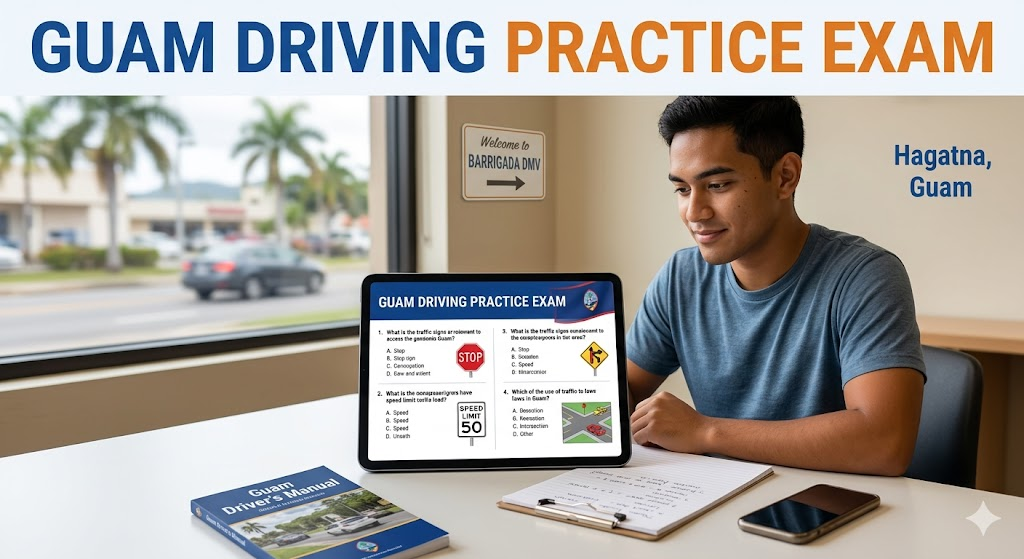
Additional Information
What the Course Entails and Exam Details
This study guide and practice exam are built upon the official Guam Driver’s Manual, ensuring all topics align precisely with the content you will encounter on test day. The core curriculum covers a broad range of knowledge areas essential for safe and legal driving in Guam. Students will review:
Guam Traffic Laws: Including speed limits for various zones (residential, business, highways), seatbelt requirements, right-of-way rules, signaling procedures, and specific regulations unique to the island.
Road Signs and Signals: A deep dive into all categories of signage, including regulatory (stop, yield), warning (curve ahead, slippery road), and guide signs, as well as traffic light signals and pavement markings.
Safe Driving Practices: Techniques for defensive driving, proper following distances (using the two-second rule), handling intersection situations, and maintaining control under different weather and road conditions.
Sharing the Road: Guidelines for safely interacting with pedestrians, bicyclists, motorcycles, and large commercial vehicles.
Special Driving Situations: Information on school buses, emergency vehicles, and maneuvers like parallel parking, three-point turns, and driving on a hill.
Driving Under the Influence: Critical information on the legal and physical consequences of operating a vehicle under the influence of alcohol or drugs on Guam.
What to Expect in the Final Exam
The actual Guam written driving exam is administered by the Department of Revenue and Taxation (DRT), Motor Vehicle Division (MVD). You should arrive prepared for a computer-based or a traditional written test consisting of multiple-choice questions.
Here are the specific details you can expect:
Exam Format: The test contains a fixed number of multiple-choice questions, with each question having several possible answers. Only one is correct.
Number of Questions: While the exact number can vary, standard versions often include around 40 to 50 questions, split between general rules and road signs.
Passing Score: To pass, you must correctly answer a significant percentage of the questions. A passing score is typically set around 80% to 90?curacy.
Time Limit: There is a reasonable time limit to complete the exam, usually ample time to read each question thoroughly and make an informed choice.
Language: The exam is primarily in English, but variations may be available in other languages; however, it is best to prepare in English.
Specific Rules: You are not permitted to use any outside materials, including your driver's manual, smartphones, or notes. Cheating of any form is strictly prohibited and results in automatic failure.
Prerequisites: You must schedule an appointment and have your required identification and documentation ready. A vision screening will be performed before the written test.
How to Study and Exam Centers
Effective study is paramount to success. Here are actionable strategies and information on where to take your test in Guam.
Actionable Study Strategies:
Master the Guam Driver's Manual: This is your primary textbook. Read it cover-to-cover and then review sections you find challenging. Every question on the test is derived from this manual.
Use Our Guam Driving Practice Exams: Take our practice tests repeatedly. They are a powerful tool to simulate the official exam environment, identify your weak areas, and build speed and accuracy.
Create Flashcards: Create physical or digital flashcards for key terms, road signs, speed limits, and specific Guam traffic laws.
Focus on Signs: Pay extra attention to the visual identification and meaning of all road signs and signals.
Observe Real Traffic: When you are a passenger, observe how experienced drivers interact with road signs, other vehicles, and pedestrians in Guam.
Exam Centers and Scheduling:
Testing Authorities: The written exam is administered by the Guam Department of Revenue and Taxation, Motor Vehicle Division.
Testing Locations: The primary written testing location has traditionally been the Guam Department of Revenue and Taxation in Barrigada (ITC Building), though the department may alternate or add locations, such as the University of Guam (UOG) for specific sessions. It is crucial to check for the current, official location when you register.
Scheduling an Appointment: Walk-ins are generally not accepted for the written knowledge test. You must schedule an appointment through the official GovGuamDocs portal or by following the instructions on the Guam Department of Revenue and Taxation website.
Road Skills Test: After successfully passing the written knowledge test and holding a learner's permit for the required duration, the road skills (driving) test is administered by authorized private driving schools, not directly by the DMV. Be sure to select an approved school for this final step.
Job Opportunities from the Course
Obtaining a driver's license in Guam is not just a personal achievement but a vital professional tool. A valid driver's license is a basic requirement for a vast array of jobs across numerous industries. While this practice exam focuses on the knowledge test, its ultimate goal is to help you secure the license that unlocks these and many other career paths:
Delivery Driver: (Package delivery, food delivery, courier services).
Professional Chauffeur: (Private car services, tour driving).
Rideshare Driver: (Independent contractor for on-demand transportation services).
Sales Representative: (Field sales positions requiring travel to clients).
Field Technician / Inspector: (Roles in construction, utilities, real estate, and government requiring travel to sites).
Property Manager: (Managing multiple sites and showing properties).
Emergency Services: (Initial requirement for EMTs, paramedics, and police officers).
Construction Worker: (Often required to operate or move company vehicles and equipment on or between job sites).
Landscaper / General Contractor: (Requires transport of tools, equipment, and crews).
Government Employees: (Many positions require driving for department business).
Frequently Asked Questions
Reviews
5.0
Based on 0 reviews
Leave a Review
No reviews yet. Be the first to review!