
Guild of Sommeliers Certified Sommelier (US and Canada) Practice Test
$69.00
- Buy to unlock unlimited access to all Quiz questions and Answers in this Quiz.
- After purchase you can print a PDF of the whole quiz at any point. The PDF will contain the questions and the correct answers.
About this Exam
The Certified Sommelier designation is the second of four levels offered by the globally recognized Court of Master Sommeliers (CMS), a premier body for wine and beverage education. This qualification is designed specifically for hospitality professionals who aim to validate and prove their mastery of professional-level knowledge, tableside service, and deductive blind tasting skills. For any aspiring sommelier, wine director, or beverage manager, achieving this title is a critical career milestone that establishes professional credibility and unlocks significant opportunities in the industry. The Certified Sommelier examination is a rigorous, three-part test that demands not just a command of theory, but real-world proficiency on the restaurant floor. Our comprehensive practice exam and guide are tailored to mirror the challenges of this demanding assessment, helping you build the confidence, skills, and strategic thinking necessary to pass.
Ready to test your knowledge?
Buy Now to Access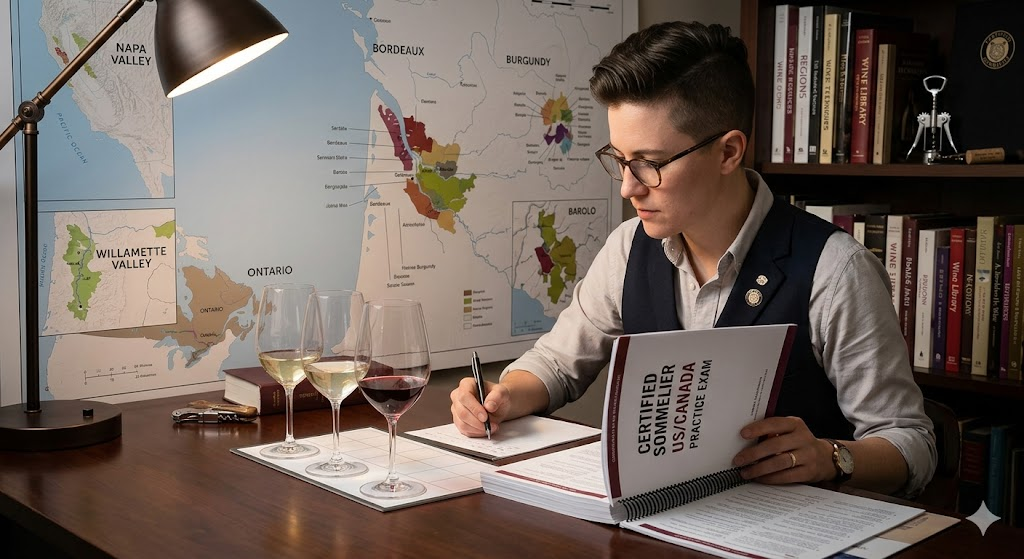
Additional Information
What the Course Entails and Exam Details
This examination does not include a taught course on the day of the exam, but rather, it tests your cumulative knowledge and skill developed through dedicated study and work experience. It requires candidates to first hold the Introductory Sommelier Certificate from the Court of Master Sommeliers and demonstrates proficiency in three core pillars: advanced theoretical knowledge, impeccably polished practical service, and a precise deductive blind tasting. The syllabus encompasses a vast range of topics including but not limited to viticulture, vinification, international wine regions, laws and appellation systems, standard service procedures for still and sparkling wine, wine-and-food pairing principles, and knowledge of spirits, beer, sake, and fortified wines. To succeed, candidates must exhibit not just technical accuracy but also the professionalism and grace expected of a top-tier sommelier. The Certified Sommelier practice exam focuses on reinforcing these foundational skills, providing targeted practice for each critical segment.
What to Expect in the Final Exam
The full Certified Sommelier Examination is a single-day event composed of three distinct and equally weighted parts. Each part must be passed during the same sitting for a candidate to earn the "Certified Sommelier" credential. The components of the final exam are:
Tasting Examination: You will be required to deduce the identities of two wines, typically one white and one red. This is a written test performed using the Court of Master Sommeliers’ specific Deductive Tasting Grid, where you will have 30 minutes to describe and correctly identify the wines based on sight, nose, palate, and final conclusion.
Theory Examination: This written test evaluates your command of the world of wine, spirits, and beverage service standards. It consists of 45 questions to be completed in 35 minutes, featuring multiple-choice, short-answer, simple calculation, and matching formats, covering everything from global wine law to classic wine styles.
Service Examination: The final part is a live performance where you act as a sommelier in a real-world, proctored restaurant scenario. You must arrive in appropriate professional attire and may be asked to open and serve still and sparkling wines tableside, demonstrate spirits and cocktail knowledge, recommend wine-and-food pairings, and answer questions from the proctors who act as your guests.
A passing score on the final exam is typically set at a minimum of 60% for each of the three sections.
How to Study and Exam Centers
Preparation for the Certified Sommelier exam requires a multi-faceted approach. To excel in the theory section, dedicate time to building a personalized study system with flashcards, maps, and detailed notebooks to learn regions, key appellations, grape varieties, vintages, and producers. For tasting, consistency is paramount. Train your palate using the CMS Deductive Tasting Grid and focus on "classic" styles for key regions, preferably in a structured tasting group to receive constructive feedback. In service, seek a mentor or practice correct techniques daily in your professional role, including tableside charm, proper pouring, and managing service pressure. Finally, incorporate the Certified Sommelier US/Canada Practice Exam into your final weeks, taking full-length, timed practice runs to simulate exam conditions and identify areas that require final reinforcement.
Regarding exam locations, it is crucial to understand that the final Certified Sommelier Examination is not taken at common computer-based test centers (such as Pearson VUE) or online. It is a physical, in-person event, organized and administered by the Court of Master Sommeliers in major cities throughout the US and Canada. You must monitor the official Court of Master Sommeliers’ calendar, select a specific date and location, and travel to that site for the all-day assessment. You can, however, find high-quality practice exams and educational resources to help you prepare through independent professional organizations like GuildSomm (the Guild of Sommeliers), which supports the CMS path with invaluable study materials.
Job Opportunities from the Course
Earning the Certified Sommelier title immediately enhances your career potential and distinguishes you within the competitive hospitality landscape. It unlocks specific job roles and higher levels of responsibility, often accompanied by a notable salary increase. Here are key career paths this certification enables:
Restaurant Sommelier / Lead Sommelier: The direct application of your qualification, managing a wine program, curating lists, and performing service on the restaurant floor.
Head Sommelier / Floor Sommelier: Leading a team, handling advanced tableside sales, and playing a key role in purchasing and inventory.
Wine & Beverage Director: Overseeing the entire beverage operation for a restaurant, hotel, or resort group.
Winery Educator / Tasting Room Manager: Providing high-level education and tailored tastings for winery guests and VIPs.
Wine Buyer / Cellar Manager: For a high-end restaurant group, private collector, or boutique retail store.
Distributor / Importer Sales Representative: A career in wine sales, acting as a professional partner to restaurant wine programs.
Wine Consultant: Providing expert advice on cellar acquisition and menu development to restaurants, clubs, and individuals.
Wine Educator: Developing and teaching wine classes for consumer or trade audiences.
Frequently Asked Questions
Reviews
5.0
Based on 0 reviews
Leave a Review
No reviews yet. Be the first to review!