
Guitar Fretboard Practice Test
$69.00
- Buy to unlock unlimited access to all Quiz questions and Answers in this Quiz.
- After purchase you can print a PDF of the whole quiz at any point. The PDF will contain the questions and the correct answers.
About this Exam
Welcome to your guide for the Guitar Fretboard Practice Exam. This assessment is designed as a crucial step for guitarists at any stage of their musical journey, from determined beginners to seasoned players looking to solidify their knowledge. Mastering the landscape of the guitar fretboard is the key to unlocking fluidity, confidence, and limitless musical expression on the instrument. This practice test is not just about memorization; it's about understanding and internalizing the relationship between notes, chords, scales, and intervals. It serves as an valuable self-assessment to gauge your proficiency, highlight areas needing more attention, and prepare you for advanced guitar studies or professional musical environments. By engaging with this comprehensive practice test, you will build the foundational skills that separate a guitar player from a truly accomplished musician. Whether your goals are to jam effortlessly, compose original music, or pursue a career in music, this practice exam is your benchmark for success on the fretboard.
Ready to test your knowledge?
Buy Now to Access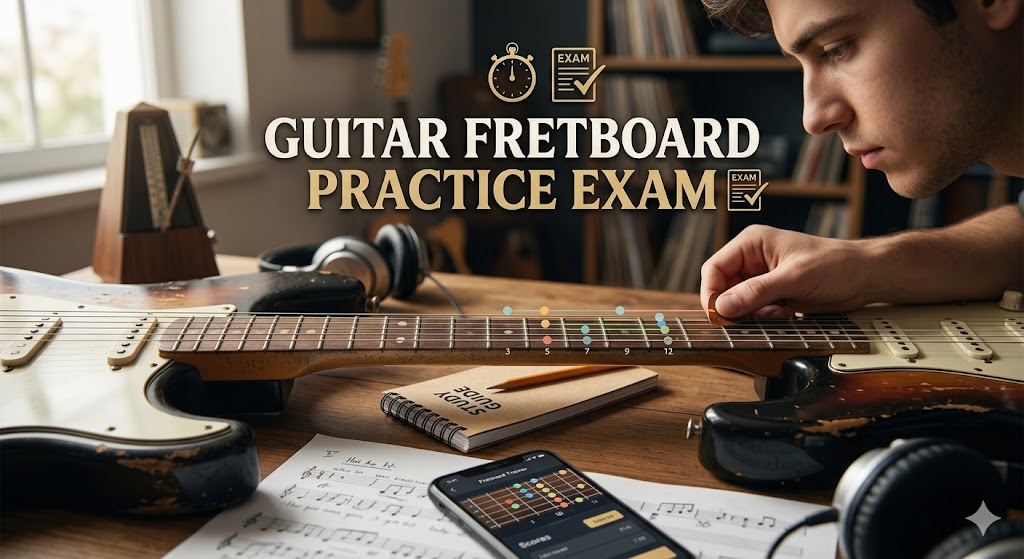
Additional Information
What the Course Entails and Exam Details
While not always a standardized formal exam from one single provider, a "Guitar Fretboard Course" and its subsequent assessment covers a comprehensive range of skills and theoretical knowledge. The practice exam typically focuses on the practical application of this foundational material.
Core Topics Often Covered:
Musical Alphabet and All Notes: Understanding the 12-note chromatic scale, including sharps (#) and flats (b), and their consistent pattern across the entire neck.
Natural Notes and Intervals: Mastery of identifying and locating natural notes (A, B, C, D, E, F, G) on every string, alongside understanding the concepts of whole steps, half steps, and intervals (distance between notes).
Fret Markers: Utilizing standard fret markers (usually at the 3rd, 5th, 7th, 9th, and 12th frets) as essential reference points for navigation.
Octave Shapes: Memorizing efficient octave patterns across strings to quickly transpose notes and understand the relationship between higher and lower pitches of the same note name.
Scale and Chord Patterns: Practical understanding and identification of major and minor scales, common pentatonic patterns, and chord shapes and voicings up and down the neck. The test may require recognition of root positions and inversions.
Practical Note Finder: Demonstrating the ability to quickly locate specified notes on all strings and within different fretboard regions, both on a physical instrument and on a virtual fretboard interface.
Pattern Recognition: Identifying musical structures like intervals, common chord progressions (by interval), or scale intervals directly on the fretboard without counting every single note.
Exam details, including passing scores and specific structures, will vary depending on the specific platform, school, or assessment method you choose. They are often designed to be comprehensive and progressively difficult to truly challenge your skill and recall speed.
What to Expect in the Final Exam
The actual format of a fretboard exam can differ significantly. For a "practice exam," this variety is a key feature, as it allows you to prepare for diverse challenges. Here’s what you might encounter:
Variety of Formats: Expect a mix of assessment types. This might include digital quizzes, interactive virtual fretboard simulations (where you click on positions to identify notes or construct chords), practical instrument assignments, or even timed recall exercises on a provided sheet.
Timed Sections: Many assessments, especially digital or app-based ones, incorporate timers to test not just accuracy, but your speed and recall fluency. Aiming for near-instant recall is essential for real-time playing.
Passing Requirements: There is rarely a standard, universal passing score. In a learning context, a high level of proficiency (e.g., 90% or above on key sections, under specific time limits) is often the target for progression. For informal assessments, you might define your own goals based on improvement.
Difficulty Scaling: A good exam will scale in difficulty. It might start with basic note identification on single strings and naturally progress to multi-string pattern recognition, practical application (play a C major scale), and identifying intervals or chords in various inversions.
Practical Application: Be prepared to either demonstrate your knowledge on your own guitar (perhaps with video submission or live instructor assessment) or within an interactive digital environment that mimics the fretboard experience. You may be asked to play specific patterns or identify what is being played.
How to Study and Exam Centers
Preparation is paramount for fretboard mastery. Actionable study strategies and understanding where and how to take the assessment are crucial:
Actionable Study Strategies:
Consistent Practice: Dedicate short, focused sessions daily. Consistent, quality practice is far more effective than long, infrequent cramming.
Fretboard Memorization Tools: Utilize dedicated apps, online quizzes, and interactive games specifically designed for fretboard note memorization and pattern recognition. Seek platforms that provide progress tracking and identify slow spots (like heatmaps).
Practical Instrument Drills: Combine visual and mental study with practical application. Practice finding all instances of one note, then another, across the neck. Play through scales and chords in different positions, calling out the notes as you go.
Interval & Pattern Study: Focus heavily on understanding intervals and learning common octave and scale patterns. This foundational knowledge allows you to logically "derive" notes rather than solely relying on rote memorization.
Use a Metronome: Integrate rhythm into your study. Practice identifying and playing notes or patterns in time, which is essential for real-world musical application.
Take Mock Tests: Utilize available practice exams or create your own challenges. Test yourself regularly to gauge progress and identify weak areas that require additional focus.
Where and How to Take the Assessment:
Since "Guitar Fretboard Practice Test" isn't generally a formal external exam like a professional certification, "exam centers" refer to the platforms providing the assessment:
Online Portals & Apps: Numerous music education websites, specialized guitar study platforms, and mobile apps offer fretboard assessments, quizzes, and tracking tools. You can take these anytime and anywhere from your personal device. Examples might include Coursera, Berklee Online, specialized practice websites (like fretboardquiz.com), and countless app store options.
Music Schools and Tutors: Local music schools, conservatories, or private instructors often use proprietary or standardized fretboard tests as part of their curriculum or assessment process. These assessments might be administered in person or through online lesson formats.
Self-Created Practice: You can always structure your own assessments! Create your own sets of note-finding challenges, set time limits, and test yourself progressively.
The specific "center" and format completely depend on your chosen learning path and the tools or institutions you utilize.
Job Opportunities from the Course
While fretboard mastery isn't a job title itself, it is a foundational skill for an array of professional music careers. Advanced proficiency in navigating the fretboard is indispensable and directly impacts success in numerous roles:
Guitar Teacher/Tutor: Private lessons, group classes, and online tutoring all demand deep musical knowledge, of which fretboard mastery is a cornerstone, to effectively guide others.
Studio Musician (Session Player): The ability to quickly internalize music, find suitable voicings, transpositions, and play with impeccable precision and flow is essential, requiring profound fretboard understanding.
Band Member / Touring Musician: Fluidity and confidence in live performance, improvisation, and contributing to songwriting are significantly enhanced by advanced fretboard knowledge, allowing for seamless communication with other band members.
Solo Performer: Comprehensive fretboard knowledge is vital for intricate solo arrangements, improvisation, and constructing compelling musical journeys without the support of other instruments.
Songwriter & Composer: A clear understanding of note relationships, scales, chords, and inversions directly facilitates the creative process, making songwriting and composition more intuitive and expressive.
Arranger: Knowledge of fretboard possibilities and chord voicings is crucial for arranging music for multiple guitars or adapting pieces to fit diverse musical settings.
Music Producer: Understanding the technical aspects of guitar playing and being able to guide performances and arrangements is heavily dependent on a strong grasp of fretboard theory.
Guitar Technician / Builder (Luthier): While not purely about playing, understanding the layout and scale of the fretboard is crucial for proper guitar set-up, repair, and construction.
By achieving mastery through focused study and practice tests, you equip yourself with the versatile skills and theoretical foundation needed to pursue a fulfilling and varied career in the music industry. The specific job titles are diverse and depend on your wider skill set, but this knowledge is an indispensable asset across the board.
Frequently Asked Questions
Reviews
5.0
Based on 0 reviews
Leave a Review
No reviews yet. Be the first to review!