
Gun License Open Book Practice Test
$69.00
- Buy to unlock unlimited access to all Quiz questions and Answers in this Quiz.
- After purchase you can print a PDF of the whole quiz at any point. The PDF will contain the questions and the correct answers.
About this Exam
The Gun License Open Book Practice Test is an essential, initial tool in the firearm proficiency and licensing process in many jurisdictions. It is a formative, self-assessment designed for prospective firearm owners who are working towards obtaining their competency certificate or official gun license. This "open-book" format allows you to consult official study manuals and resources while answering the questions. The primary purpose of this practice test is to help you familiarize yourself with the material, understand the legal and safety requirements, and prepare for the final, closed-book examination and practical assessment. It is for anyone seeking to responsibly own, carry, or work with firearms, bridging the gap between independent study and the official certification.
Ready to test your knowledge?
Buy Now to Access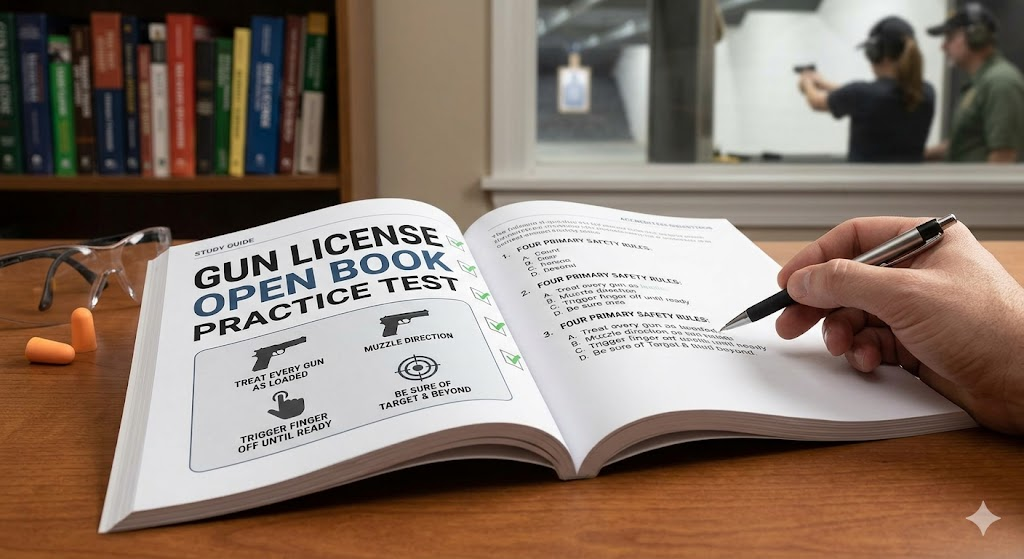
Additional Information
What the Course Entails and Exam Details
This practice test corresponds to a comprehensive foundation of knowledge required for safe and lawful firearm use. The scope is broad but centered on core competencies. The associated study course entails a deep dive into several critical modules.
The core modules generally include:
Knowledge of the Firearms Control Act/Laws: Detailed understanding of national and local legislation governing the ownership, use, transport, and storage of firearms. This is often a mandatory, primary prerequisite.
Firearm Safety and Handling: A rigid focus on the fundamental safety rules, including the 'Four Primary Rules' of firearms safety, muzzle direction, and safe storage.
Safe Handling and Use of Specific Firearms: Different modules or subsets of the test often cover distinct categories, such as:
Handgun: (Pistols and Revolvers)
Manually Operated Rifle: (Bolt-Action, Lever-Action)
Self-Loading Rifle: (Semi-Automatic)
Shotgun: (Pump-Action, Break-Action, Semi-Automatic)
Anatomy of Firearms: Basic understanding of a firearm’s components, actions, and how different types operate.
Ammunition: Different types, calibers, and their safe use and storage.
Ethical and Practical Considerations: The responsibility of ownership, situational awareness, and the legal implications of firearm use.
The "Open Book" part of the name refers specifically to the nature of this preliminary test: you are encouraged to use your study guide to answer the questions. This reinforces learning by requiring you to locate and verify information within the material. The format is typically a series of written questions that mirror the structure of the final exam.
What to Expect in the Final Exam
While the Open Book Practice Test is a self-study aid, it directly prepares you for the summative, high-stakes final evaluation, which is generally a two-part process.
The final official assessment typically includes:
A Summative Closed-Book Exam: This is the written component of the official certification. You will be tested on the same subjects covered in your practice test and study materials, but without access to any external resources. It most commonly consists of multiple-choice questions, and some sections may require very high, or even 100%, pass marks for key safety questions. You can expect a strict time limit.
A Practical Assessment/Shoot: This is a physical demonstration of your safe firearm handling. You will need to prove your proficiency under the supervision of a certified instructor. This often involves loading, unloading, clearing malfunctions, and a live-fire exercise on an accredited range, where you will be scored on both safety and accuracy.
Passing both the theoretical (closed-book) and practical components is necessary to obtain your competency certificate or license.
How to Study and Exam Centers
Preparation is paramount for success in both the practice and final exams. Here are effective strategies and details on where to complete the process.
Effective Study Strategies:
Master the Primary Manuals: Your Open Book Practice Test is your guide. Actively use it while reviewing your assigned study manuals. Make a habit of cross-referencing every question to its exact section in the text.
Focus on the 'Four Safety Rules': Memorize and internalize the core firearm safety rules. They are foundational and non-negotiable.
Utilize Online Practice & Apps: Seek out reputable online portals and applications that offer simulated closed-book practice questions to test your knowledge retention without the open-book crutch.
Attend an Official Safety Course: While the open-book portion is self-study, the final assessment must be conducted by an accredited training provider. It is highly recommended, and often required, to attend a formal class for hands-on instruction and practical handling before attempting the final exam.
Where to Take the Exams: The final, official closed-book exam and practical assessment must be completed at an authorized and accredited facility.
Authorized Training Schools: Accredited firearm academies and training providers.
Accredited Shooting Ranges: Often affiliated with authorized schools for the practical component.
Licensed Firearms Dealers: In some jurisdictions, specifically for certain certifications like the California FSC.
Police Departments: Sometimes serve as final testing/licensing centers.
The initial Open Book Practice Test itself is typically provided as part of your study package by an accredited training center, and you complete it in your own time.
Job Opportunities from the Course
Achieving your firearm competency through this process is a mandatory step that opens various professional doors, primarily within the security and law enforcement sectors. The following job titles and career paths are often unlocked or enhanced by this certification.
Armed Security Officer
Armed Guard / Bodyguard
Cash-in-Transit (CIT) Officer
Police Officer / Law Enforcement (A prerequisite for the academy)
Correctional Officer
Private Investigator
Range Safety Officer
Firearms Instructor (With further advanced certifications)
Wildlife Control / Conservation Officer
Commercial Asset Protection
Border Patrol Agent
This certification provides the core foundation needed to legally and professionally work in environments that require the use of a firearm for protection, law enforcement, or training.
Frequently Asked Questions
Reviews
5.0
Based on 0 reviews
Leave a Review
No reviews yet. Be the first to review!