
Gunner’s Mate "A" School GMB Practice Test
$69.00
- Buy to unlock unlimited access to all Quiz questions and Answers in this Quiz.
- After purchase you can print a PDF of the whole quiz at any point. The PDF will contain the questions and the correct answers.
About this Exam
The Gunner’s Mate "A" School GMB Practice Test is a crucial assessment for Sailors in the initial phase of their professional development within the Gunner’s Mate (GM) rating. The "A" School is designed to provide entry-level knowledge and skills to personnel who will be responsible for the operation, maintenance, and repair of the Navy's wide array of ordnance equipment, from small arms to guided missile launching systems.
While "A" School itself provides the foundational rate-specific training, a "GMB" segment—or similar phase or variant—typically focuses on a subset of these critical skills. This practice test is intended for those preparing to tackle a formalized phase or module final exam, helping them gauge their readiness and identify areas for focused review. Passing the final "A" School exam is required to officially become a rated Gunner’s Mate and proceed to advanced "C" School training or the fleet.
Ready to test your knowledge?
Buy Now to Access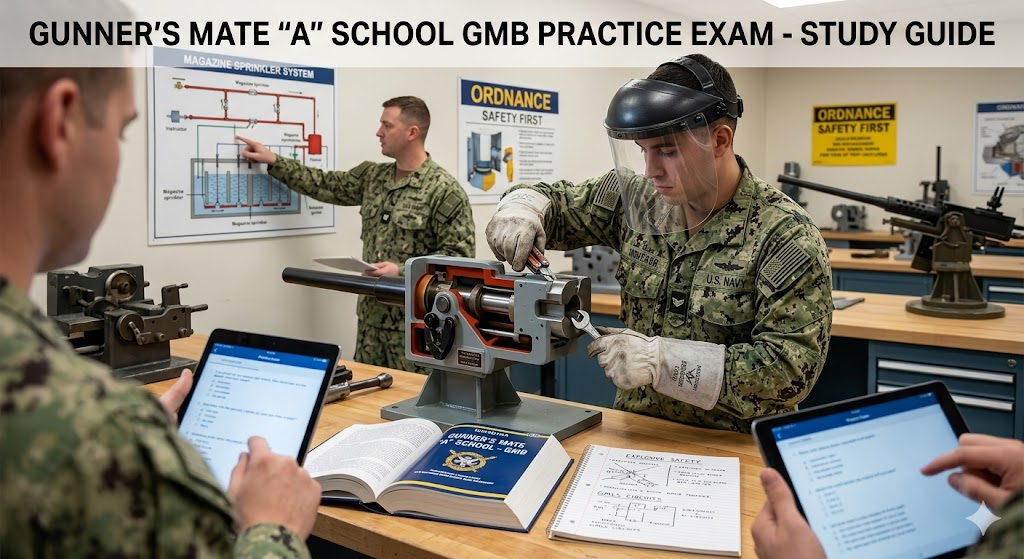
Additional Information
What the Course Entails and Exam Details
The full Gunner’s Mate "A" School curriculum is intensive and encompasses a wide spectrum of technical and administrative skills. The GMB component of this training, and its corresponding practice exam, will primarily cover a combination of the following core subject areas:
Explosives and Pyrotechnics: Detailed understanding of explosive types, properties, and the precise safety procedures for handling, transporting, and storing them.
Ammunition and Magazines: Knowledge of Naval ammunition classifications, identification, handling protocols, and the critical systems that ensure magazine safety, such as sprinkler and alarm systems.
Small Arms: Familiarity with the operation, disassembly, reassembly, maintenance, and troubleshooting of standard Navy small arms, such as pistols, rifles, and machine guns.
Basic Mechanisms: Fundamentals of mechanical systems, including leverage, gearing, and basic troubleshooting principles applicable to weapon systems.
Electrical and Electronic Circuit Analysis: Basic principles of electricity and electronics, with a focus on understanding the circuitry used to control and operate gun mounts and launching systems.
Hydraulics and Pneumatics: Introduction to the fluid and air power systems that drive many heavy ordnance platforms.
Gun Mounts and GMLS: Specific knowledge related to the operation, maintenance, and functions of various naval gun mounts and Guided Missile Launching Systems (GMLS).
What to Expect in the Final Exam
The actual final exam at Gunner’s Mate "A" School is a comprehensive technical assessment. The format is typically a mix of a computerized multiple-choice exam and, depending on the training facility and phase, practical applications or "hands-on" assessments in a lab environment.
Multiple-Choice Questions: The written portion will feature numerous questions designed to test your knowledge retention of the theory, facts, and procedures covered in the course material. Expect questions on safety regulations, technical specifications, and procedural steps.
Practical Assessments: In "A" School, your ability to perform tasks like small arms maintenance or magazine system troubleshooting may be assessed. These are often "Pass/Fail" but must be passed to proceed.
Passing Score: While specific passing score requirements can vary slightly by training cycle and instruction, a high standard of accuracy is expected in the Naval rating training environment. You should strive for mastery.
Time Limits: Both the written and practical portions of the exam will have set time limits to simulate real-world operational pressure and evaluate efficient performance.
Safety Criticality: Above all, any violation of basic ordnance safety rules during the training or assessment is typically an immediate failure.
How to Study and Exam Centers
Effective preparation for this exam requires a dedication to both technical study and hands-on familiarity.
Study Strategies:
Utilize Official Navedtra Materials: Your primary study resources are the assigned Naval Education and Training Command (NAVEDTRA) self-study courses and your "A" School curriculum guides. Read them thoroughly, paying close attention to learning objectives, tables, and safety warnings.
Practice with Computer-Based Training (CBT): Take advantage of any authorized CBT modules available at your training center. These often include interactive diagrams and practice question sets.
Create Flashcards: For topics requiring memorization, such as ammunition color codes, tool names, or specific safety protocols, flashcards are an excellent tool.
Hands-on Practice: During your lab time, maximize your practice. Review disassembly/reassembly steps for small arms until they become second nature. Familiarize yourself with the layout and components of the equipment you are studying.
Form Study Groups: Collaborating with your fellow students can help you clarify difficult concepts and test your knowledge against others.
Exam Centers:
The final exams for Gunner’s Mate "A" School are administered internally at the training command. For the United States Navy, this training is located at the Surface Combat Systems Training Command (SCSTC) Great Lakes in Illinois. The practice tests are often available through internal computer networks at these locations.
Job Opportunities from the Course
Upon graduation from Gunner’s Mate "A" School, and successfully passing all associated exams, you will be officially rated as a Gunner’s Mate (GM). This certification unlocks numerous career paths and advanced technical training opportunities.
Navy Rating Paths:
Gunner's Mate (GM)
Aviation Ordnanceman (AO) (Requires cross-rating)
Mineman (MN) (Requires cross-rating)
Fleet Roles:
Weapons Division Maintenance Technician
Small Arms Instructor
Range Safety Officer
Magazine Custodian
Special Warfare Ordnance Support
Advanced "C" Schools (Further specialization):
Vertical Launching System (VLS) Technician
Crew Served Weapons Instructor
Armorer
Specific Gun Mount System Specialist (e.g., 5-inch/54 Caliber Gun Mount)
Civilian Career Opportunities (Related skills and paths):
Armorer/Gunsmith
Ammunition Foreman
Firearms Instructor
Electronics Technician
Hydraulic/Pneumatic Equipment Operator
By mastering the material on the Gunner’s Mate "A" School GMB Practice Test, you are building the essential foundation for a challenging and rewarding career, ensuring the operational readiness and safety of the fleet.
Frequently Asked Questions
Reviews
5.0
Based on 0 reviews
Leave a Review
No reviews yet. Be the first to review!