
GWWI WEF Wastewater Treatment Fundamentals Practice Test
$69.00
- Buy to unlock unlimited access to all Quiz questions and Answers in this Quiz.
- After purchase you can print a PDF of the whole quiz at any point. The PDF will contain the questions and the correct answers.
About this Exam
Achieving professional certification is a critical milestone for anyone pursuing a career in the essential field of wastewater management. The GWWI WEF Wastewater Treatment Fundamentals Practice Test is an indispensable preparatory resource for aspiring operators aiming for licensure. This practice exam is expertly designed to mirror the content and rigor of official certification tests endorsed by the Georgia Water & Wastewater Institute (GWWI) and the Water Environment Federation (WEF). It serves as a vital diagnostic tool, ensuring candidates are thoroughly prepared for the foundational knowledge required in modern wastewater facilities. By simulating the official testing experience, this practice exam helps both new entrants and advancing professionals gauge their readiness and build the confidence necessary to succeed.
Ready to test your knowledge?
Buy Now to Access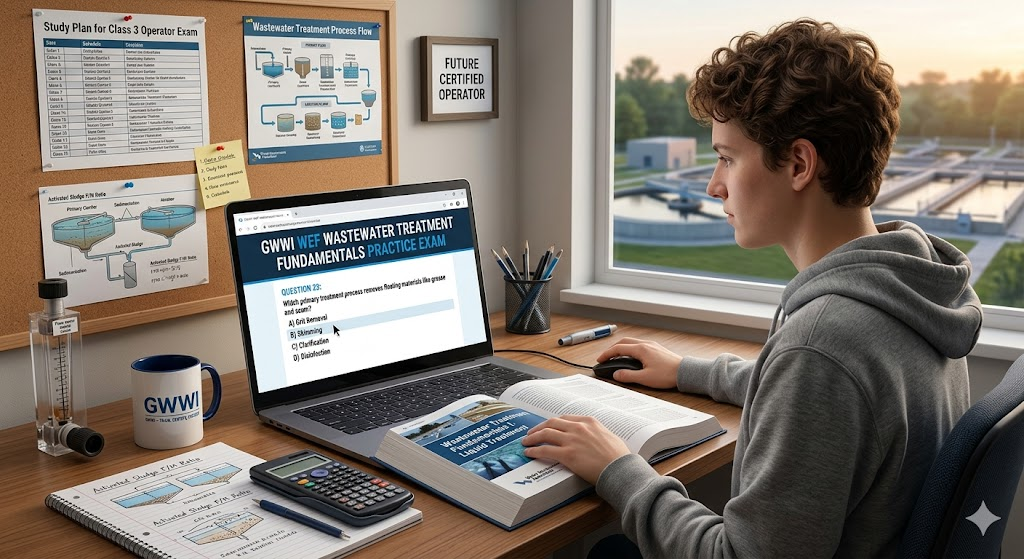
Additional Information
What the Course Entails and Exam Details
This preparatory course covers the foundational science, engineering, and practical operations critical to effective wastewater treatment. The scope of the practice exam encompasses key topics required by current regulatory standards for certification. Participants will explore core areas including the biological principles of waste degradation, fundamental mathematics needed for calculating flow and dosage, and essential safety procedures. The examination curriculum aligns closely with the WEF's established "Wastewater Treatment Fundamentals I" knowledge areas. Topics often include preliminary treatment (like screening), primary clarification, secondary treatment processes (such as activated sludge), and residual solids handling. Reviewing these fundamentals ensures that operators understand not just what tasks to perform, but why they are essential for environmental and public health.
What to Expect in the Final Exam
While the exact structure may vary slightly depending on the specific grade level being tested, this practice exam follows the common format used by state certification boards and national water organizations. Candidates should expect a standardized exam comprised entirely of multiple-choice questions. Each question presents a realistic scenario or requires specific factual recall to assess the taker’s operational competency. The practice exam will have an enforced time limit designed to simulate the pacing required during the actual proctored test. To replicate official standards, a passing score—often set around 70% or higher for licensure—is implemented to provide an accurate reflection of preparedness. The questions will challenge you to apply your knowledge to mathematical calculations, chemical analysis interpretations, and operational troubleshooting.
How to Study and Exam Centers
The most effective study strategy for the GWWI WEF Wastewater Fundamentals Practice Exam involves combining the practice test results with focused conceptual review. Begin by taking the practice exam under timed conditions to establish your baseline. Analyze your results to identify knowledge gaps; do not merely look up the correct answer, but rather understand the underlying principle behind the correct choice. It is highly recommended to study the primary source material, specifically the "Wastewater Treatment Fundamentals" training guide provided by WEF. Group study and discussing operational scenarios with experienced mentors can also provide invaluable perspective. The actual certification exam is administered through authorized organizations; in Georgia, this is typically handled via GWWI training centers or approved state proctors. For national WEF certifications, tests are often accessed online or through third-party computer-based testing services like Pearson VUE.
Job Opportunities from the Course
Earning the foundational certification validated by this practice exam opens numerous doors within the essential water and environmental sectors. Candidates who successfully leverage this study guide to achieve certification often transition into a variety of roles that provide competitive salaries and significant career stability. The skills learned are applicable in both public municipalities and private industrial settings. Below is a list of job opportunities unlocked by completing the foundational coursework and the subsequent certification:
Wastewater Treatment Plant Operator (Grades I, II, III, and IV)
Municipal Utilities Operator
Industrial Wastewater Specialist
Environmental Laboratory Technician
Utility Maintenance Technician
Water Quality Compliance Officer
Treatment Facility Supervisor
Field Services Technician for Wastewater Systems
Frequently Asked Questions
Reviews
5.0
Based on 0 reviews
Leave a Review
No reviews yet. Be the first to review!