
HACCP Managers Certificate Course Practice Test
$69.00
- Buy to unlock unlimited access to all Quiz questions and Answers in this Quiz.
- After purchase you can print a PDF of the whole quiz at any point. The PDF will contain the questions and the correct answers.
About this Exam
The HACCP Managers Certificate Course is an essential credential for professionals aiming to lead food safety initiatives within the global food supply chain. "HACCP" stands for Hazard Analysis and Critical Control Points, a science-based, preventative management system used to identify, evaluate, and control food safety hazards. This course and its final certification exam are specifically designed for managers, supervisors, quality assurance personnel, and members of HACCP teams in food manufacturing, processing, retail, and hospitality sectors. Achieving this certificate demonstrates a comprehensive understanding of the 7 HACCP principles and the ability to effectively develop, implement, and maintain a robust food safety plan that complies with regulatory requirements (such as the FDA and USDA) and international standards like the Codex Alimentarius. The HACCP Managers Practice Test serves as a vital tool for students to assess their readiness for the official examination, simulating the experience of the final certification and highlighting areas that need further study.
Ready to test your knowledge?
Buy Now to Access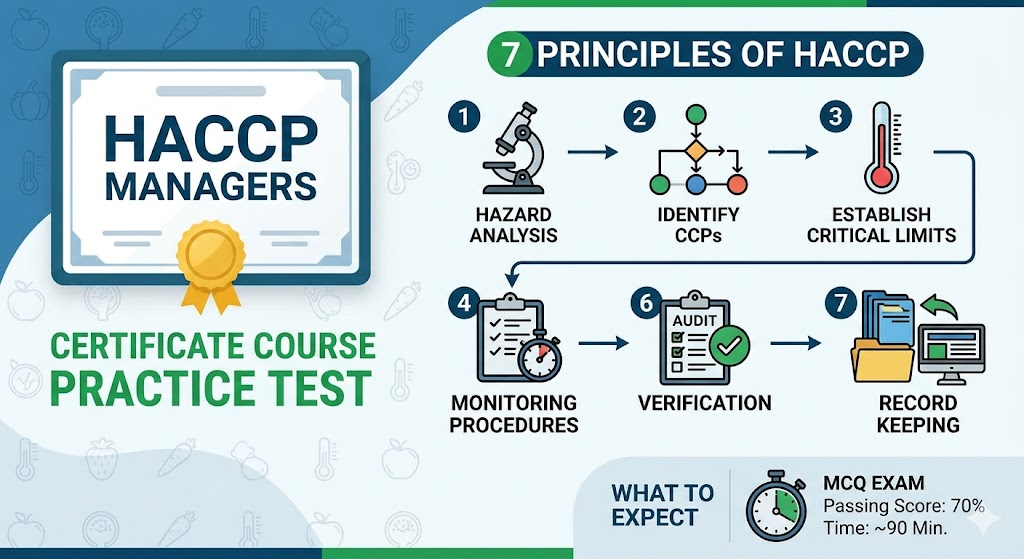
Additional Information
What the Course Entails and Exam Details
The HACCP Managers Certificate Course provides a deep dive into the practical application of the HACCP system. Students will begin by learning the pre-requisite programs, known as Good Manufacturing Practices (GMPs) and standard operating procedures (SOPs), which are the foundation of any successful food safety plan. The core of the curriculum is centered on the 7 fundamental principles of HACCP:
Conducting a Hazard Analysis to identify biological, chemical, and physical hazards.
Identifying Critical Control Points (CCPs) in the process.
Establishing critical limits for each CCP (e.g., minimum cooking temperature or time).
Establishing monitoring procedures to ensure critical limits are met.
Establishing corrective actions to be taken when monitoring indicates a deviation from a critical limit.
Establishing verification procedures to confirm the HACCP system is working effectively.
Establishing record-keeping and documentation procedures.
Additionally, the course covers the five preliminary steps to hazard analysis, which include assembling the HACCP team, describing the product, identifying its intended use and consumers, constructing a process flow diagram, and on-site verification of the flow diagram. Students will also learn about common food-borne illnesses, methods to prevent cross-contamination, pest control strategies, and the legal responsibilities associated with food safety management.
What to Expect in the Final Exam
The official final exam for the HACCP Managers Certificate, which this practice test is designed to mirror, typically follows a specific format. It is generally a multiple-choice, closed-book examination. Students can expect to answer a varying number of questions, commonly ranging from 40 to 60 questions, depending on the specific accredited provider. The time limit is usually around 60 to 90 minutes. Candidates must demonstrate their proficiency in applying all 12 elements of HACCP (the 5 preliminary steps and the 7 principles). The passing score is commonly set at 70% or higher to receive the official certificate. A practice test is the best way to get a feel for the phrasing of questions, the pressure of the clock, and the breadth of knowledge required.
How to Study and Exam Centers
Preparation is key to succeeding in the HACCP Managers exam. To get the most from a practice test, you should treat it as the "real thing." Find a quiet environment, set a timer, and try to complete it without using your course materials. Reviewing your wrong answers and the detailed explanations provided for each can help you target your study time effectively.
Actionable Study Strategies Include:
Master the Terminology: Ensure you have a crystal-clear understanding of terms like "Critical Limit," "Deviation," "Corrective Action," and "Verification" vs. "Validation." Misinterpreting these core concepts is a common mistake.
Apply the Principles: Instead of just memorizing the list, work through real-world case studies to see how you would determine CCPs and set critical limits in a mock food processing scenario.
Review Your Coursework: Utilize the accredited training materials, user manuals, and any sample food safety plans provided during your 18-hour training course. The core questions are often drawn from these specifics.
Where and How to Take the Exam:
For the "HACCP Managers Certificate Course," the final, official exam is almost exclusively taken online through an authorized course provider’s learning management system. Once you register for and complete the required hours of instruction (e.g., from an IHA-accredited provider like the NEHA, CIEH, or Tap Series), the exam will be made accessible to you. You do not typically need to go to a physical testing center like Pearson VUE for this specific, course-based certification; it is conveniently completed in your own home or office after completing the course material.
Job Opportunities from the Course
A HACCP Managers certification is a valuable asset in the food industry, opening doors to various roles focused on quality control and regulatory compliance. Here are some specific job titles and career paths this qualification can help you unlock:
Food Safety Manager
Quality Assurance (QA) Manager
HACCP Coordinator
Food Production Supervisor
Food Service Manager (e.g., in hotels, restaurants, or hospitals)
Regulatory Compliance Officer
Food Industry Auditor (both internal and external)
Supply Chain Manager for Food Products
Health Inspector
Food Safety Trainer
This certification is not just about passing a test; it is a critical step in building a career dedicated to protecting public health and ensuring the safety of the food we consume.
Frequently Asked Questions
Reviews
5.0
Based on 0 reviews
Leave a Review
No reviews yet. Be the first to review!